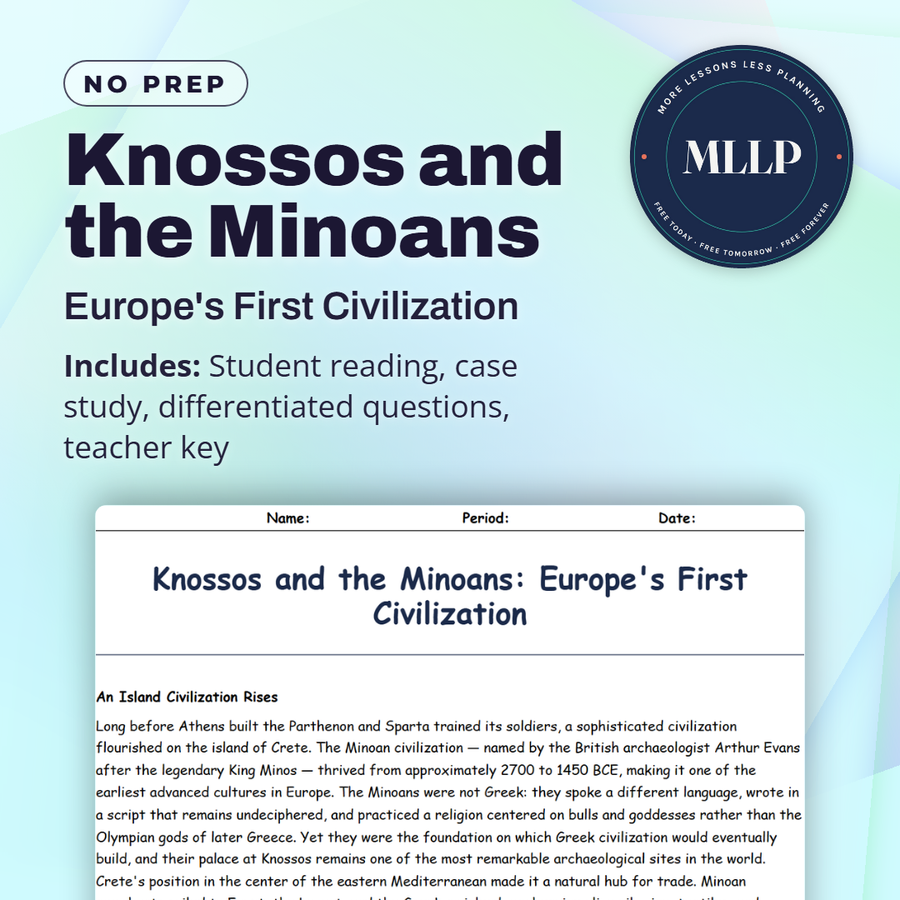
Knossos and the Minoans: Europe's First Civilization
Quality reviewed September 2026
Facts verified September 21, 2026
- Subject
- Social Studies
- Grades
- Grades 9-12
- Length
- 8-page student worksheet
- Time
- About one 50-minute class period
- Great for
- Sub plans and independent work
- Includes
- Reading passage, comprehension questions + full answer key
- Format
- Print-and-go PDF
What students do
- Fill in three blanks naming the archaeologist, the volcano, and the ritual shown in the bull-leaping frescoes
- Trace how Michael Ventris's 1952 decipherment of Linear B proved Mycenaean Greeks had taken over Knossos
- The undeciphered Linear A script and what it still hides from historians get checked across a multiple-choice question
- A teenage sailor hauling olive oil jars toward Egypt while Thera looms behind him becomes the basis for two case study questions
What it covers
- Arthur Evans's excavation and controversial concrete reconstruction of Knossos
- The difference between the deciphered Linear B and the still-unreadable Linear A
- The Thera eruption and its debated connection to the Atlantis myth
Start reading this worksheet
An Island Civilization Rises
Long before Athens built the Parthenon and Sparta trained its soldiers, a sophisticated civilization flourished on the island of Crete. The Minoan civilization, named by the British archaeologist Arthur Evans after the legendary King Minos, thrived from approximately 2700 to 1450 BCE, making it one of the earliest advanced cultures in Europe. The Minoans were not Greek: they spoke a different language, wrote in a script that remains undeciphered, and practiced a religion centered on bulls and goddesses rather than the Olympian gods of later Greece. Yet they were the foundation on which Greek civilization would eventually build, and their palace at Knossos remains one of the most remarkable archaeological sites in the world. Crete's position in the center of the eastern Mediterranean made it a natural hub for trade. Minoan merchants sailed to Egypt, the Levant, and the Greek mainland, exchanging olive oil, wine, textiles, and pottery. This maritime trade generated enormous wealth that the Minoan rulers channeled into architecture, art, and administration. By 2000 BCE, Knossos had grown into a palace complex covering more than 20,000 square meters: a sprawling, multi-story structure with hundreds of rooms, elaborate drainage systems, and walls decorated with some of the most vivid paintings produced anywhere in the ancient world.
Arthur Evans and the Excavation of Knossos
Arthur Evans was a wealthy English archaeologist who purchased the hill of Knossos in 1900 and began excavating immediately. What he found astonished the world. Within weeks, his team had uncovered the remains of a vast palace, colorful frescoes showing bull-leaping acrobats and elegant women in flounced skirts, clay tablets covered in two unknown writing systems (which Evans called Linear A and Linear B), and evidence of sophisticated plumbing including flush toilets and indoor drainage. Evans named the culture 'Minoan' and spent the next three decades excavating, publishing, and, controversially, reconstructing. Evans's reconstruction of Knossos remains deeply controversial among archaeologists. He used concrete to rebuild walls, columns, and even frescoes, creating a partially restored palace that visitors can walk through today. Many of his reconstructions were based more on imagination than evidence, and modern archaeologists argue that Evans imposed his own interpretations on the ruins rather than letting the evidence speak. His work at Knossos illustrates a fundamental tension in archaeology: the desire to make ancient sites accessible and understandable to the public versus the obligation to preserve what actually survives and not overwrite it with modern guesswork.
Life in the Minoan Palace
Knossos was not just a royal residence. It was simultaneously a palace, administrative center, religious sanctuary, storehouse, and manufacturing hub. Archaeologists have found evidence of olive oil storage in massive ceramic jars called pithoi, workshops where craftspeople produced luxury goods, archive rooms filled with clay tablets recording economic transactions, and elaborate ceremonial spaces where religious rituals took place. The Linear B tablets, discovered at Knossos and later deciphered (unlike Linear A, which remains a mystery), turned out to record an early form of Greek and revealed a highly organized administrative system tracking livestock, grain, bronze, and personnel. The frescoes that decorated Knossos's walls give us our most vivid glimpse of Minoan life. One of the most famous depicts the bull-leaping ritual: young men and women grasp the horns of a charging bull and somersault over its back. Whether this was an actual athletic practice, a religious ceremony, or a symbolic representation remains debated. Other frescoes show dolphins, court ladies with elaborate hairstyles and jewelry, and processions carrying offerings. These images suggest a culture that valued beauty, nature, and the human body: a striking contrast to the military imagery that dominates many other ancient cultures.
Like what you read? The full reading, the case study, and every question set are in the free download below, along with the answer key.
Why this matters
Linear A is still a locked door after more than a century of trying, and that gap is worth sitting with because it shows students that archaeology does not always get to finish the story. We can walk through Knossos and look at its frescoes, but we cannot read what the Minoans wrote about themselves in their own language, which limits what we actually know versus what we are guessing. Arthur Evans's concrete reconstructions raise a related question that comes up anywhere old buildings get restored for tourists: how much of what visitors see is the real ancient structure, and how much is one archaeologist's best guess poured in concrete and treated as fact ever since.
From one teacher to another
Long before Athens built the Parthenon, a sophisticated civilization was already trading across the Mediterranean from the island of Crete. The Minoans built a sprawling palace at Knossos with indoor plumbing and walls covered in vivid frescoes, and this worksheet covers both what archaeologists found there and the mess the excavator made of it. Arthur Evans rebuilt large sections of Knossos in concrete based on guesswork, which students weigh as both a benefit and a problem for the site. The reading also gets into the two Minoan writing systems, Linear B, which was deciphered as early Greek in 1952, and Linear A, which nobody has ever cracked. A case study follows a young sailor hauling storage jars toward Egypt with the volcanic island of Thera visible behind his ship, unaware of what is coming.
What you get
Download
Where should I send the next one?
Everything here is free and it stays that way. Leave your email and I'll send you the new lessons as they go up. You can unsubscribe from any one of them.
Related resources
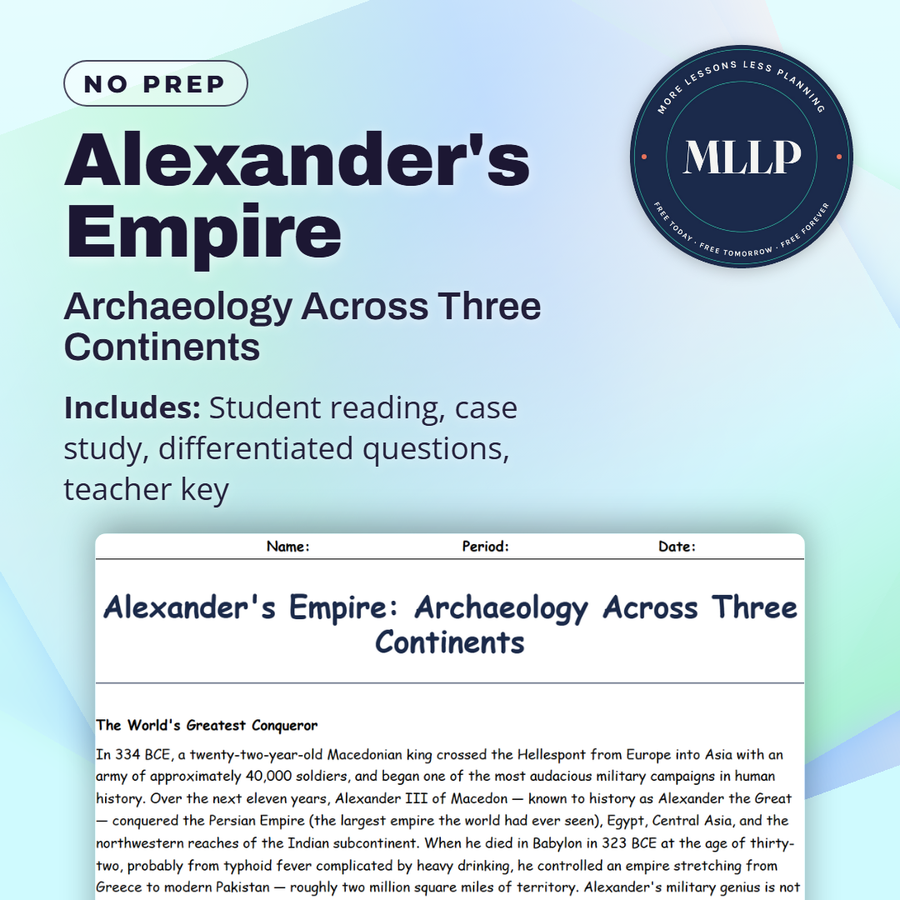
Alexander's Empire: Archaeology Across Three Continents
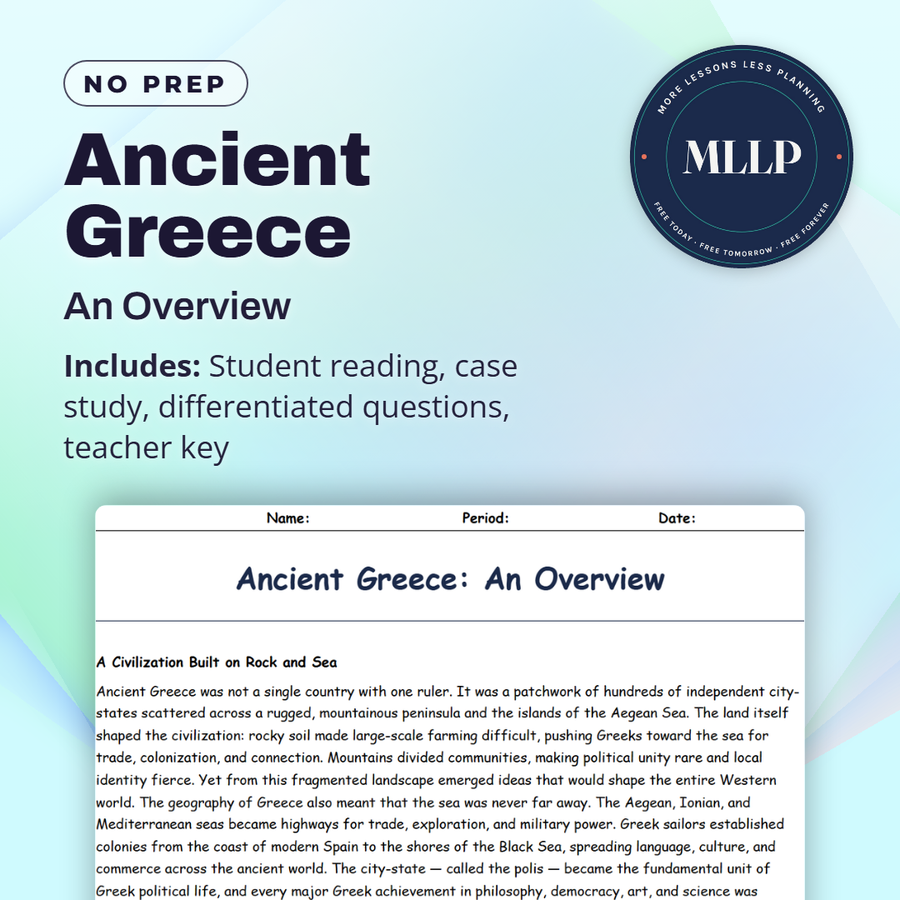
Ancient Greece: An Overview
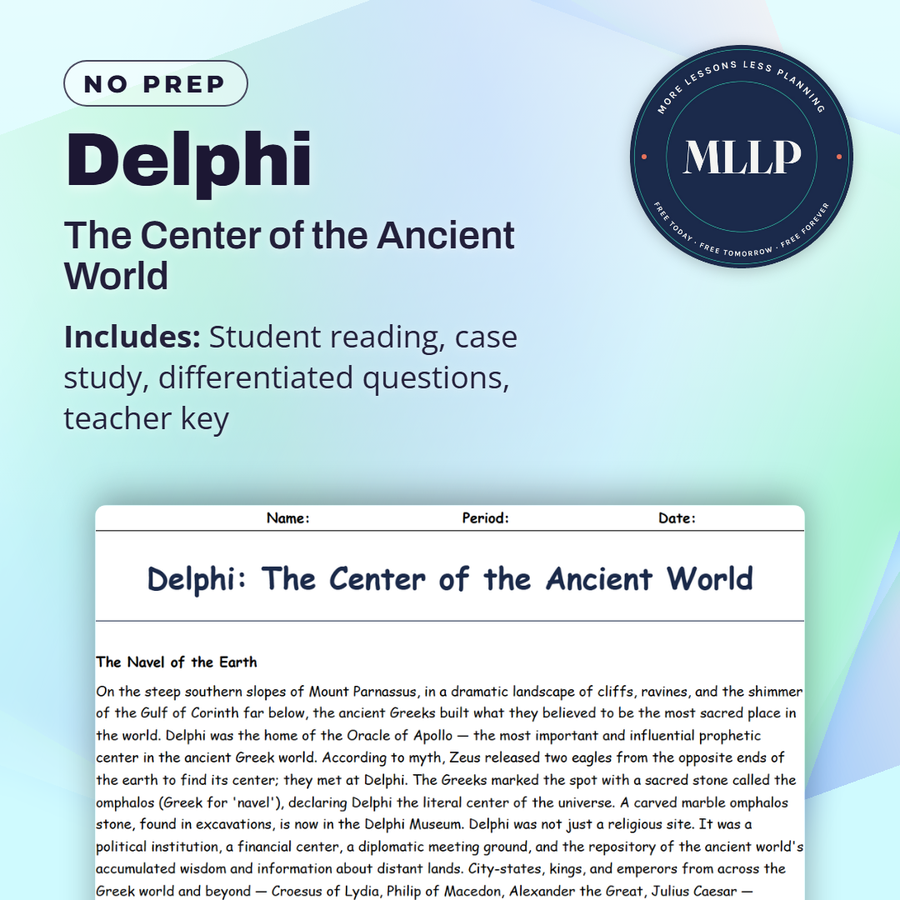
Delphi: The Center of the Ancient World
Greek Pottery: Art That Tells Stories
Mycenae and the Trojan War: Where Myth Meets Archaeology
Olympia and the Ancient Olympic Games: Archaeology of Ancient Athletics
Every lesson on this site is free to download and use. If one of them saved you a prep period, you can chip in a few bucks toward my three kids' daycare fund. That's genuinely where tips go.