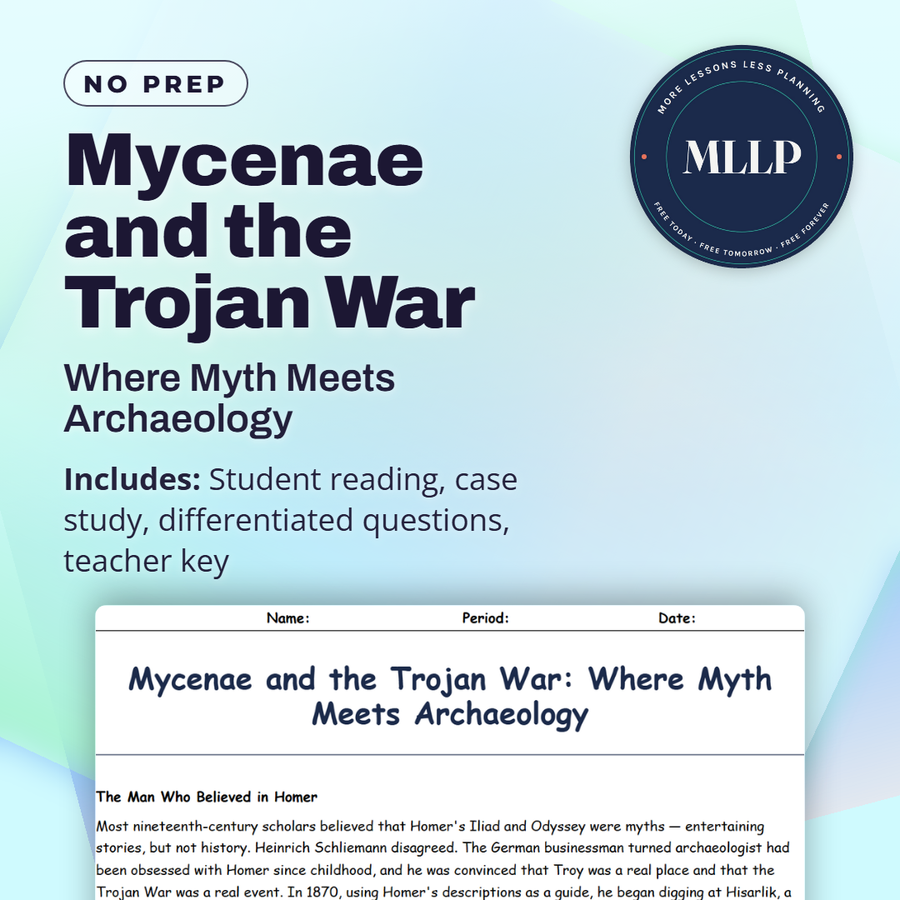
Mycenae and the Trojan War: Where Myth Meets Archaeology
Quality reviewed September 2026
Facts verified September 21, 2026
- Subject
- Social Studies
- Grades
- Grades 9-12
- Length
- 8-page student worksheet
- Time
- About one 50-minute class period
- Great for
- Sub plans and independent work
- Includes
- Reading passage, comprehension questions + full answer key
- Format
- Print-and-go PDF
What students do
- Answer short-response questions on why using Homer's Iliad as an excavation guide is both risky and useful
- Sort five terms, from Hisarlik to the shaft grave, by what each one refers to
- Heinrich Schliemann's smuggled gold jewelry, later dated a thousand years too old for Troy, runs through two case study questions on archaeological ethics
- Three blanks cover the hill where Troy stood, the gate at Mycenae, and the language shared between Linear B and later Greek religion
What it covers
- Heinrich Schliemann's excavations at Troy and the Mask of Agamemnon
- What Linear B tablets and the Lion Gate reveal about Mycenaean power
- Why epic poetry cannot be read as a reliable historical record
Start reading this worksheet
The Man Who Believed in Homer
Most nineteenth-century scholars believed that Homer's Iliad and Odyssey were myths: entertaining stories, but not history. Heinrich Schliemann disagreed. The German businessman turned archaeologist had been obsessed with Homer since childhood, and he was convinced that Troy was a real place and that the Trojan War was a real event. In 1870, using Homer's descriptions as a guide, he began digging at Hisarlik, a hill in northwestern Turkey. He found ruins. In fact, he found at least nine successive cities built on top of each other over thousands of years. In his excitement, he concluded that a burned layer near the bottom was Homer's Troy and announced the discovery to the world. Schliemann was partly right and largely wrong. Hisarlik is almost certainly the site of ancient Troy, a city the Greeks called Ilion. But the layer he identified as Homeric Troy was more than a thousand years too old. The city that most archaeologists now associate with the Trojan War period (Troy VII, dating to approximately 1300-1180 BCE) shows evidence of destruction and burning at exactly the right time. Whether that destruction was caused by a Greek military campaign led by King Agamemnon, a natural disaster, or some other force is a question archaeology alone cannot definitively answer.
Schliemann at Mycenae: The Mask of Agamemnon
After Troy, Schliemann turned to Mycenae on the Greek mainland, the legendary home of King Agamemnon. In 1876, he excavated a shaft grave cemetery inside the citadel walls and uncovered extraordinary riches: gold death masks, bronze swords, inlaid daggers, amber beads, and the skeletal remains of warriors and women buried with enormous wealth. Schliemann found one gold mask particularly compelling, telegraphed the king of Greece to announce that he had gazed on the face of Agamemnon, and named it accordingly. The Mask of Agamemnon became one of the most famous objects in archaeology. Schliemann was wrong again, in the best possible way. The shaft graves he excavated predate the legendary Trojan War by about three hundred years. They belong to an earlier, even more spectacular phase of Mycenaean power. The mask is almost certainly not Agamemnon's. But the graves proved something more important than confirming a myth: they demonstrated that Mycenae was genuinely one of the wealthiest and most powerful cities in the Bronze Age Aegean, a real civilization that Homer's stories had preserved a memory of. The archaeological record validated the general historical picture, even if the specific details didn't match.
The Mycenaean World
The Mycenaeans were the first Greek-speaking civilization on the European mainland. They built fortified citadels with massive stone walls. The Greeks of later centuries, unable to imagine how humans could have moved such enormous blocks, called this Cyclopean masonry, believing it must have been built by giants. At Mycenae, the Lion Gate (two lionesses carved in relief above a limestone threshold) still stands as one of the oldest surviving examples of monumental sculpture in Europe. The citadel contained a palace, treasury buildings, and residential quarters, all connected by the same Linear B administrative system that operated at Knossos. Mycenaean civilization was a warrior culture that also engaged in long-distance trade. Mycenaean pottery has been found across the Mediterranean from Egypt to Sicily. Linear B tablets from Pylos (another major Mycenaean site) record massive preparations that look like mobilization for war: inventories of bronze, troops, and rowers. Mycenaean warriors were buried with bronze armor, swords, and spears. The Linear B tablets also record the names of gods recognizable from later Greek religion: Zeus, Hera, Poseidon, Dionysus. This continuity between Mycenaean religion and Classical Greek religion suggests that Greek mythology preserved real cultural memories across the Dark Age that separates them.
Like what you read? The full reading, the case study, and every question set are in the free download below, along with the answer key.
Why this matters
Schliemann wanted so badly to find Homer's Troy that he dug straight through the actual war-era layer to get to something older, and then smuggled gold artifacts out of Turkey because he was sure he already knew what he had found. That is a warning about what happens when someone decides on the answer before checking the evidence, in archaeology or anywhere else research gets done. The reading is also honest about the limits of what we can know: the Mycenaean world was real, wealthy, and capable of the kind of warfare Homer describes, but no dig can confirm a ten-year siege or a wooden horse, and students get practice telling the difference between what evidence proves and what a good story merely suggests.
From one teacher to another
Heinrich Schliemann was convinced Homer's Trojan War was real history, not myth, and in 1870 he started digging at a hill in Turkey to prove it. He found a real city with nine layers of rebuilding, though the layer he identified as Homer's Troy turned out to be a thousand years too early. This worksheet follows Schliemann to Mycenae next, where he uncovered a gold death mask he insisted belonged to King Agamemnon and named it accordingly, wrongly, but the shaft graves he found proved Mycenae really had been rich and powerful. A case study follows the smuggled "Jewels of Helen" that Schliemann's wife wore for a famous photograph, artifacts that turned out to be a thousand years older than the war they were supposed to prove. The reading ends on what archaeology can and cannot confirm about Homer's story.
What you get
Download
Where should I send the next one?
Everything here is free and it stays that way. Leave your email and I'll send you the new lessons as they go up. You can unsubscribe from any one of them.
Related resources
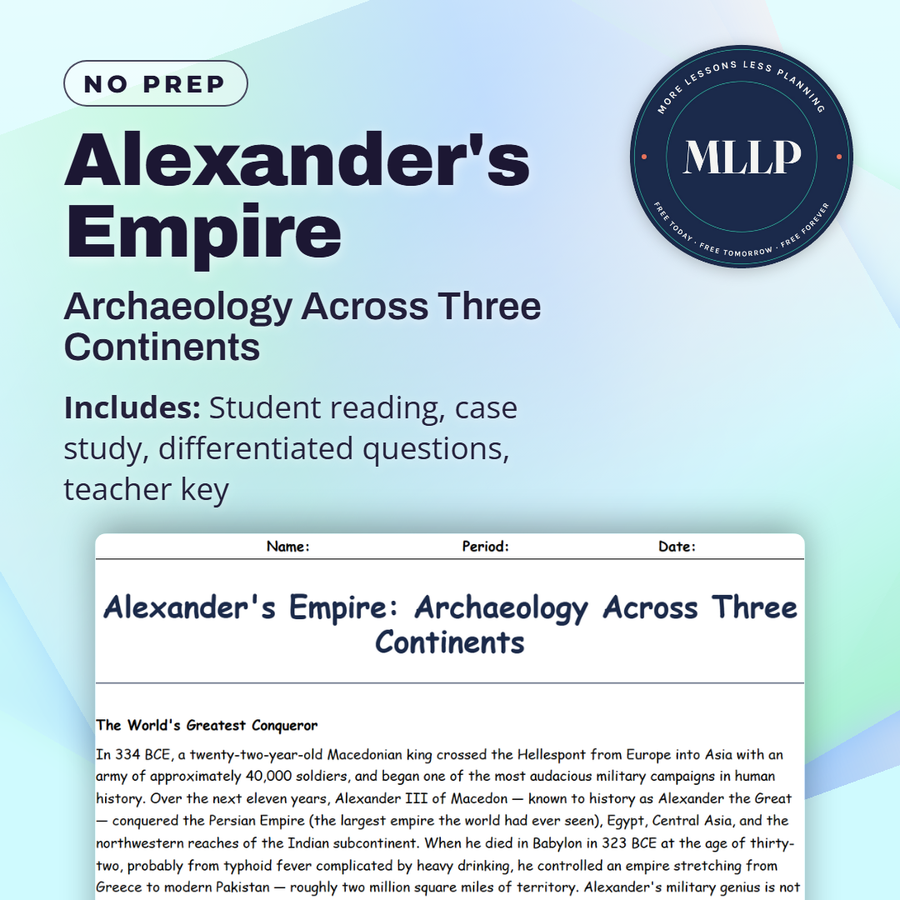
Alexander's Empire: Archaeology Across Three Continents
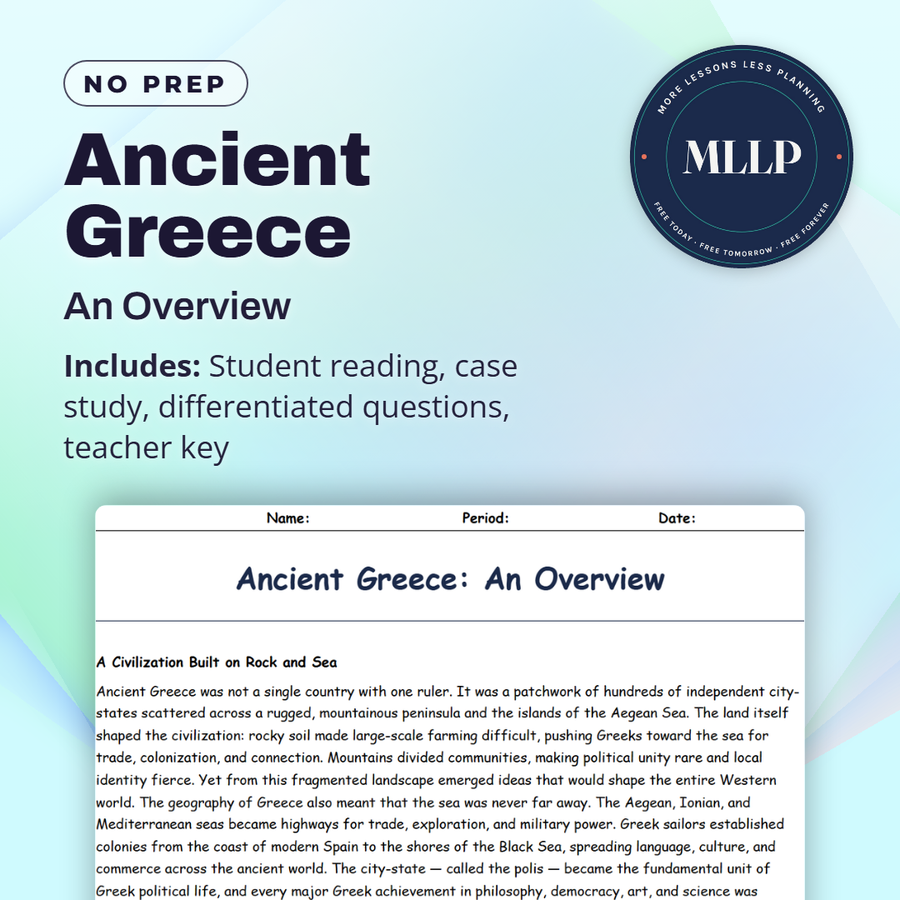
Ancient Greece: An Overview

Delphi: The Center of the Ancient World

Greek Pottery: Art That Tells Stories
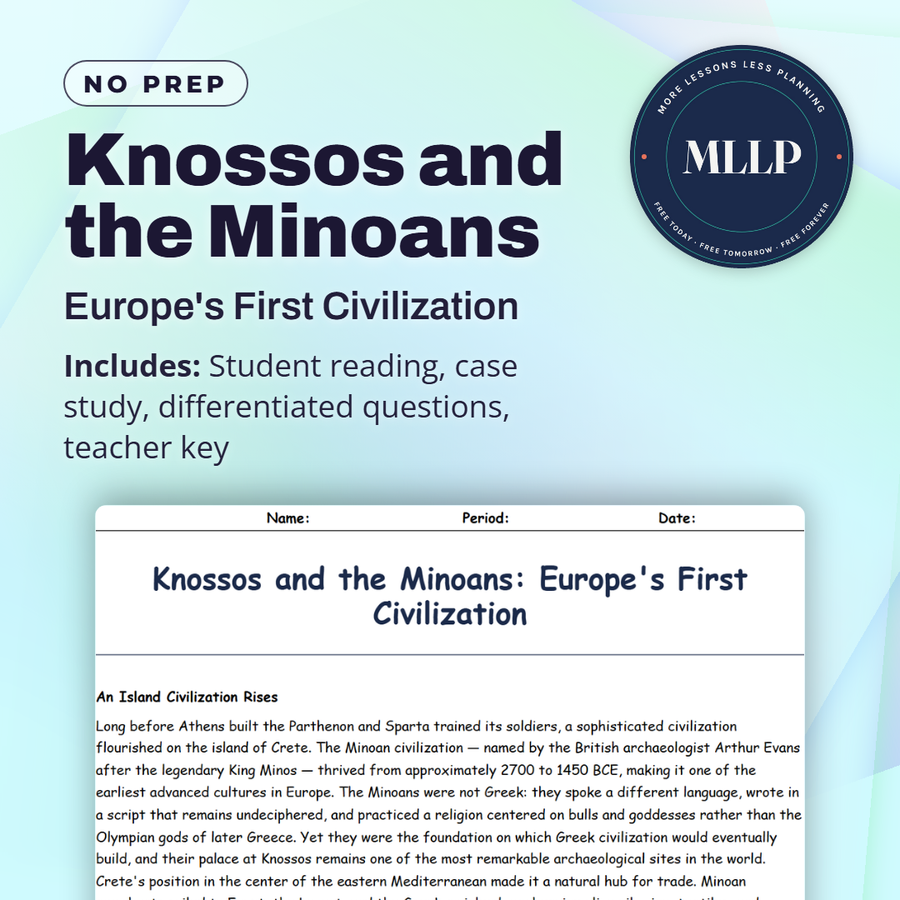
Knossos and the Minoans: Europe's First Civilization
Olympia and the Ancient Olympic Games: Archaeology of Ancient Athletics
Every lesson on this site is free to download and use. If one of them saved you a prep period, you can chip in a few bucks toward my three kids' daycare fund. That's genuinely where tips go.