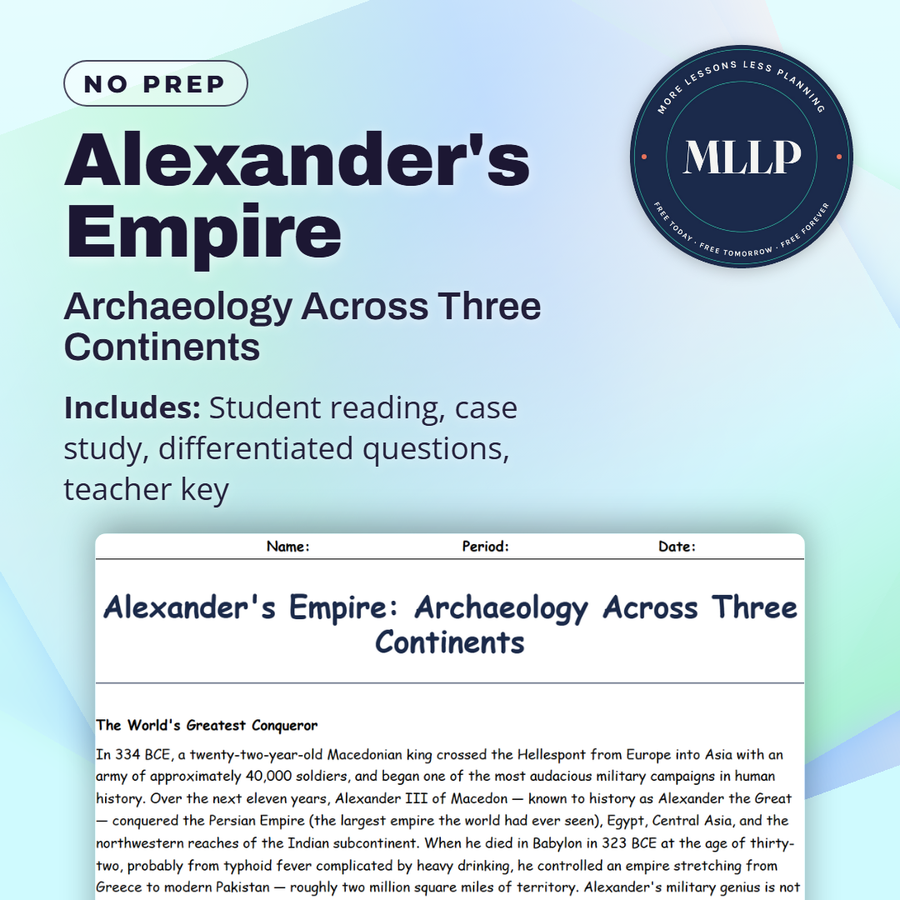
Alexander's Empire: Archaeology Across Three Continents
Quality reviewed September 2026
Facts verified September 21, 2026
- Subject
- Social Studies
- Grades
- Grades 9-12
- Length
- 9-page student worksheet
- Time
- About one 50-minute class period
- Great for
- Sub plans and independent work
- Includes
- Reading passage, comprehension questions + full answer key
- Format
- Print-and-go PDF
What students do
- Alexander's eleven-year campaign across the Persian Empire, Egypt, and Central Asia gets tracked across three questions on how Hellenization actually spread
- Match five terms, from Ai-Khanoum to the Ptolemaic dynasty, to what each one explains about the Hellenistic world
- Demetria's case study, a girl born in a Greek city in Afghanistan who cannot name her own identity, leads to two short-response questions
- Fill in three blanks on where Alexander died, which language unified his empire, and where Ai-Khanoum was excavated
What it covers
- Alexander the Great's conquests and the spread of Hellenistic culture across Asia, Africa, and Europe
- Ai-Khanoum, a Greek city French archaeologists excavated in northern Afghanistan
- The underwater archaeology of ancient Alexandria's palace quarter and lighthouse
Start reading this worksheet
The World's Greatest Conqueror
In 334 BCE, a twenty-two-year-old Macedonian king crossed the Hellespont from Europe into Asia with an army of approximately 40,000 soldiers, and began one of the most audacious military campaigns in human history. Over the next eleven years, Alexander III of Macedon, known to history as Alexander the Great, conquered the Persian Empire (the largest empire the world had ever seen), Egypt, Central Asia, and the northwestern reaches of the Indian subcontinent. When he died in Babylon in 323 BCE at the age of thirty-two, probably from typhoid fever complicated by heavy drinking, he controlled an empire stretching from Greece to modern Pakistan, roughly two million square miles of territory. Alexander's military genius is not in doubt. But from an archaeological perspective, what matters most about his campaigns is what they left behind: the extraordinary spread of Greek culture (language, art, philosophy, urban planning, coinage, and religion) across a vast swath of Asia, Africa, and Europe. This process, which historians call Hellenization, created a cosmopolitan world in which Greek served as the international language of culture and commerce, Greek-style cities were built from Egypt to Afghanistan, and local cultures everywhere blended with Greek influences in complex and fascinating ways that archaeology has spent decades uncovering.
Ai-Khanoum: A Greek City at the Edge of the World
One of the most remarkable sites in all of Greek archaeology is Ai-Khanoum, located in northern Afghanistan near the border with Tajikistan. Founded probably by Seleucus I (one of Alexander's generals who inherited part of the empire) around 300 BCE, Ai-Khanoum was a thoroughly Greek city, or rather a city that looked thoroughly Greek, in one of the most remote corners of the ancient world. French archaeologists excavating the site between 1964 and 1978 (before the Soviet invasion ended the work) uncovered a gymnasium, a theater, a large palace, Greek temples, and inscriptions in Greek, including a copy of philosophical maxims from Delphi. A city built on Greek principles, 5,000 kilometers from Athens. Ai-Khanoum also reveals the complexity of Hellenization. While the city's public architecture was Greek in style, the material culture of its inhabitants shows extensive mixing: Bactrian, Persian, Indian, and Greek elements combined in art, religion, and daily life. Local pottery forms appeared alongside Greek shapes. Coins struck at Ai-Khanoum show Greek inscriptions on one side and Aramaic or Bactrian scripts on the other. A bronze statuette found at the site combines Greek artistic style with Central Asian iconography. This cultural blending, neither purely Greek nor purely local, is the archaeological signature of the Hellenistic world everywhere archaeologists look.
Alexandria: The City Alexander Built
Of the many cities Alexander founded (he reportedly founded over twenty, many of them called Alexandria), the most important was the one in Egypt: Alexandria at the mouth of the Nile Delta, established in 331 BCE. Under the rule of the Ptolemaic dynasty (the Greek-Macedonian successors who ruled Egypt after Alexander's death), Alexandria became the intellectual capital of the ancient world: home to the famous Library of Alexandria, the Museum (an ancient university), and the Pharos Lighthouse, one of the Seven Wonders of the Ancient World. The city attracted scholars, poets, scientists, and philosophers from across the Greek and Near Eastern worlds. Archaeological investigation of ancient Alexandria is complicated by the fact that the modern city of Alexandria sits directly on top of the ancient one. However, underwater archaeology in the harbor has uncovered dramatic evidence of the ancient city: the foundations of the royal palace quarter, colossal statues of pharaohs and sphinxes, and what appears to be the location of the Pharos Lighthouse, all submerged when an ancient earthquake lowered the coastline into the sea. The ancient city that the diver Franck Goddio and his team have been systematically mapping since the 1990s is yielding a picture of an extraordinarily cosmopolitan metropolis.
Like what you read? The full reading, the case study, and every question set are in the free download below, along with the answer key.
Why this matters
Alexander's empire raises a question students run into constantly online, what happens when cultures collide instead of one simply replacing the other. Ai-Khanoum is the clearest evidence in the reading that conquest did not erase local life, it mixed with it: coins struck with Greek writing on one side and Bactrian script on the other, temples that look Greek from outside but held familiar older rites inside. That kind of mixing is still how migration and globalization work today, and it gives students language for describing identity that is not simply one thing or another, which matters for their own increasingly connected lives.
From one teacher to another
A twenty-two-year-old Macedonian king crossed into Asia in 334 BCE and spent the next eleven years conquering the Persian Empire, Egypt, and reaches of Central Asia and India. I built this worksheet around what he left behind rather than the battles themselves, the spread of Greek language, architecture, and coinage into places that had never seen a Greek before. Students read about Ai-Khanoum, a genuinely Greek-looking city that French archaeologists excavated in northern Afghanistan, and about the submerged ruins of Alexandria that divers have been mapping since the 1990s. A case study follows a girl born in Ai-Khanoum who cannot decide what to call her own mixed Greek and Bactrian identity. The reading closes on how Koine Greek, the common language Alexander's conquests spread, ended up as the language of the New Testament and the Septuagint.
What you get
Download
Where should I send the next one?
Everything here is free and it stays that way. Leave your email and I'll send you the new lessons as they go up. You can unsubscribe from any one of them.
Related resources
Ancient Greece: An Overview
Delphi: The Center of the Ancient World
Greek Pottery: Art That Tells Stories
Knossos and the Minoans: Europe's First Civilization
Mycenae and the Trojan War: Where Myth Meets Archaeology
Olympia and the Ancient Olympic Games: Archaeology of Ancient Athletics
Every lesson on this site is free to download and use. If one of them saved you a prep period, you can chip in a few bucks toward my three kids' daycare fund. That's genuinely where tips go.