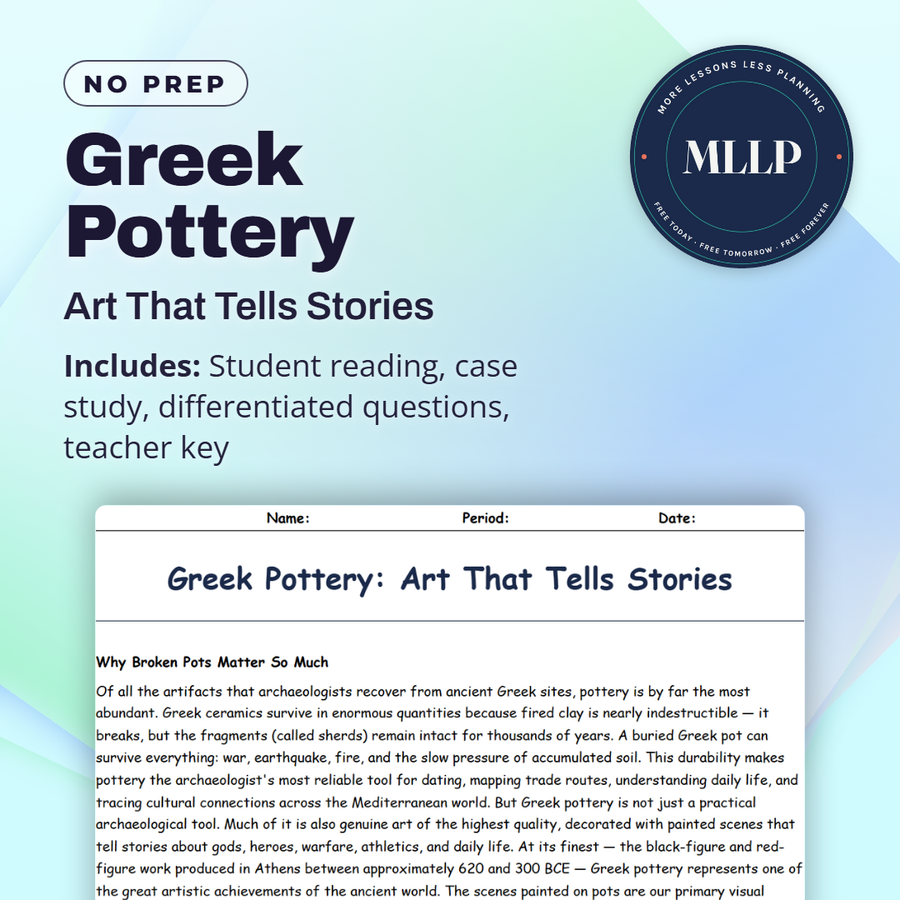
Greek Pottery: Art That Tells Stories
Quality reviewed September 2026
Facts verified September 21, 2026
- Subject
- Social Studies
- Grades
- Grades 9-12
- Length
- 8-page student worksheet
- Time
- About one 50-minute class period
- Great for
- Sub plans and independent work
- Includes
- Reading passage, comprehension questions + full answer key
- Format
- Print-and-go PDF
What students do
- Black-figure and red-figure techniques get compared across a multiple-choice question on why red-figure allowed finer detail
- Match five pottery terms, from amphora to krater, to what each object actually was used for
- Explain how chemical analysis of amphorae lets archaeologists trace ancient olive oil and wine back to their region of origin
- An Athenian vase painter finishing his fortieth Heracles scene opens into two case study questions about anonymous artists
What it covers
- How black-figure and red-figure painting techniques actually differed
- Athenian pottery's trade routes into Etruscan tombs across the Mediterranean
- What everyday scenes on Greek pots reveal about ancient daily life
Start reading this worksheet
Why Broken Pots Matter So Much
Of all the artifacts that archaeologists recover from ancient Greek sites, pottery is by far the most abundant. Greek ceramics survive in enormous quantities because fired clay is nearly indestructible: it breaks, but the fragments (called sherds) remain intact for thousands of years. A buried Greek pot can survive everything: war, earthquake, fire, and the slow pressure of accumulated soil. This durability makes pottery the archaeologist's most reliable tool for dating, mapping trade routes, understanding daily life, and tracing cultural connections across the Mediterranean world. But Greek pottery is not just a practical archaeological tool. Much of it is also genuine art of the highest quality, decorated with painted scenes that tell stories about gods, heroes, warfare, athletics, and daily life. At its finest, in the black-figure and red-figure work produced in Athens between approximately 620 and 300 BCE, Greek pottery represents one of the great artistic achievements of the ancient world. The scenes painted on pots are our primary visual source for what ancient Greeks looked like, how they dressed, what they drank, and which myths they cared about enough to paint a thousand times.
Black-Figure and Red-Figure Techniques
The two dominant styles of decorated Greek pottery are black-figure and red-figure, and the technological innovation that produced them was one of the most significant in ancient art history. In black-figure pottery (developed in Corinth around 700 BCE and perfected in Athens), figures are painted in black silhouette against the red clay body of the pot, with interior details incised (scratched) with a sharp tool. The result is striking but limited: interior details are reduced to fine lines scratched through black paint, and complex expressions or anatomy are difficult to show. Around 530 BCE, an unnamed Athenian potter invented the red-figure technique: instead of painting figures in black, the background was painted black and the figures were left in the red color of the clay. Interior details were then added in paint rather than scratched, giving artists much finer control over anatomy, drapery, and expression. Red-figure pottery could show muscles, facial expressions, and complex drapery folds in a way that black-figure could not. The best red-figure painters were celebrated artists whose names we know: the Berlin Painter, the Kleophrades Painter, and Douris. Their works are among the finest paintings to survive from the ancient world.
What Pot Scenes Tell Us
The scenes painted on Greek pottery are an irreplaceable source of visual information about ancient Greek culture. Mythological scenes dominate: Heracles fighting monsters, Achilles and Ajax playing a board game, Dionysus and his followers, the Trojan War, the labors of Perseus. These scenes show how Greeks visualized their gods and heroes, what attributes identified each figure (Heracles's lion skin, Athena's helmet and owl), and which episodes of mythology were most culturally important. Equally valuable are scenes of daily life. Symposium scenes tell us about aristocratic social life: men reclining on couches, drinking wine from kraters, and listening to music. Athletic scenes on prize amphorae from the Panathenaic Games show us what ancient sports looked like. Wedding scenes, harvest scenes, funerary scenes, and children's toys depicted on pots give us windows into aspects of Greek life that were rarely considered important enough to record in text. A red-figure cup showing a schoolboy practicing writing on a wax tablet is more informative about ancient Greek education than many written sources.
Like what you read? The full reading, the case study, and every question set are in the free download below, along with the answer key.
Why this matters
Most of what survives from ancient Greece is not a temple or a famous name, it is broken pieces of pottery that ordinary potters made without expecting anyone to remember them. The painter in the case study says outright that he expects to stay anonymous, and that his labor mattered because the story on the pot mattered, not his own name attached to it. Students used to thinking about art as personal branding get a real contrast here, and the trade evidence in the reading, Athenian pots turning up in Etruscan tombs across the sea, shows how much economic and cultural history gets carried by objects nobody thought was significant at the time.
From one teacher to another
Broken pottery survives almost everything: fire, earthquake, centuries buried in soil. That durability is why Greek ceramics are the single most abundant artifact archaeologists recover, and why this reading spends real time on how the pots were made and sold rather than just what they show. Students learn the difference between the earlier black-figure technique and the red-figure method invented around 530 BCE that let painters show real muscle and expression for the first time. A case study follows an Athenian workshop painter finishing a prize amphora with a scene of Heracles he has painted forty times before, and his apprentice asking whether anyone will remember his name. The reading closes on the chemistry, how archaeologists can tell where a jar of olive oil actually came from by analyzing its clay.
What you get
Download
Where should I send the next one?
Everything here is free and it stays that way. Leave your email and I'll send you the new lessons as they go up. You can unsubscribe from any one of them.
Related resources
Alexander's Empire: Archaeology Across Three Continents
Ancient Greece: An Overview
Delphi: The Center of the Ancient World
Knossos and the Minoans: Europe's First Civilization
Mycenae and the Trojan War: Where Myth Meets Archaeology
Olympia and the Ancient Olympic Games: Archaeology of Ancient Athletics
Every lesson on this site is free to download and use. If one of them saved you a prep period, you can chip in a few bucks toward my three kids' daycare fund. That's genuinely where tips go.