Delphi: The Center of the Ancient World
Quality reviewed September 2026
Facts verified September 21, 2026
- Subject
- Social Studies
- Grades
- Grades 9-12
- Length
- 9-page student worksheet
- Time
- About one 50-minute class period
- Great for
- Sub plans and independent work
- Includes
- Reading passage, comprehension questions + full answer key
- Format
- Print-and-go PDF
What students do
- Sort five terms, from the Pythia to the Charioteer of Delphi, by what each one actually was
- The geology behind the Pythia's trance, a fault line releasing ethylene gas, gets checked against a multiple-choice question on the science
- Write in three blanks naming the mountain, the treasury, and the emperor who closed the sanctuary
- A Spartan messenger waiting to ask the Oracle about attacking Athens becomes the basis for two case study questions
What it covers
- The Oracle of Delphi and the geology behind the Pythia's trance
- The treasuries along the Sacred Way and Greek interstate rivalry
- The French excavation that recovered the Charioteer of Delphi
Start reading this worksheet
The Navel of the Earth
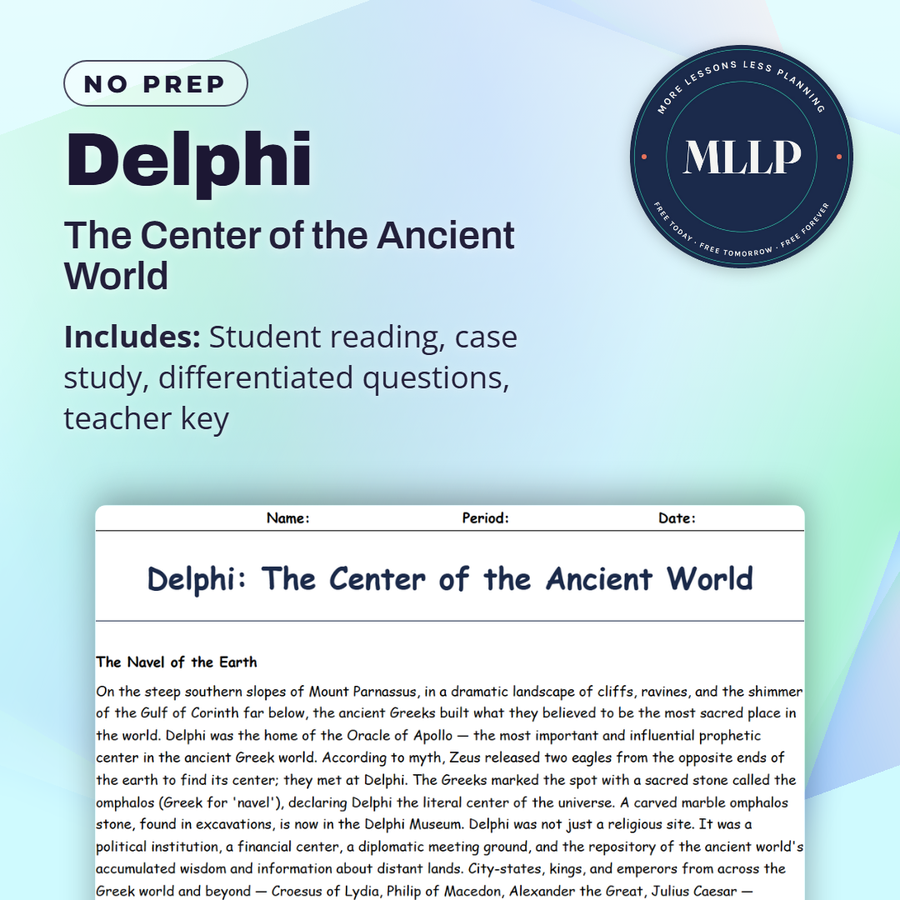
On the steep southern slopes of Mount Parnassus, in a dramatic landscape of cliffs, ravines, and the shimmer of the Gulf of Corinth far below, the ancient Greeks built what they believed to be the most sacred place in the world. Delphi was the home of the Oracle of Apollo, the most important and influential prophetic center in the ancient Greek world. According to myth, Zeus released two eagles from the opposite ends of the earth to find its center; they met at Delphi. The Greeks marked the spot with a sacred stone called the omphalos (Greek for 'navel'), declaring Delphi the literal center of the universe. A carved marble omphalos stone, found in excavations, is now in the Delphi Museum. Delphi was not just a religious site. It was a political institution, a financial center, a diplomatic meeting ground, and the repository of the ancient world's accumulated wisdom and information about distant lands. City-states, kings, and emperors from across the Greek world and beyond (Croesus of Lydia, Philip of Macedon, Alexander the Great, Julius Caesar) consulted the Oracle before major decisions. Delphi accumulated extraordinary wealth in the form of treasuries (small temple-like buildings erected by city-states to house offerings), and its neutrality made it a trusted mediator in Greek interstate conflicts.
The Oracle and the Pythia
The Oracle of Delphi spoke through a human medium called the Pythia, a woman chosen from the local community who served as Apollo's mouthpiece. Ancient sources describe the Pythia sitting on a tripod over a chasm in the earth, breathing vapors that rose from below, and entering a trance state in which she spoke Apollo's words in a frenzy of inspired speech. Her words were then interpreted by priests called the Prophetes, who translated her utterances into the formal hexameter verse responses delivered to consulting parties. Modern geological research has confirmed that Delphi sits at the intersection of two geological fault lines, and that the sanctuary is positioned directly over fissures through which sweet-smelling ethylene gas, a mild hallucinogenic, could have risen from the earth. This does not prove that the Oracle was a fraud. The Pythia and her priests genuinely believed in Apollo's inspiration, and ethylene in low concentrations can produce altered states of consciousness without causing full hallucination. The Oracle's responses were famously ambiguous, deliberately so, allowing them to be interpreted as correct regardless of the outcome. The most famous example: Croesus of Lydia was told that if he attacked Persia, he would destroy a great empire. He attacked. He was conquered. The Oracle had been technically correct. It just never said which empire.
The Treasuries and the Wealth of Delphi
The Sacred Way (the winding path that ancient visitors climbed from Delphi's lower entrance to the Temple of Apollo) was lined on both sides with treasury buildings, victory monuments, and bronze statues. City-states competed to erect the most impressive dedications, using Delphi as a stage for interstate rivalry expressed in marble and bronze. The Treasury of the Athenians, built after the Athenian victory at Marathon (490 BCE), is one of the best-preserved structures at Delphi. Its sculpted metopes show scenes of Heracles and Theseus, both Athenian heroes, in an explicit declaration of Athenian power and piety. The accumulated wealth at Delphi was eventually its downfall. Various ancient states plundered the sanctuary's treasuries over the centuries. The Romans stripped Delphi of its most valuable bronze statues to decorate Rome and Constantinople. By the time the Roman emperor Theodosius I banned pagan worship in 391 CE and formally closed the sanctuary, Delphi had already been significantly stripped of its riches. What remained was uncovered by French archaeologists beginning in 1892, in one of the most important excavation programs of the nineteenth century.
Like what you read? The full reading, the case study, and every question set are in the free download below, along with the answer key.
Why this matters
Delphi shows how institutions maintain credibility even when they get things wrong, which students see everywhere from news sources to companies to their own social media feeds. The Oracle's answers were built to be technically defensible no matter what happened, and the reading's Croesus story shows exactly how that worked in practice. The geology angle matters too: knowing that a real gas seep might explain the Pythia's trance does not prove the whole system was fraudulent, it just means ancient belief and physical science were operating in the same place at the same time, which is a more honest way to think about religion and reason than treating them as opposites.
From one teacher to another
High on Mount Parnassus, the ancient Greeks built the sanctuary they believed marked the exact center of the world. Delphi was where kings and generals went to ask the Oracle what to do next, and where city-states competed to build the most impressive treasury along the Sacred Way. This worksheet gets into both the myth and the modern science, including geological research showing the sanctuary sits over a fault line that could have released a mild hallucinogenic gas. It also covers the famous Croesus story, where the Oracle's answer turned out to be technically correct and disastrously misleading at the same time. A case study follows a Spartan messenger waiting days for an answer he is not sure he can trust.
What you get
Download
Where should I send the next one?
Everything here is free and it stays that way. Leave your email and I'll send you the new lessons as they go up. You can unsubscribe from any one of them.
Related resources
Alexander's Empire: Archaeology Across Three Continents
Ancient Greece: An Overview
Greek Pottery: Art That Tells Stories
Knossos and the Minoans: Europe's First Civilization
Mycenae and the Trojan War: Where Myth Meets Archaeology
Olympia and the Ancient Olympic Games: Archaeology of Ancient Athletics
Every lesson on this site is free to download and use. If one of them saved you a prep period, you can chip in a few bucks toward my three kids' daycare fund. That's genuinely where tips go.