The Opium Wars and China
Quality reviewed September 2026
- Grades
- Grades 9-12
- Time
- About two 50-minute class periods
- Includes
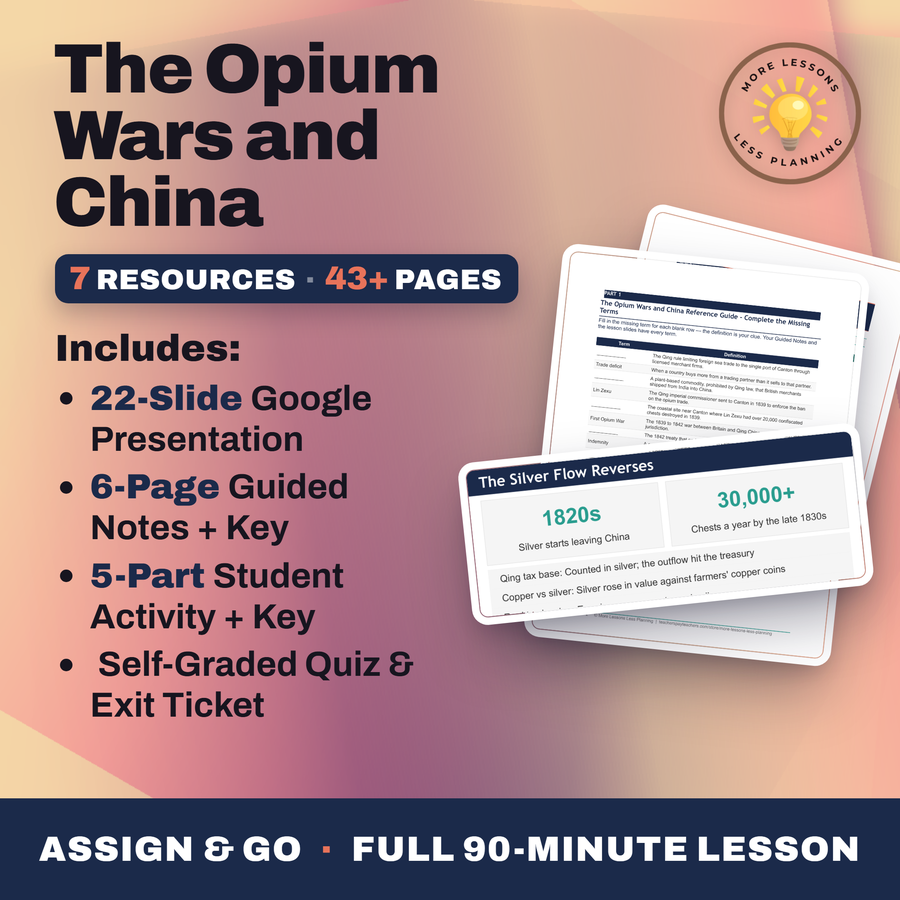
- 11 ready-to-teach files
- Format
- Word (.docx) · PowerPoint (.pptx)
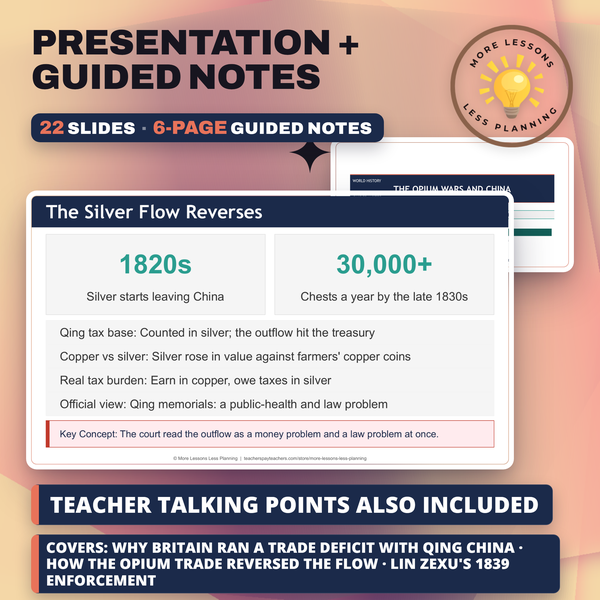
- Slide deck
- Guided notes
- Guided notes teacher key
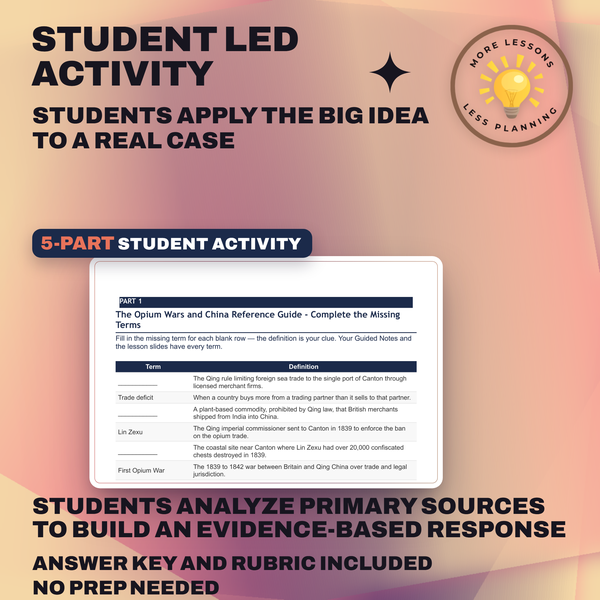
- Activity + answer key
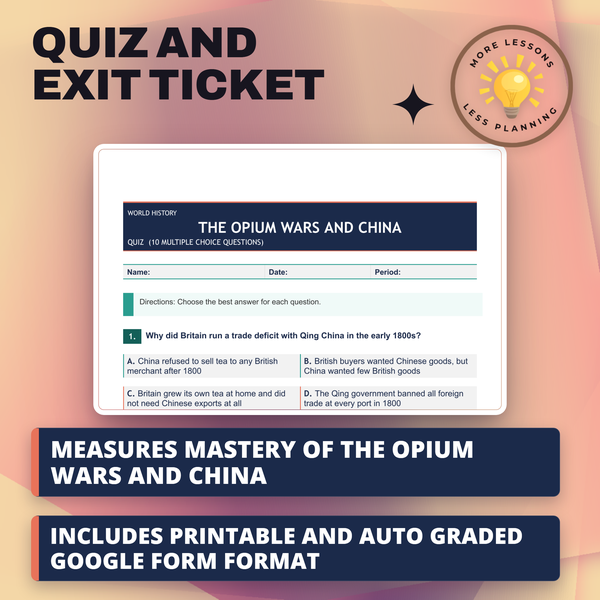
- Quiz + answer key
- Exit ticket + answer key
- Teacher guide
- Teacher presentation notes
What students do
- Explain why Britain ran a trade deficit with Qing China under the Canton System
- Describe Commissioner Lin Zexu's 1839 destruction of over 20,000 chests of opium at Humen
- Analyze Lin Zexu's letter to Queen Victoria as a primary source
- Evaluate the Treaty of Nanjing as an unequal treaty
What it covers
- How the opium trade reversed the flow of silver into China
- Why industrial and naval technology decided the outcome of the First Opium War
- Key vocabulary including Canton System, extraterritoriality, indemnity, and unequal treaty
Learning targets
- Explain why Britain ran a trade deficit with Qing China in the early 1800s.
- Describe how the opium trade reversed the flow of silver into China.
- Analyze Lin Zexu's 1839 enforcement and his letter to Queen Victoria.
- Explain how industrial technology shaped the First Opium War's outcome.
- Evaluate the Treaty of Nanjing and why it is called an unequal treaty.
Peek inside
Qing China limited all foreign sea trade to one port, Canton (Guangzhou).
Foreign merchants traded only through licensed Chinese firms called the Cohong.
Foreign traders could not travel inland or petition Qing officials directly.
Under this system trade was a privilege the Qing court granted, not a right.
British merchants disliked the limits but accepted them in order to buy tea.
One Port, Licensed Firms
Qing China limited all foreign sea trade to one port, (Guangzhou).
Licensed Chinese firms called the handled all foreign trade at Canton.
Under this system trade was a the Qing court granted, not a right.
Britain sent envoys in 1793 and to ask for more ports; both were refused.
1. Britain bought far more tea, silk, and porcelain from China than China bought from Britain, so Britain ran a .
Why this matters
Silver had flowed into China for years in exchange for tea and silk, until the opium trade under the Canton System reversed that flow and started draining it back out. Commissioner Lin Zexu answered by destroying more than 20,000 chests of opium at Humen in 1839, then wrote to Queen Victoria to make his case.
Lin's letter deserves a closer read than most primary sources get, since it's a Qing official reasoning with a foreign monarch rather than denouncing her. Once students see how one-sided the technology was, the Treaty of Nanjing stops being a name to memorize and becomes an unequal treaty in the fullest sense.
From one teacher to another
Lin Zexu's letter to Queen Victoria is the document I built the whole lesson to protect, because it's a Qing official making a direct, reasoned appeal, and it deserves to be read that way instead of skimmed as backstory. Students trace the trade deficit that started the conflict, then follow Lin's 1839 crackdown at Humen through to a war his side had no real chance of winning on industrial terms. The Treaty of Nanjing closes the lesson, and students have to explain exactly what makes it unequal rather than just naming it as such.
Every file in this toolkit
Download
Where should I send the next one?
Everything here is free and it stays that way. Leave your email and I'll send you the new lessons as they go up. You can unsubscribe from any one of them.
Related resources
Cities and Slums
Life in the Factory
Railroads and the Transportation Revolution
Sparks of the Industrial Revolution
The Battle of Adwa
The Berlin Conference
Every lesson on this site is free to download and use. If one of them saved you a prep period, you can chip in a few bucks toward my three kids' daycare fund. That's genuinely where tips go.