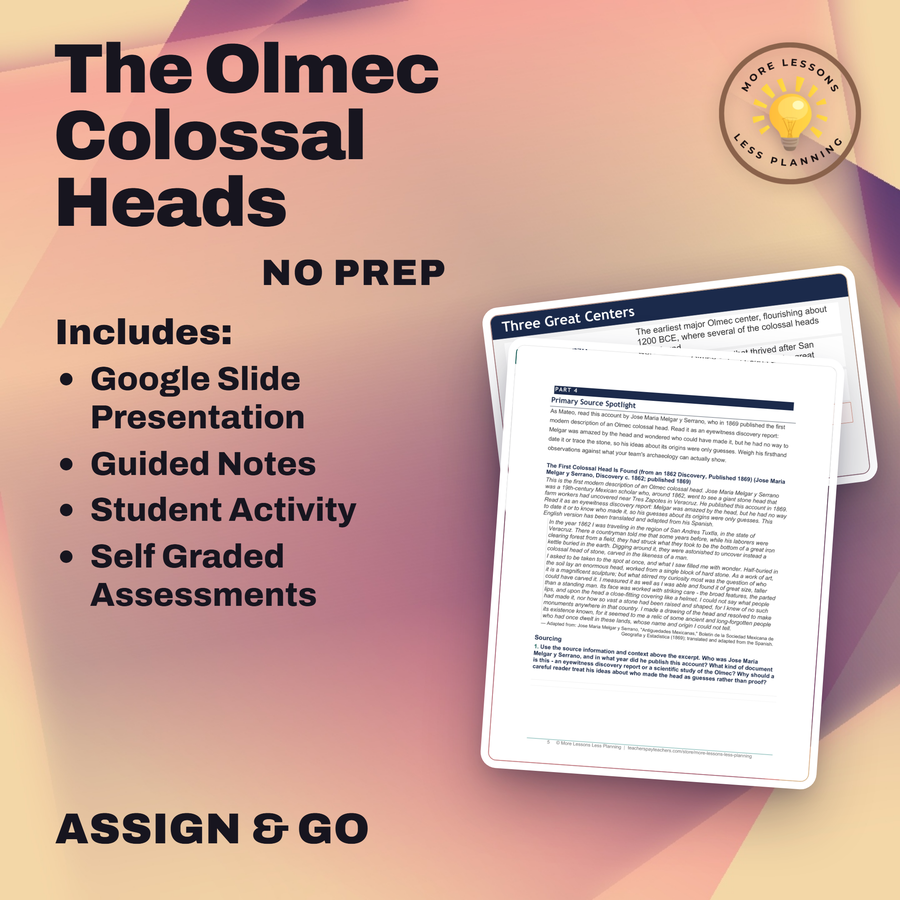



The Olmec Colossal Heads
Quality reviewed September 2026
- Subject
- World History
- Grades
- Grades 9-12
- Time
- About two 50-minute class periods
- Includes
- 11 ready-to-teach files
- Format
- Word (.docx) · PowerPoint (.pptx)
- Slide deck
- Guided notes
- Guided notes teacher key
- Activity + answer key
- Quiz + answer key
- Exit ticket + answer key
- Teacher guide
- Teacher presentation notes
What students do
- Describe the Olmec colossal heads - basalt portraits up to 3 meters and 40+ tons, carved for rulers
- Explain how blocks that size moved for miles with no wheels and no draft animals
- Read Melgar's 1869 discovery report and separate his eyewitness account from his unsupported guesses
- Explain how radiocarbon dating and stone-sourcing prove the Olmec were an indigenous Mesoamerican people
What it covers
- The scale of the colossal heads - up to 3 meters and 40+ tons, carved from single blocks of basalt
- How basalt quarried miles away was moved with no wheels and no draft animals
- Melgar's 1869 report and the discredited 19th-century guesses about the heads' origin
- The debated "mother culture" idea and the Olmec's influence on the later Maya and Aztec
Learning targets
- Describe who the Olmec were - the first major civilization of Mesoamerica, on the Gulf Coast of Mexico (c. 1200-400 BCE), centered on San Lorenzo, La Venta, and Tres Zapotes.
- Explain what the colossal heads are - giant portrait heads carved from single blocks of basalt, up to about 3 meters and 40+ tons, quarried far away and moved without wheels or draft animals, each likely a ruler wearing a helmet-like headdress.
- Analyze a primary source (Melgar y Serrano's 1869 discovery report) and distinguish one 19th-century observer's eyewitness account and guesswork from how modern archaeologists actually know the Olmec were an indigenous Mesoamerican people.
- Explain Olmec influence as the 'mother culture' of later Mesoamerica (Maya, Aztec) and how archaeologists interpret a civilization that left no decipherable writing.
Peek inside
The First Great Civilization of Mesoamerica
were the first major civilization of Mesoamerica, living on the Gulf Coast of Mexico from about 1200 to 400 BCE and known for giant stone heads.
is the region of southern Mexico and Central America where early civilizations such as the Olmec, Maya, and Aztec developed.
1. Q1. What is the name for the first major civilization of Mesoamerica, which lived on the Gulf Coast of Mexico from about 1200 to 400 BCE? (one word)
Why this matters
Forty tons of solid basalt, carved into a single portrait, had to travel miles from its quarry, and the Olmec had no wheels and no draft animals to help move it. That logistics problem, not the carving itself, is the detail that makes students stop and consider what organized labor without machinery actually required.
Some of the earliest guesses about who carved these heads were simply wrong, and I like showing students that a wrong idea can circulate for decades before evidence catches up to it. Radiocarbon dating and tracing the basalt back to its exact volcanic source is what finally settled an argument that used to run on opinion alone.
From one teacher to another
Around 1862, farm workers clearing a field near Tres Zapotes hit a buried stone that turned out to be a forty-ton portrait of an Olmec ruler, and by 1869 a local scholar named Melgar had published the first modern account of it. I use his report as the whole point of the lesson: he was honest that he could only guess who carved it, and some of the guesses circulating in the 1800s about where the Olmec came from were flat wrong. Students trace how modern archaeology settled the question instead - dating the site, tracing the basalt back to specific volcanic mountains, and following the artistic threads that connect the Olmec straight to the Maya and Aztec who came after them. It's a clean case study in the difference between a confident story and the evidence that actually survives.
Every file in this toolkit
Download
Where should I send the next one?
Everything here is free and it stays that way. Leave your email and I'll send you the new lessons as they go up. You can unsubscribe from any one of them.
Related resources
Ashoka and the Edicts of a Warrior King
Chavín de Huántar and Early Andean Civilization

Indian Mathematics and the Invention of Zero

Paper and Papermaking in Han China

The Golden Age of the Gupta Empire

The Han Dynasty and Confucian Government
Every lesson on this site is free to download and use. If one of them saved you a prep period, you can chip in a few bucks toward my three kids' daycare fund. That's genuinely where tips go.