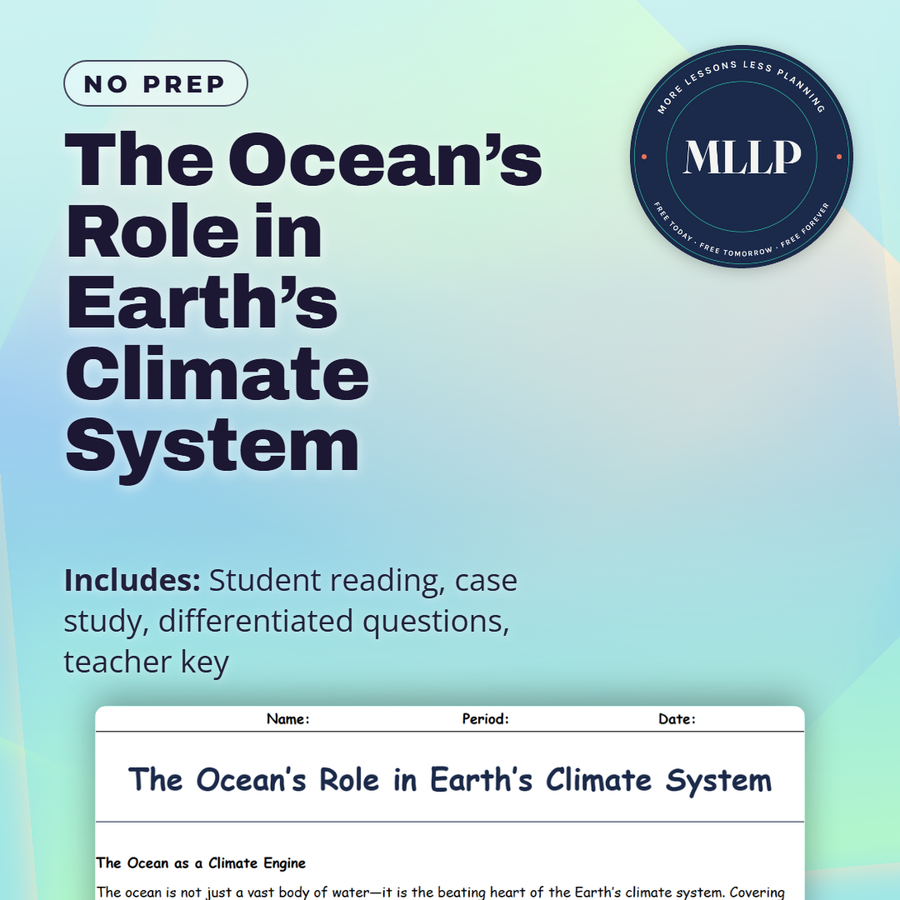
The Ocean’s Role in Earth’s Climate System
Quality reviewed September 2026
Facts verified September 14, 2026
- Subject
- Science
- Grades
- Grades 9-12
- Length
- 7-page student worksheet
- Time
- About one 50-minute class period
- Great for
- Sub plans and independent work
- Includes
- Reading passage, comprehension questions + full answer key
- Format
- Print-and-go PDF
What students do
- Match terms like Phytoplankton, Thermohaline Circulation, Gulf Stream, and El Niño to their correct definitions
- Fill in the blank sentences on phytoplankton's oxygen output, the Gulf Stream, and ocean acidification
- Answer multiple choice questions on why the ocean moderates climate, what thermohaline circulation is also called, and one risk of the ocean absorbing carbon dioxide
- Write short answers on how ocean heat storage affects coastal climates, why thermohaline circulation matters for global stability, and how El Niño and La Niña affect agriculture and health
What it covers
- How the ocean stores and moves heat through currents like the Gulf Stream and thermohaline circulation
- The ocean's role in the carbon and oxygen cycles, including phytoplankton and ocean acidification
- A case study on El Niño and La Niña and how the 1997-1998 El Niño disrupted weather worldwide
Start reading this worksheet
The Ocean as a Climate Engine
The ocean is not just a vast body of water—it is the beating heart of the Earth’s climate system. Covering more than 70% of the planet, the ocean stores and transports heat, regulates atmospheric gases, and produces much of the oxygen we breathe. Without the ocean, Earth would be an unrecognizable world, with scorching equatorial zones and frozen poles. Marine scientists study these processes to understand how the ocean interacts with the atmosphere and drives long-term climate patterns. This knowledge is critical in the era of climate change, where ocean processes are being altered by rising temperatures and human activity. The ocean’s ability to absorb heat is central to its role in climate regulation. Water has a high heat capacity, meaning it can store large amounts of thermal energy without dramatically changing temperature. This stabilizes Earth’s climate, buffering against extremes. For example, coastal regions often have milder weather than inland areas because the ocean absorbs heat in summer and releases it in winter. On a global scale, this heat storage balances the distribution of solar energy across the planet, making Earth habitable.
Currents and Heat Transport
Ocean currents are the conveyor belts of the climate system. Driven by winds, Earth’s rotation, and differences in temperature and salinity, these currents move massive amounts of water around the globe. The most famous is the Gulf Stream, which carries warm water from the Caribbean up the east coast of North America and across the Atlantic to Europe. This flow is one reason why Western Europe has a relatively mild climate compared to other regions at similar latitudes. Another critical system is the thermohaline circulation, sometimes called the “global conveyor belt.” This deep current is driven by differences in water density, with cold, salty water sinking in the polar regions and flowing across ocean basins. It can take centuries for water to complete this cycle, but it plays a vital role in transporting heat and nutrients. Disruptions to thermohaline circulation could have dramatic effects on climate, altering rainfall patterns, storm frequency, and even the stability of ice sheets.
Carbon and Oxygen Cycles
The ocean is also a key player in the carbon cycle. It absorbs about a quarter of the carbon dioxide emitted by human activity, storing it both in surface waters and deep currents. This helps slow the pace of global warming but also leads to ocean acidification, as CO₂ lowers the pH of seawater. Acidification poses a threat to corals, shellfish, and other organisms that build skeletons from calcium carbonate. At the same time, tiny organisms called phytoplankton perform photosynthesis, producing oxygen and absorbing carbon. In fact, phytoplankton are responsible for generating at least half of the oxygen in Earth’s atmosphere. Marine science tracks these cycles to understand both the benefits and risks: the ocean protects us by absorbing carbon, but changes in chemistry could destabilize ecosystems that humans depend on.
Like what you read? The full reading, the case study, and every question set are in the free download below, along with the answer key.
Why this matters
Phytoplankton produce much of the oxygen in the air a student breathes, and the same ocean that grows them also banks enough heat to reshape weather thousands of miles from any coastline. The Gulf Stream and thermohaline circulation move that heat around the globe, which is why a shift in ocean currents can dry out one continent while flooding another.
This reading earns its slot right before the extreme weather unit, since most students keep the ocean and the sky filed as two separate stories. The 1997 and 1998 El Niño alone ran up billions of dollars in flood and drought damage across different continents, and that price tag is what finally makes a warm current feel like more than someone else's problem.
From one teacher to another
The ocean acts like Earth's climate engine, storing heat and moving it around the globe through currents. This reading covers the Gulf Stream, thermohaline circulation, and the ocean's part in the carbon and oxygen cycles, including how phytoplankton produce much of the planet's oxygen. The case study explains El Niño and La Niña, including how the 1997-1998 El Niño caused billions of dollars in damage through floods and drought. Questions ask students to connect ocean heat storage, currents, and carbon absorption to climate stability.
What you get
Download
Where should I send the next one?
Everything here is free and it stays that way. Leave your email and I'll send you the new lessons as they go up. You can unsubscribe from any one of them.
Related resources
Ancient Ocean Explorers: Polynesians, Phoenicians, and Beyond
Branches of Marine Science: Biology, Chemistry, Geology, and Physical Oceanography
Careers in Marine Science and Oceanography

Famous Expeditions: HMS Challenger, Alvin, and Beyond
Marine Science Contributions to Society: Medicine, Climate, and Food
Modern Tools of Ocean Exploration: ROVs, AUVs, and Sonar
Every lesson on this site is free to download and use. If one of them saved you a prep period, you can chip in a few bucks toward my three kids' daycare fund. That's genuinely where tips go.