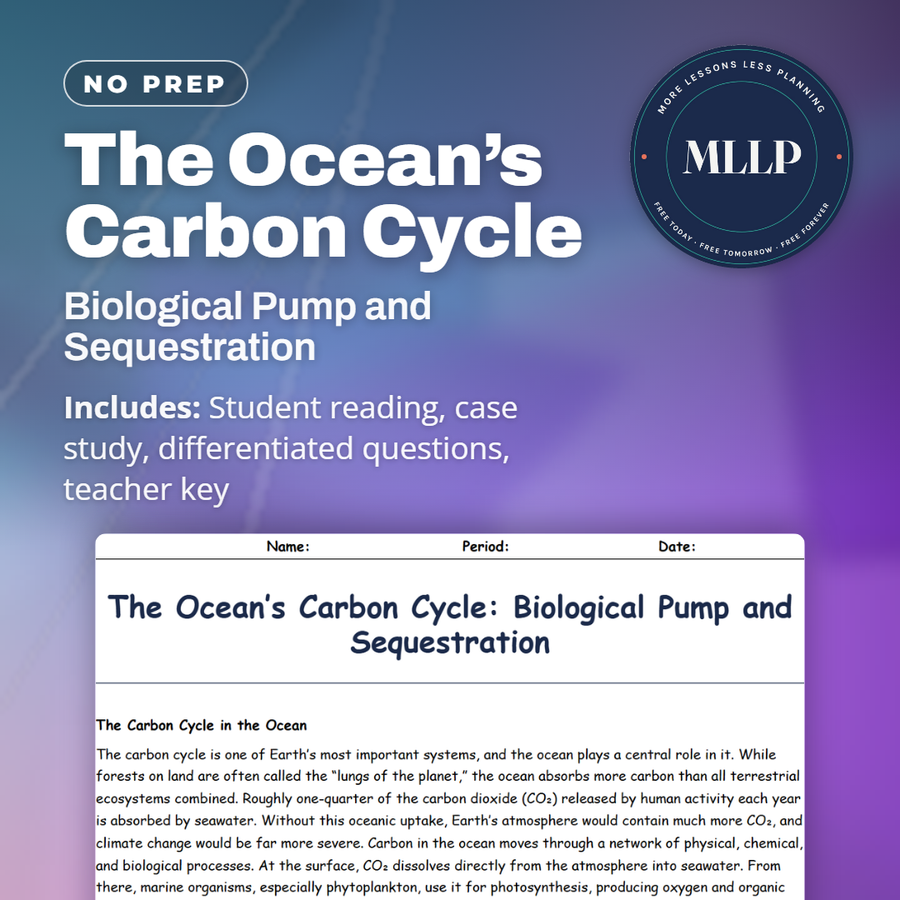
The Ocean’s Carbon Cycle: Biological Pump and Sequestration
Quality reviewed September 2026
Facts verified September 14, 2026
- Subject
- Science
- Grades
- Grades 9-12
- Length
- 6-page student worksheet
- Time
- About one 50-minute class period
- Great for
- Sub plans and independent work
- Includes
- Reading passage, comprehension questions + full answer key
- Format
- Print-and-go PDF
What students do
- Match terms like the Southern Ocean, photosynthesis, sequestration, the biological pump, and dissolution to their correct definitions
- Fill in the blank sentences on what carries carbon to the deep ocean, what phytoplankton use for photosynthesis, and where carbon gets locked away for millions of years
- Answer multiple choice questions on what the biological pump does, which region absorbs the largest share of oceanic carbon dioxide, and why sediment sequestration matters
- Write short answers and case study questions on why the biological pump matters for climate regulation, how deep-ocean storage differs from sediment storage, and why the Southern Ocean absorbs so much carbon
What it covers
- How the biological pump carries carbon from surface phytoplankton down to the deep ocean, where it can stay stored for centuries
- How carbon sequestration in seafloor sediments locks carbon away on a geologic timescale, far longer than storage in deep water alone
- A case study on the Southern Ocean, where strong winds and upwelling drive blooms responsible for a large share of the ocean's total carbon uptake
Start reading this worksheet
The Carbon Cycle in the Ocean
The carbon cycle is one of Earth’s most important systems, and the ocean plays a central role in it. While forests on land are often called the “lungs of the planet,” the ocean absorbs more carbon than all terrestrial ecosystems combined. Roughly one-quarter of the carbon dioxide (CO₂) released by human activity each year is absorbed by seawater. Without this oceanic uptake, Earth’s atmosphere would contain much more CO₂, and climate change would be far more severe. Carbon in the ocean moves through a network of physical, chemical, and biological processes. At the surface, CO₂ dissolves directly from the atmosphere into seawater. From there, marine organisms, especially phytoplankton, use it for photosynthesis, producing oxygen and organic matter. This process links the ocean’s carbon cycle directly to life. Not all carbon stays in the surface ocean. Some of it is recycled rapidly through food webs, while other portions sink to deeper waters, where they may be stored for decades, centuries, or even longer. The movement of carbon from the surface to the deep ocean is known as the biological pump.
How the Biological Pump Works
The biological pump is a natural conveyor system that transports carbon from surface waters to the deep ocean. When phytoplankton take up CO₂, they incorporate it into organic matter. Some of this carbon is consumed by zooplankton and higher organisms, fueling marine food webs. But not all carbon remains in circulation near the surface. When plankton die, their bodies, along with fecal pellets and other organic debris, sink toward the seafloor. As they sink, some material is decomposed by bacteria, releasing CO₂ back into the water. However, a significant portion continues downward. Once carbon reaches deep waters, it can remain trapped there for hundreds to thousands of years. This long-term storage is what makes the biological pump so vital for climate regulation. If the pump were to weaken, more CO₂ would remain in the atmosphere, accelerating global warming. Conversely, if it strengthens, the ocean can act as an even greater carbon sink, slowing climate change. Understanding this system helps scientists predict how human actions will shape Earth’s future climate.
Like what you read? The full reading, the case study, and every question set are in the free download below, along with the answer key.
Why this matters
Carbon dioxide dissolved at the ocean's surface doesn't stay there. Phytoplankton pull it in through photosynthesis, and the biological pump carries it into the deep ocean, where it can stay locked away for centuries. Some settles into seafloor sediment, sequestered for millions of years, a timescale most students have never had to reason about.
Making this concrete means leaning on the Southern Ocean case study. Strong winds and constant upwelling feed blooms there responsible for a striking share of the ocean's total carbon uptake, one remote region doing outsized work most people never consider. Tracing one carbon atom from bloom to sediment turns an abstract term into a supply chain.
From one teacher to another
Forests get called the lungs of the planet, but the ocean actually absorbs more carbon than every forest on Earth combined. This worksheet traces that carbon from the moment it dissolves into surface water, through the biological pump that carries it into the deep ocean, to the sediments where it can stay locked away for millions of years. The case study on the Southern Ocean shows how one region's blooms account for a striking share of global carbon uptake.
What you get
Download
Where should I send the next one?
Everything here is free and it stays that way. Leave your email and I'll send you the new lessons as they go up. You can unsubscribe from any one of them.
Related resources
Chemical Tracers and Ocean Circulation
Dissolved Gases in Seawater: Oxygen, CO₂, and Nitrogen
Gas Solubility in the Ocean: Temperature and Salinity Effects
Nitrogen and Phosphorus in the Ocean: Vital Nutrient Cycles
Nutrient Limitation Across Ocean Zones
Ocean Acidification: Threats to Marine Life
Every lesson on this site is free to download and use. If one of them saved you a prep period, you can chip in a few bucks toward my three kids' daycare fund. That's genuinely where tips go.