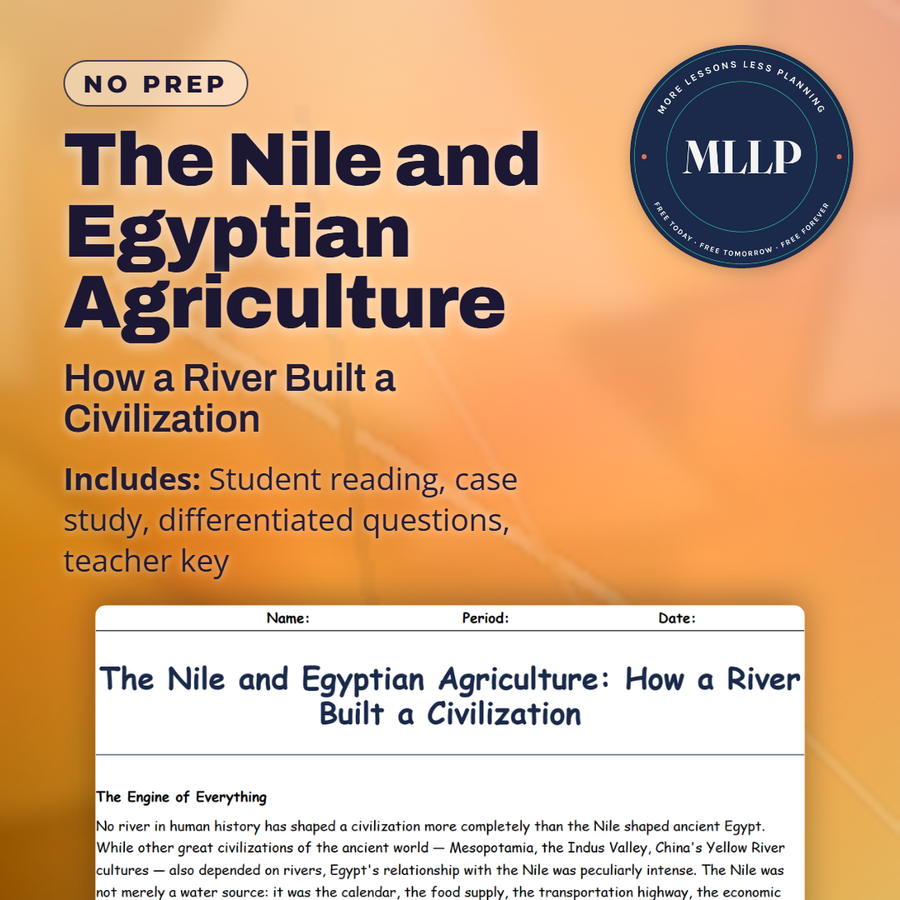
The Nile and Egyptian Agriculture: How a River Built a Civilization
Quality reviewed September 2026
Facts verified September 21, 2026
- Subject
- Social Studies
- Grades
- Grades 9-12
- Length
- 9-page student worksheet
- Time
- About one 50-minute class period
- Great for
- Sub plans and independent work
- Includes
- Reading passage, comprehension questions + full answer key
- Format
- Print-and-go PDF
What students do
- Akhet, Peret, and Shemu get sorted by what farmers actually did during each season
- The shaduf and basin irrigation get compared as two different tools for the same problem
- Write out how a nilometer reading turned into a tax decision for an entire province
- A provincial official named Amenhotep drafts two letters after a bad flood, and students weigh both
What it covers
- The three farming seasons set by the Nile's flood cycle
- Irrigation tools like the shaduf and basin systems
- How nilometer readings shaped tax policy and politics
Start reading this worksheet
The Engine of Everything
No river in human history has shaped a civilization more completely than the Nile shaped ancient Egypt. While other great civilizations of the ancient world, such as Mesopotamia, the Indus Valley, and China's Yellow River cultures, also depended on rivers, Egypt's relationship with the Nile was peculiarly intense. The Nile was not merely a water source: it was the calendar, the food supply, the transportation highway, the economic regulator, and the spiritual spine of Egyptian life. When the Nile behaved predictably, Egypt prospered. When it did not, Egypt suffered, and sometimes rulers fell. The Nile flows south to north from its headwaters in the mountains of central Africa and Ethiopia to its delta on the Mediterranean coast, one of the few major rivers to flow northward. It receives nearly all its water from the Ethiopian highlands, where summer monsoon rains swell two major tributaries, the Blue Nile and the Atbara, sending a vast surge of water downstream each year. In ancient Egypt, this surge arrived in Egypt around the summer solstice in June, reached its peak in September, and receded through October and November. The Egyptians called this period the inundation, or Akhet, and it was the first of their three agricultural seasons.
The Three Seasons
Egyptian farmers organized their year around three seasons defined by the Nile. Akhet (inundation) ran from June to September, when the flooded fields were inaccessible. Farmers used this time for other work, including the labor on royal building projects that constituted their tax payment. Peret (growing season) ran from October through February, when the floodwaters receded and left behind a thick layer of black silt that fertilized the newly exposed soil. Farmers planted immediately as the water withdrew, sowing wheat, barley, flax, and vegetables in the rich mud. Shemu (harvest) ran from March through May, when crops were reaped, threshed, and stored. The silt deposited by the Nile was extraordinarily fertile (rich in minerals from the Ethiopian highlands) and required no plowing, no fertilizers, and no crop rotation to maintain its productivity. This is remarkable: most agricultural land, farmed intensively, degrades over time without careful management. Egypt's fields were naturally refreshed each year by the flood, allowing continuous cultivation for thousands of years without soil depletion. This natural fertility is the fundamental reason Egypt could sustain one of the ancient world's largest and most stable populations for over 3,000 years.
Irrigation and Water Management
While the Nile's flood was Egypt's agricultural miracle, farmers also developed irrigation systems to extend and regulate water availability. Basin irrigation, dividing floodplains into large rectangular basins separated by earthen banks, was the dominant system. As the flood came in, it filled the basins; when the water receded, it left behind perfectly saturated soil ready for planting. Farmers also used a simple but ingenious device called the shaduf (a counterweighted pole with a bucket at one end) to lift water from canals and irrigation ditches for crops growing at higher elevations or during the dry season. Control of irrigation became a major source of political power in ancient Egypt. The pharaoh and his administrators managed the canal networks and determined water allocation across the country. Provincial governors (nomarchs) were responsible for maintaining local irrigation infrastructure, and their success or failure at this task could make them powerful allies or dangerous rivals to central authority. In years when the flood was too low, failing to water the fields adequately, the consequences were devastating: reduced harvests, rising food prices, hunger, and political instability that could threaten the pharaoh's divine legitimacy.
Like what you read? The full reading, the case study, and every question set are in the free download below, along with the answer key.
Why this matters
Amenhotep's two letters in the case study describe a problem that has never gone away: what a government owes its people when the harvest fails through no fault of their own. The reading draws a straight line from low Nile floods to real famine, recorded cannibalism, and the political collapse of the First Intermediate Period, which makes the nilometer far more than measuring equipment. It was the instrument that decided whether a tax bill was fair or a death sentence.
That connection between environment and political stability has not disappeared. Droughts still trigger food shortages, and governments still have to decide how to respond when farmers cannot pay what they owe in a bad year. Students who understand why a pharaoh's legitimacy depended on the Nile behaving predictably have a real framework for thinking about food security and government response in any century, including this one.
From one teacher to another
Egypt's entire farming calendar ran on a river, not a fixed date on any calendar humans invented. This reading walks through the three seasons the flood created, Akhet when the fields disappeared underwater, Peret when farmers planted in the fresh silt, and Shemu when they brought in the harvest, then adds the irrigation tools, basin systems and the counterweighted shaduf, that stretched the water further. It also explains the nilometer, a measuring well cut into the riverbank that told officials exactly how much tax a district could actually pay that year. Students trace what happened when the flood failed: the First Intermediate Period's droughts, recorded famines, and a political collapse the reading connects directly to a river that did not rise on schedule. The case study drops students into the office of a provincial water official named Amenhotep, writing two letters after a bad flood, one asking his governor for emergency grain and one asking a tax collector for mercy.
What you get
Download
Where should I send the next one?
Everything here is free and it stays that way. Leave your email and I'll send you the new lessons as they go up. You can unsubscribe from any one of them.
Related resources
Ancient Egypt: Land of the Pharaohs, An Overview

Building the Pyramids: Engineering Without Modern Technology
Daily Life in Ancient Egypt: Beyond the Pharaohs

Egyptian Religion and the Afterlife
Hatshepsut: The Woman Who Became Pharaoh
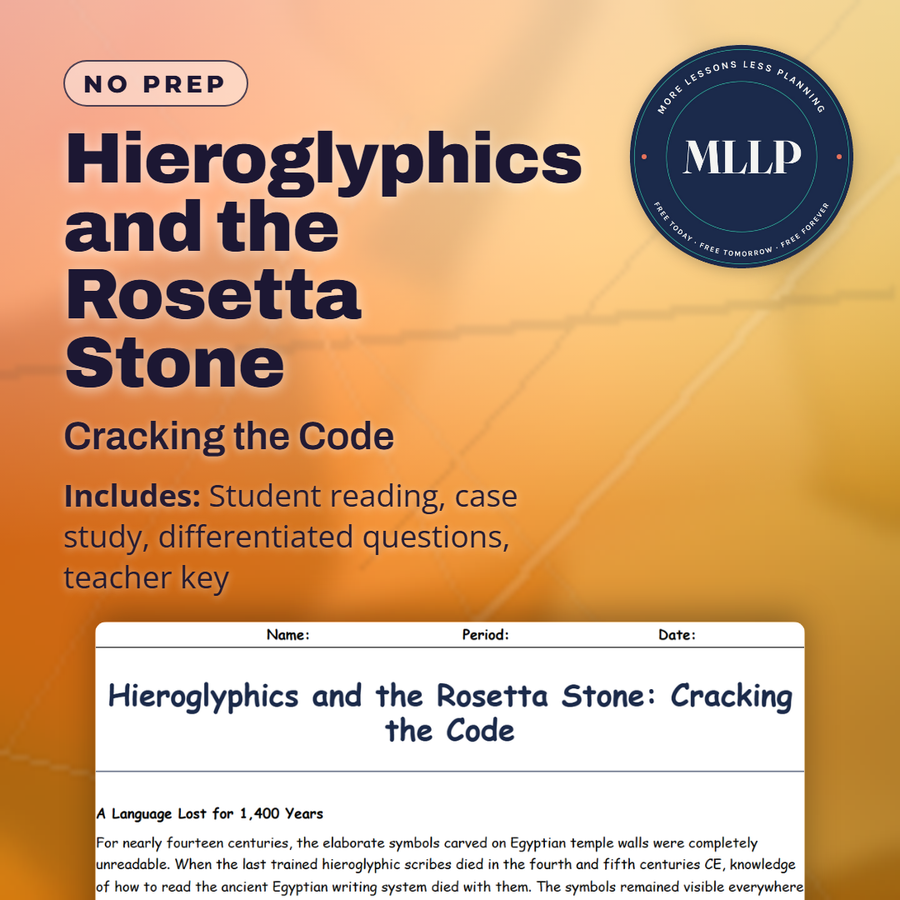
Hieroglyphics and the Rosetta Stone: Cracking the Code
Every lesson on this site is free to download and use. If one of them saved you a prep period, you can chip in a few bucks toward my three kids' daycare fund. That's genuinely where tips go.