
The Mystery of the Indus Valley
Quality reviewed September 2026
- Subject
- World History
- Grades
- Grades 9-12
- Time
- About two 50-minute class periods
- Includes
- 11 ready-to-teach files
- Format
- Word (.docx) · PowerPoint (.pptx)
- Slide deck
- Guided notes
- Guided notes teacher key
- Activity + answer key
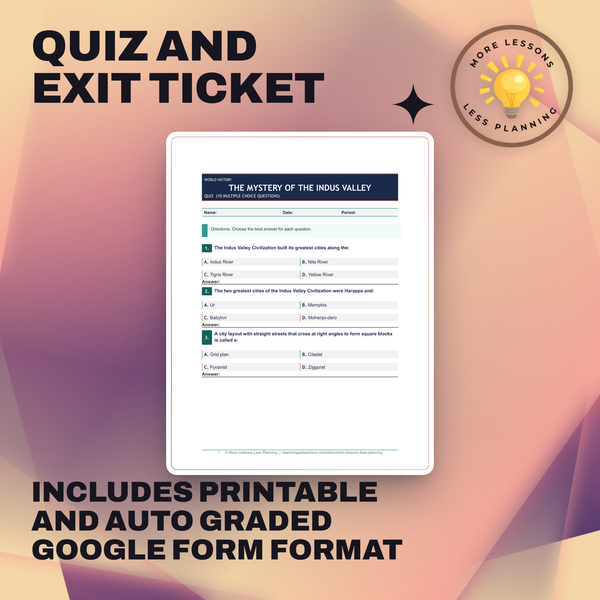
- Quiz + answer key
- Exit ticket + answer key
- Teacher guide
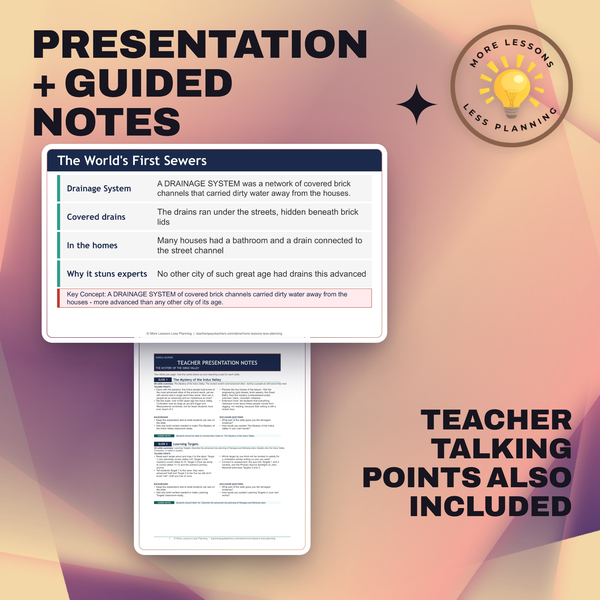
- Teacher presentation notes
What students do
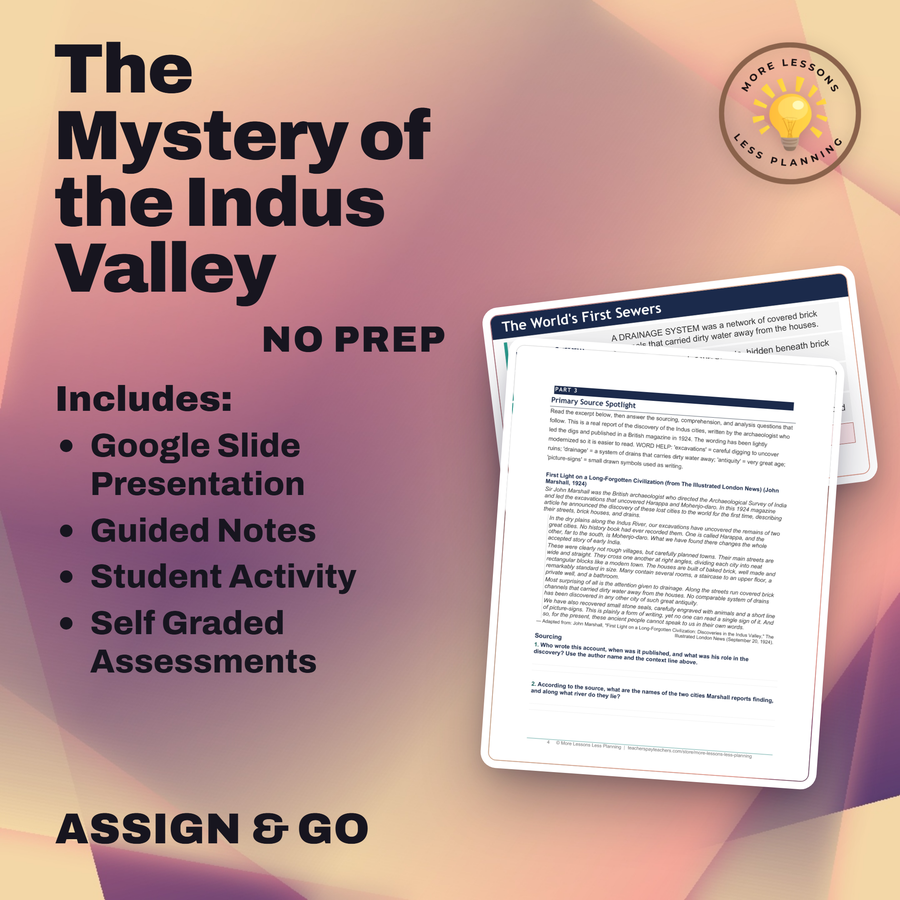
- Describe the grid-plan streets, covered brick drains, and standardized weights of Harappa and Mohenjo-daro
- Explain why the Great Bath's exact purpose stays a guess even though its engineering is plain to see
- Analyze John Marshall's 1924 magazine announcement of the Mohenjo-daro excavations as a primary source
- Explain how archaeologists study a civilization whose Indus script has never been deciphered
What it covers
- The grid-plan streets, baked-brick drainage, and the Great Bath of Mohenjo-daro
- Standardized weights and carved seals as evidence of organized, long-distance trade
- The Indus script's hundreds of picture-signs, still completely undeciphered today
- The open questions of who ruled the cities and why they were abandoned around 1900 BCE
Learning targets
- Describe the advanced city planning of Harappa and Mohenjo-daro - grid streets, baked-brick drains, the Great Bath, and standardized weights
- Explain why the Indus Valley Civilization is called a mystery, including the undeciphered Indus script and its unknown rulers
- Analyze how archaeologists learn about a civilization whose writing has never been deciphered
Peek inside
Two Cities in the Sand
Valley Civilization was an early civilization along the Indus River, also called the Harappan Civilization.
was one of the two greatest cities of the Indus Valley Civilization.
was the largest Indus city, and its name means 'Mound of the Dead.'
rediscovered these buried cities in the 1920s.
1. Who wrote this account, when was it published, and what was his role in the discovery? Use the author name and the context line above.
Why this matters
Matching stone weights turning up hundreds of miles apart proves organized trade without a single receipt or letter surviving to describe it. The people who built Mohenjo-daro's grid streets and covered drains left the plan itself as evidence, brick by brick, even though the writing that would explain who was in charge is never translated.
A civilization this advanced without a decoded language forces a different kind of reading, one I have to build from drains and weights instead of sentences. John Marshall's 1924 report shows the first archaeologists on site making the same inferences students make now, working from objects toward conclusions instead of the other way around.
From one teacher to another
I tell my students up front that nobody alive can read a single word the Indus Valley people wrote, and then I hand them a civilization more carefully planned than almost anything else in the ancient world. Grid streets, covered brick sewers, matching stone weights found hundreds of miles apart - all of it reconstructed from objects, not from writing, because the Indus script has never been cracked and there is no Rosetta Stone to translate it. They read John Marshall's own 1924 announcement of the Mohenjo-daro excavations and have to sort out what he actually saw from what he could only guess. By the end they can explain why the same civilization can be this advanced and this mysterious at once.
Every file in this toolkit
Download
Where should I send the next one?
Everything here is free and it stays that way. Leave your email and I'll send you the new lessons as they go up. You can unsubscribe from any one of them.
Related resources
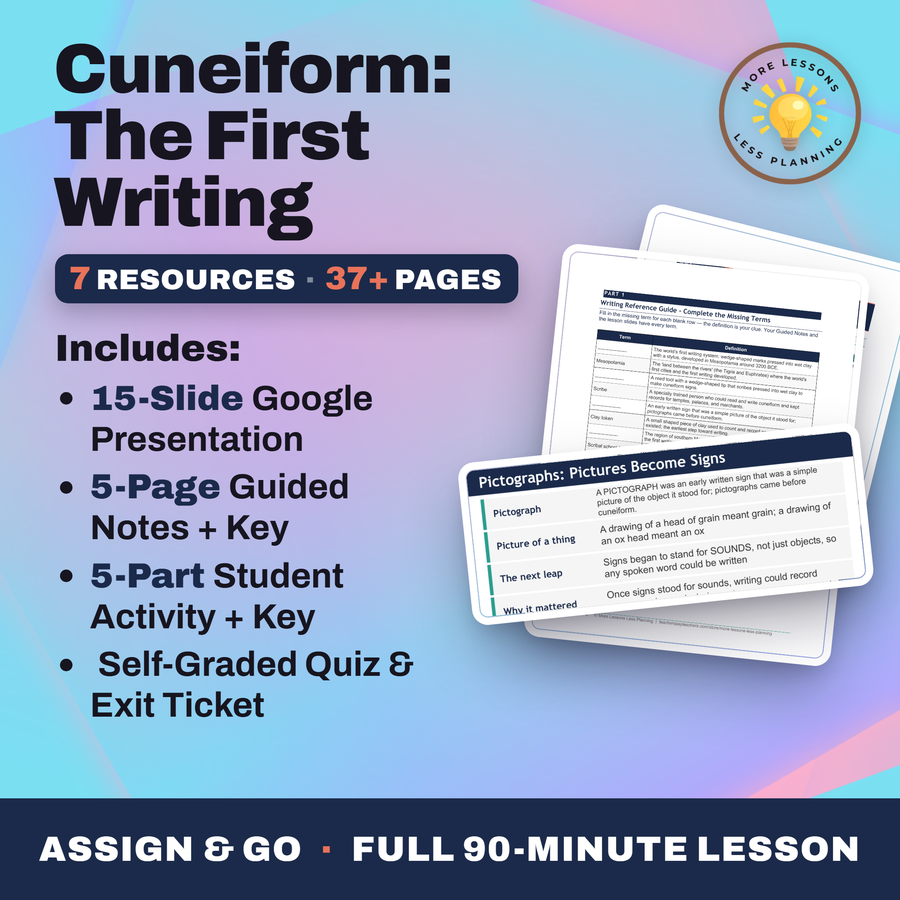
Cuneiform The First Writing
Hieroglyphics and the Rosetta Stone
Oracle Bones and Early Chinese Writing
Pyramids and Pharaohs
The Art of Mummification
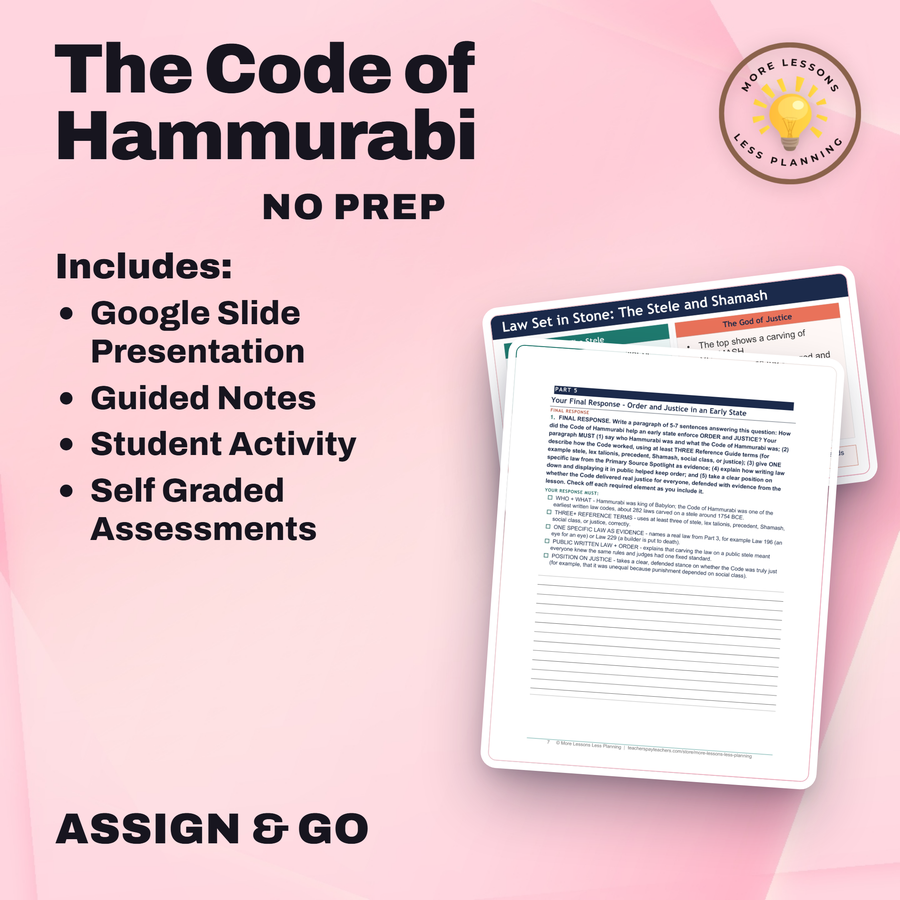
The Code of Hammurabi
Every lesson on this site is free to download and use. If one of them saved you a prep period, you can chip in a few bucks toward my three kids' daycare fund. That's genuinely where tips go.