The Mound Builders of Cahokia
Quality reviewed September 2026
- Grades
- Grades 9-12
- Time
- About two 50-minute class periods
- Includes
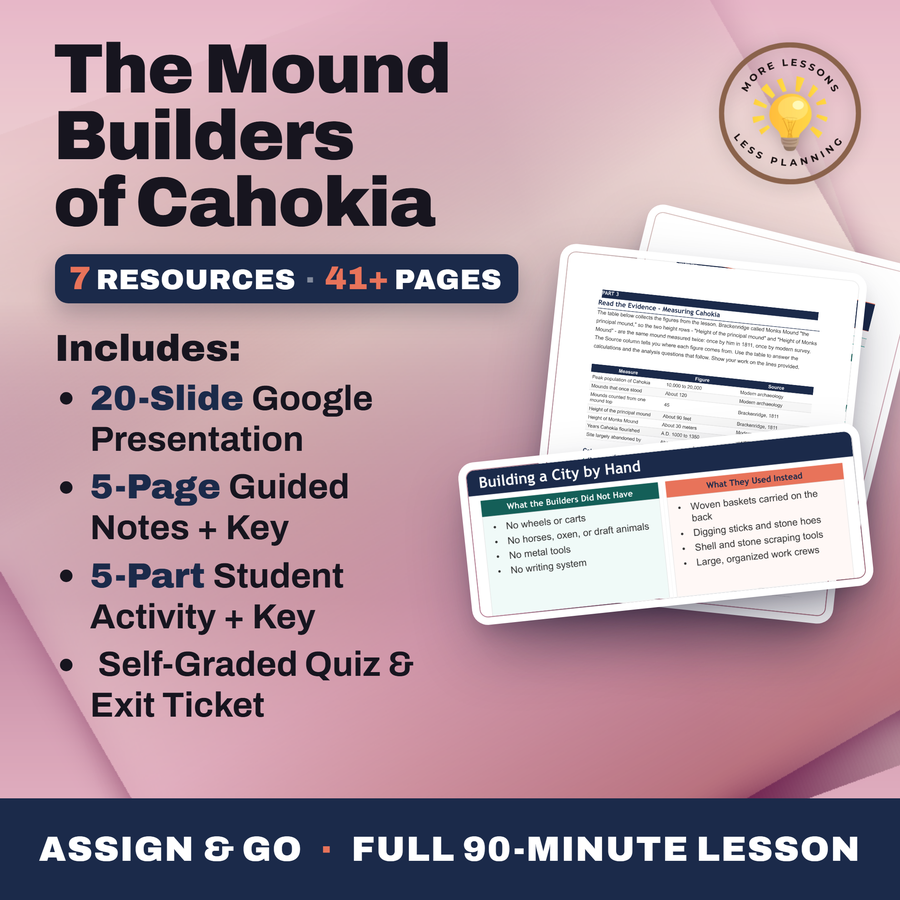
- 11 ready-to-teach files
- Format
- Word (.docx) · PowerPoint (.pptx)
- Slide deck
- Guided notes
- Guided notes teacher key
- Activity + answer key
- Quiz + answer key
- Exit ticket + answer key
- Teacher guide
- Teacher presentation notes
What students do
- Compare the footprint of Monks Mound to the base of the Great Pyramid of Giza
- Distinguish an observation from an inference when reading physical evidence like post holes and borrow pits
- Explain what a deliberately leveled Grand Plaza reveals about planning and power
- Read Henry Brackenridge's 1811 account of the Great Mound and judge what one eyewitness could and could not establish
What it covers
- The scale of Cahokia and what it implies about organized labor
- How archaeologists reconstruct what's gone from post holes and borrow pits
- What an 1811 eyewitness account is good evidence for, and where it oversteps
Learning targets
- Describe the size, location, and dates of Cahokia at its height.
- Explain how Monks Mound, Woodhenge, and the palisade were built and used.
- Explain what archaeologists learn from mounds, post holes, and borrow pits.
- Use Brackenridge's 1811 account of the mounds as evidence.
- Explain why the causes of Cahokia's decline are still an open question.
Peek inside
Where, When, and How Big
The city flourished from about A.D. 1000 to .
At its height to 20,000 people lived there.
About mounds once stood inside the city.
1. A city of 10,000 to 20,000 people once covered more than six square miles of Mississippi floodplain across the river from present-day St. Louis, and archaeologists call that city .
Why this matters
Monks Mound at Cahokia covers more ground than the base of the Great Pyramid of Giza, built by people who left no writing behind to explain how they did it. Everything we know about the labor that raised it comes from reading the dirt itself: post holes that mark where structures stood, borrow pits that show where the fill was dug, a plaza leveled flat on purpose.
Students usually assume that no writing means no evidence, and this lesson corrects that fast. Henry Brackenridge's 1811 account adds a human voice to the physical record, but only after students have already learned what a hole in the ground can and can't tell them, so they catch exactly where his description holds up and where it doesn't.
From one teacher to another
Henry Brackenridge stood at the base of Monks Mound in 1811 and wrote down what he saw, decades before anyone dug a shovel into the site to test it. I use his account as the hinge of the whole lesson: students spend the first half figuring out what an empty post hole or a borrow pit can actually prove, then turn around and hold Brackenridge's claims to that same standard. It's the earliest my US History year can push evidence-first thinking, and it's why I don't open the year in 1492 anymore.
Every file in this toolkit
-
Activity (Student)
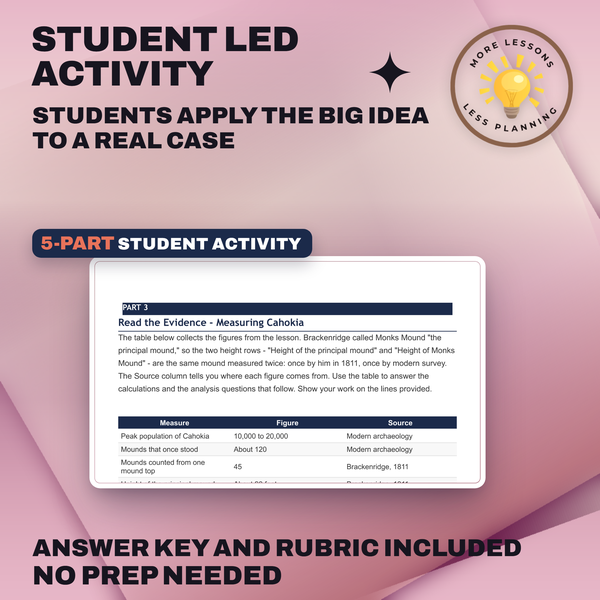
After the notes, students size up Monks Mound against the base of the Great Pyramid and decide what that comparison actually proves about organized labor at Cahokia. Works as partner work, a station, or solo practice.
-
Activity (Answer Key)
This key grades the Monks Mound versus Great Pyramid comparison, laying out what counts as a defensible claim about labor and planning at Cahokia instead of a guess dressed up as one.
-
Exit Ticket (Student)
Right at the end of class, students sort a handful of Cahokia claims into observation and inference, the same skill the post holes and borrow pits section trained all period. Takes about five minutes.
-
Exit Ticket (Answer Key)
Grading the Cahokia exit ticket takes minutes with this key, which draws the line between an observation about a post hole and an inference resting on top of it, the same distinction the lesson trains all period long.
-
Guided Notes (Student)
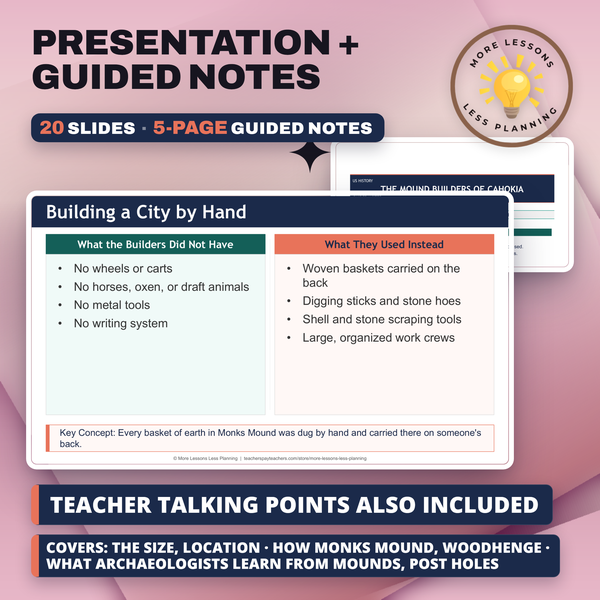
Monks Mound's scale, the Grand Plaza, and Woodhenge fill these fill-in-the-blank notes in the same order the slides teach them, so students build their own record of Cahokia's height instead of copying blocks of text off a screen.
-
Guided Notes (Teacher Key)
This is the Cahokia guided notes with every blank filled in, matched to the slide order on Monks Mound, the palisade, and the borrow pits archaeologists dug to raise it. Keep it open while you teach or hand it to a sub cold.
-
Quiz (Student)
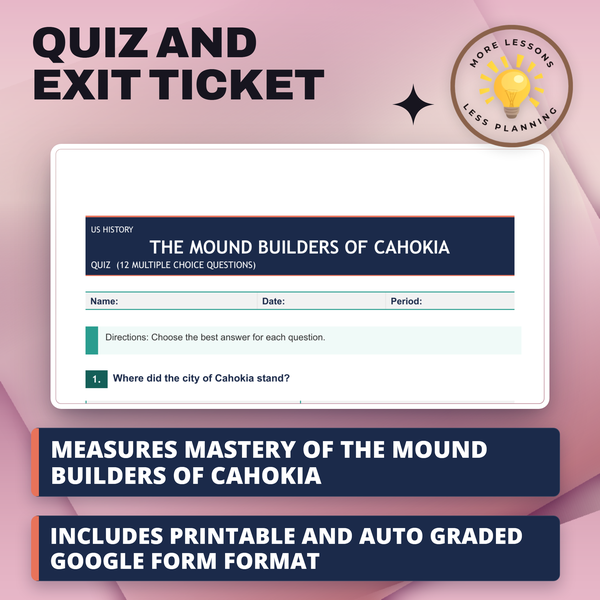
How big Cahokia actually was, what Woodhenge tracked, and why the palisade went up are the three things this paper quiz checks, using nothing beyond what the notes and slides already covered.
-
Quiz (Answer Key)
Every answer to the Cahokia quiz is here, keyed to Monks Mound's dimensions, the palisade's purpose, and what post holes and borrow pits actually tell archaeologists about a city most students have never heard of.
-
Slides
Monks Mound, Woodhenge, and the palisade carry this deck from Cahokia's size at its height through to Brackenridge's 1811 account, laid out in the same order as the guided notes that go with it.
-
Teacher Guide
This guide covers pacing and where the class usually stalls on Cahokia, from sizing Monks Mound against the Great Pyramid to deciding what Brackenridge's 1811 account could and couldn't actually establish.
-
Teacher Presentation Notes
Cue by cue notes for the Cahokia deck tell you what to say when Monks Mound's footprint lands next to the Great Pyramid, and how to set up Brackenridge's 1811 account before students read it themselves.
Download
Where should I send the next one?
Everything here is free and it stays that way. Leave your email and I'll send you the new lessons as they go up. You can unsubscribe from any one of them.
Related resources
Cliff Palace and the Ancestral Puebloans
The Columbian Exchange: A New World Remade
The Great Law of Peace and the Iroquois Confederacy
Totem Poles and the Potlatch of the Pacific Northwest
Bound Labor: How Servitude Became Slavery
Franklin's Philadelphia
Every lesson on this site is free to download and use. If one of them saved you a prep period, you can chip in a few bucks toward my three kids' daycare fund. That's genuinely where tips go.