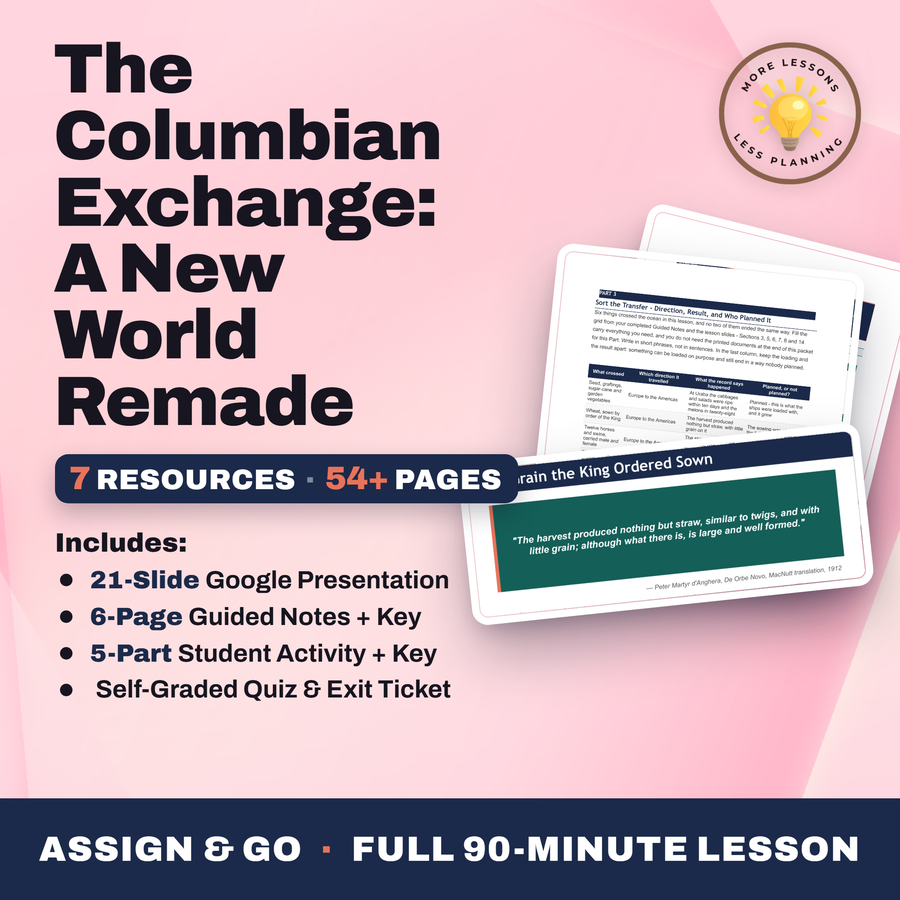
The Columbian Exchange: A New World Remade
Quality reviewed September 2026
- Grades
- Grades 9-12
- Time
- About two 50-minute class periods
- Includes
- 11 ready-to-teach files
- Format
- Word (.docx) · PowerPoint (.pptx)
- Slide deck
- Guided notes
- Guided notes teacher key
- Activity + answer key
- Quiz + answer key
- Exit ticket + answer key
- Teacher guide
- Teacher presentation notes
What students do
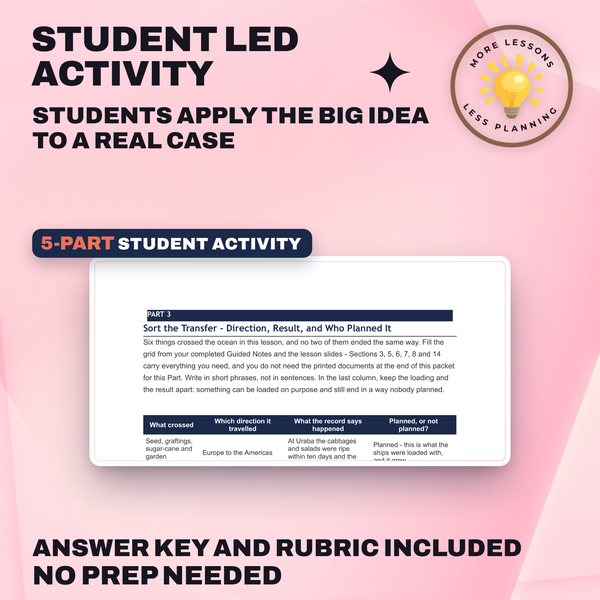
- Sort six crossings, from sugar-cane to smallpox, by direction, recorded result, and whether anyone planned that result
- Read Peter Martyr's 1912-translated account and tell apart a counted figure from a writer's estimate
- Compare Bernal Diaz's account of smallpox reaching New Spain against the Kaqchikel Maya annals' own record of the same pestilence
- Rule on whether a death-toll claim is a finding, a reasonable reading, or a guess, using Las Casas's own contradictory totals
What it covers
- Six crossings, from sugar-cane to smallpox, sorted by direction and whether anyone planned the result
- Peter Martyr's 1912-translated account, read for the difference between a counted figure and a writer's estimate
- Bernal Diaz's account of smallpox reaching New Spain set against the Kaqchikel Maya annals' own record
- Las Casas's contradictory death-toll totals as proof of estimating, not a settled count
Learning targets
- Sort a crop or an animal by the direction it travelled and the result recorded.
- Describe how the disease crossing entered the written record.
- Tell a counted figure apart from a writer's estimate.
- Name who set a record down, when, and from what standpoint.
- Judge what these four documents can and cannot establish.
Peek inside
Ships sailing west carried seed, graftings, sugar-cane and slips of trees.
They also carried chickens and quadrupeds, brought from Europe.
Quadrupeds means four-footed animals: cattle, pigs and horses.
Ships sailing east carried maize, roots called potatoes, and a fruit.
A third cargo travelled with them that nobody loaded on purpose.
What Each Way Carried
Ships sailing west carried slips of , plus seed, graftings and sugar-cane.
They also carried chickens and quadrupeds brought from on the same ships.
Ships sailing east carried maize, roots called potatoes, and one for the king.
A third cargo travelled with them that nobody on purpose at all.
1. A household grows one crop in bulk and eats it nearly every day - wheat in one place, maize or the potato in another. A crop like that is a .
Why this matters
Every textbook prints a death toll for what happened in the Americas after Europeans arrived, and hardly any two of them agree. This lesson explains why: Bartolome de Las Casas himself wrote "above Twelve Millions" in one line and "above Fifty Millions" a few lines later, in the same paragraph, proof that even an eyewitness was estimating.
What changes once students read Bernal Diaz's account of smallpox reaching New Spain against the Kaqchikel Maya annals, written by people the sickness actually reached, is that they stop treating a textbook number as settled fact. By the end they can sort a claim into a finding, a reasonable reading, or a guess instead of just repeating whatever figure they were handed.
From one teacher to another
Most Columbian Exchange lessons stop at crops and animals crossing an ocean, but the sharpest work in this one is teaching students to read four disagreeing sources and say plainly where the record runs out. They sort wheat, pigs, and sugar-cane against the maize and potatoes that went the other way, using an account where cabbages were ripe in ten days and a royal wheat-sowing order produced "nothing but straw," then move to the harder material: Bernal Diaz's Spanish memoir describing smallpox coming ashore in one sick man, set directly against the Kaqchikel Maya annals, the only document here written by people the sickness actually reached, which name the writer's own father among the dead. The closing task is the real skill, ruling on a textbook death-toll claim as a finding, a reasonable reading, or a guess, using Las Casas's own account, which prints "above Twelve Millions" and then "above Fifty Millions" in the same paragraph, proof he was estimating and showing it.
Every file in this toolkit
-
Activity (Student)
Bernal Diaz's smallpox account sits next to the Kaqchikel Maya annals in this hands-on piece, and students have to weigh a Spanish memoir against the one document here written by people the sickness actually reached.
-
Activity (Answer Key)
How much credit a half-right crossing deserves is spelled out here, alongside a sample response weighing Diaz's account against the Kaqchikel annals, so grading the direction-and-result task isn't a guessing game.
-
Exit Ticket (Student)
One more crossing needs sorting by direction and result before the bell rings, a five-minute check that closes the loop without reopening the harder Las Casas death-toll argument from the activity.
-
Exit Ticket (Answer Key)
Correct answers for the closing crossing-sort question are here, quick enough to grade between classes without re-reading the full Las Casas material the lesson spent most of its time on.
-
Guided Notes (Student)
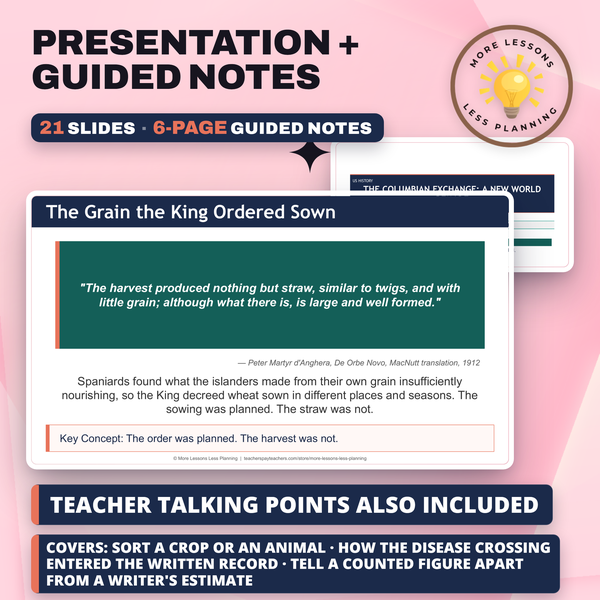
Six crossings, from sugar-cane to smallpox, anchor these fill-in-the-blank notes, tracking direction and recorded result in the same order the slides move through them, right up to the wheat-sowing order that produced nothing but straw.
-
Guided Notes (Teacher Key)
The answer key behind these notes spells out Peter Martyr's own wording on the ten-day cabbages and the wheat that came up nothing but straw, so mid-lesson checks don't require you to reopen his source.
-
Quiz (Student)
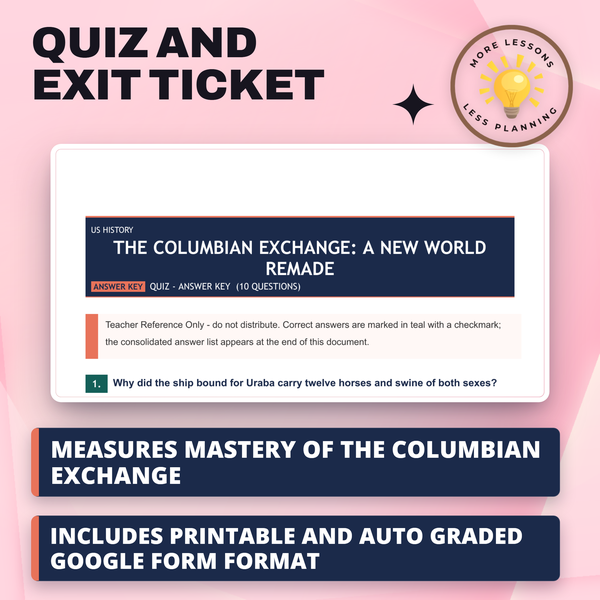
Twelve Million or Fifty Million: this quiz asks students to read Las Casas's own contradictory totals as a sign of estimating, alongside items on the six crossings and their recorded results.
-
Quiz (Answer Key)
Every item on the Las Casas death-toll question and the crossings-sorting question is broken down here in order, so you can see exactly which source, Martyr, Diaz, or the Kaqchikel annals, each answer is pulling from.
-
Slides
The projectable deck runs in the same order as the guided notes, from the six crossings through Bernal Diaz and the Kaqchikel annals to the closing Las Casas numbers students are asked to judge.
-
Teacher Guide
The crop-and-animal sorting task should move fast, but budget real time for the Diaz-versus-Kaqchikel comparison, where students usually need a nudge to separate a counted figure from a writer's estimate.
-
Teacher Presentation Notes
Cues for framing Peter Martyr's account, timing the reveal of the wheat-sowing order, and slowing down before the Las Casas contradiction lands are built into these speaking notes, slide by slide.
Download
Where should I send the next one?
Everything here is free and it stays that way. Leave your email and I'll send you the new lessons as they go up. You can unsubscribe from any one of them.
Related resources
Cliff Palace and the Ancestral Puebloans
The Great Law of Peace and the Iroquois Confederacy
The Mound Builders of Cahokia
Totem Poles and the Potlatch of the Pacific Northwest
Bound Labor: How Servitude Became Slavery
Franklin's Philadelphia
Every lesson on this site is free to download and use. If one of them saved you a prep period, you can chip in a few bucks toward my three kids' daycare fund. That's genuinely where tips go.