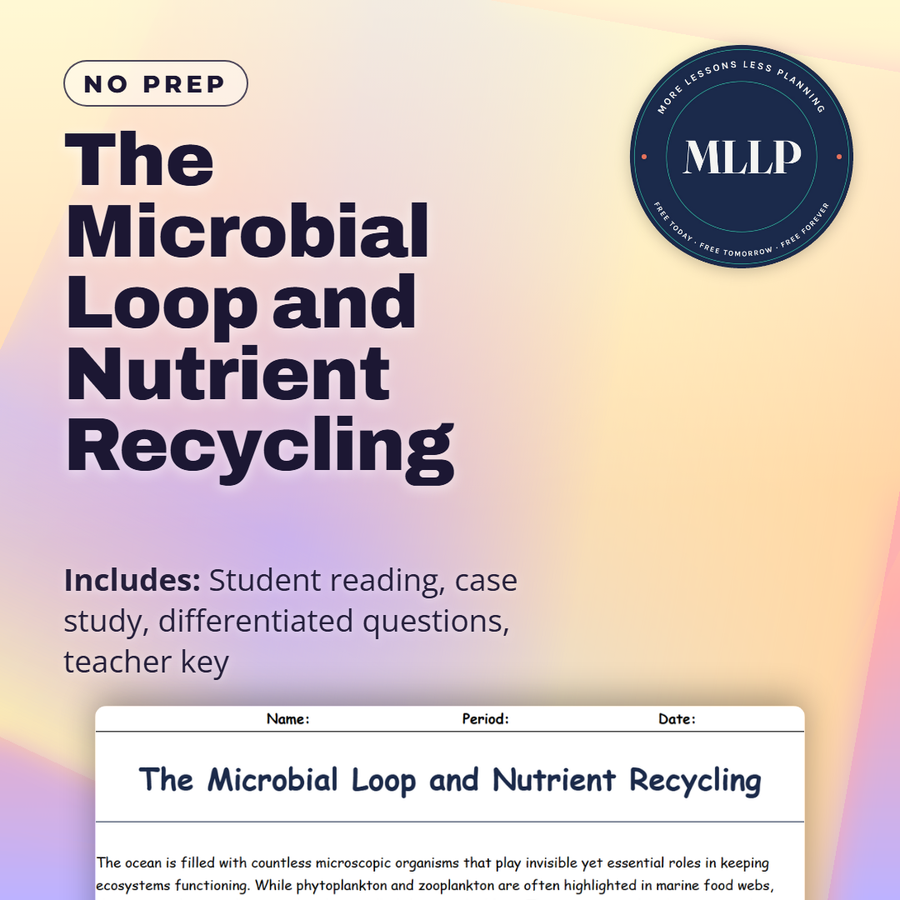
The Microbial Loop and Nutrient Recycling
Quality reviewed September 2026
Facts verified September 14, 2026
- Subject
- Science
- Grades
- Grades 9-12
- Length
- 6-page student worksheet
- Time
- About one 50-minute class period
- Great for
- Sub plans and independent work
- Includes
- Reading passage, comprehension questions + full answer key
- Format
- Print-and-go PDF
What students do
- Match terms like DOM, bacteria, protozoans, and zooplankton to their correct definitions
- Fill in the blank sentences on dissolved organic matter, DOM in coral reefs, and the carbon cycle
- Answer multiple choice questions on what bacteria do with DOM, why coral reefs stay productive, and which nutrients get recycled
- Write short answers on why the microbial loop matters, how microbial shifts can harm coral reefs, and its role in global productivity
What it covers
- How bacteria, protozoans, and zooplankton recycle dissolved organic matter back into the food web
- The microbial loop's role in nitrogen, phosphorus, and carbon cycling across the ocean
- A case study on how microbial loops help coral reefs stay productive in nutrient-poor water
Start reading this worksheet
The ocean is filled with countless microscopic organisms that play invisible yet essential roles in keeping ecosystems functioning. While phytoplankton and zooplankton are often highlighted in marine food webs, there is another equally critical pathway called the microbial loop. This process involves bacteria, archaea, and tiny protozoans recycling nutrients and organic matter back into forms that other organisms can use. Without the microbial loop, much of the organic material in the ocean would remain locked away, unavailable to support higher trophic levels. Instead, microbial activity ensures that nutrients are constantly cycled, maintaining the productivity of marine ecosystems. Understanding this loop highlights the incredible efficiency of ocean ecosystems and the hidden importance of microbes.
How the Microbial Loop Works
Marine ecosystems generate enormous amounts of dissolved organic matter (DOM). When phytoplankton photosynthesize, they release some of the carbon they fix into the water as DOM. Additionally, when organisms die or excrete waste, more DOM is produced. If left unused, these molecules would accumulate and reduce the availability of carbon and nutrients in the ecosystem. Here is where microbes enter the picture. Bacteria consume DOM, converting it into biomass that can be eaten by small protozoans such as ciliates and flagellates. These protozoans are then consumed by larger zooplankton, which in turn are eaten by fish and higher predators. In this way, the microbial loop recycles otherwise inaccessible energy and nutrients back into the classical food web.
Nutrient Recycling in the Ocean
The microbial loop is critical for recycling nutrients such as nitrogen, phosphorus, and carbon. By breaking down organic matter, microbes release inorganic nutrients that can be reused by phytoplankton. This ensures that the primary producers at the base of the food web have a constant supply of the materials they need for photosynthesis. In the absence of this recycling, much of the ocean would become unproductive. Instead, microbes act as recyclers, turning waste into fuel. This process also highlights the interconnectedness of the marine ecosystem: no material is truly wasted, as long as microbes are present to break it down and make it useful again.
Like what you read? The full reading, the case study, and every question set are in the free download below, along with the answer key.
Why this matters
Clear, blue, tropical water looks inviting, but that clarity is a sign of how little food floats in it, which makes coral reefs an odd place to expect a thriving ecosystem. The microbial loop is why reefs manage it anyway: bacteria break down dissolved organic matter, and protozoans and zooplankton eat those bacteria, recycling nutrients back into the food web.
Ocean food chains, in most students' minds, start with something visible: a fish or a plant. Bacteria as the starting point takes convincing. The same loop recycles nitrogen, phosphorus, and carbon, and pollution or warming can disrupt it in ways that show up as reef decline before anyone notices the microbes involved.
From one teacher to another
Bacteria take center stage in this reading, showing how the microbial loop turns dissolved organic matter into food for protozoans, zooplankton, and eventually fish. The case study looks at how coral reefs use microbial loops to stay productive despite living in nutrient-poor water, and what happens when pollution or warming disrupts that balance.
What you get
Download
Where should I send the next one?
Everything here is free and it stays that way. Leave your email and I'll send you the new lessons as they go up. You can unsubscribe from any one of them.
Related resources
Chemosynthesis at Hydrothermal Vent Communities
Cyanobacteria and the Breath of Life
Diatoms, Dinoflagellates, and Coccolithophores Explained
Harmful Algal Blooms: Red Tides, Toxins, and Ecological Consequences
Photosynthesis in the Marine Environment
Phytoplankton: The Powerhouse of the Oceans
Every lesson on this site is free to download and use. If one of them saved you a prep period, you can chip in a few bucks toward my three kids' daycare fund. That's genuinely where tips go.