The Maya Calendar and Astronomy
Quality reviewed September 2026
- Subject
- World History
- Grades
- Grades 9-12
- Time
- About two 50-minute class periods
- Includes
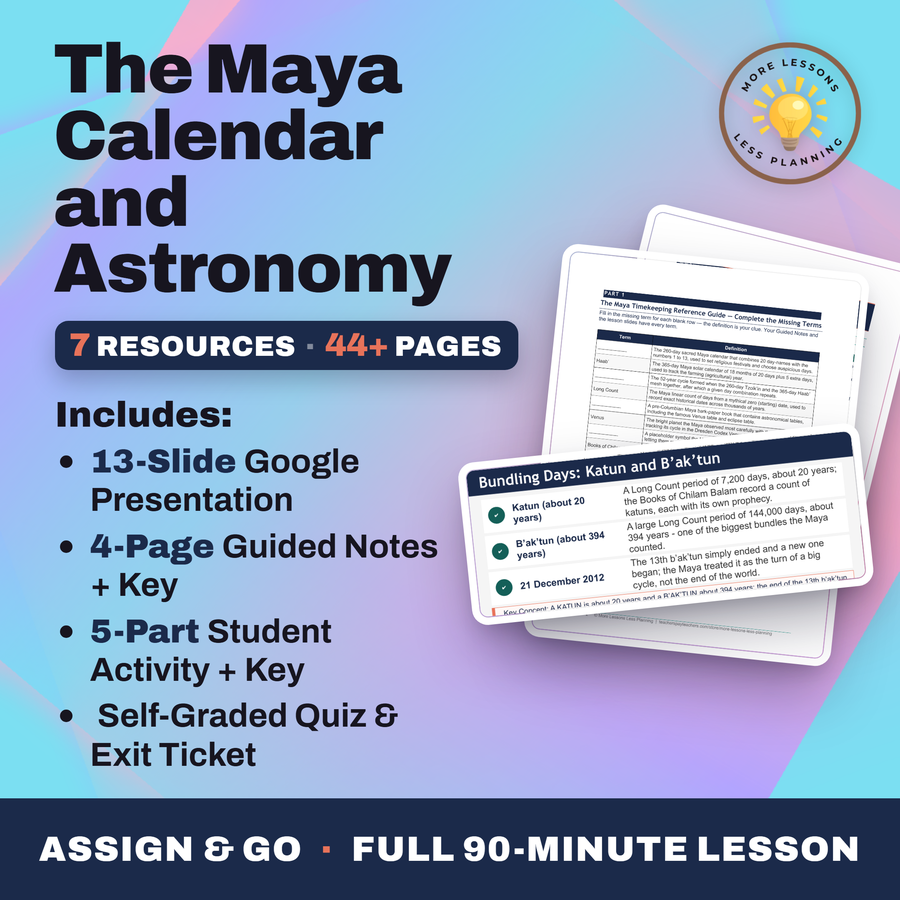
- 11 ready-to-teach files
- Format
- Word (.docx) · PowerPoint (.pptx)
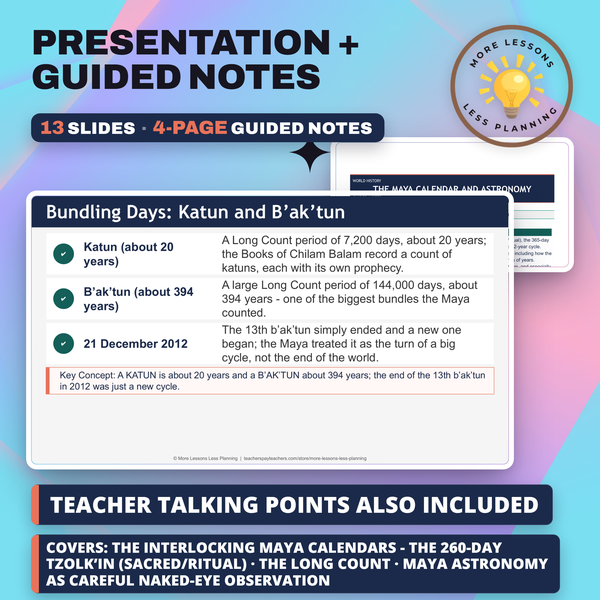
- Slide deck
- Guided notes
- Guided notes teacher key
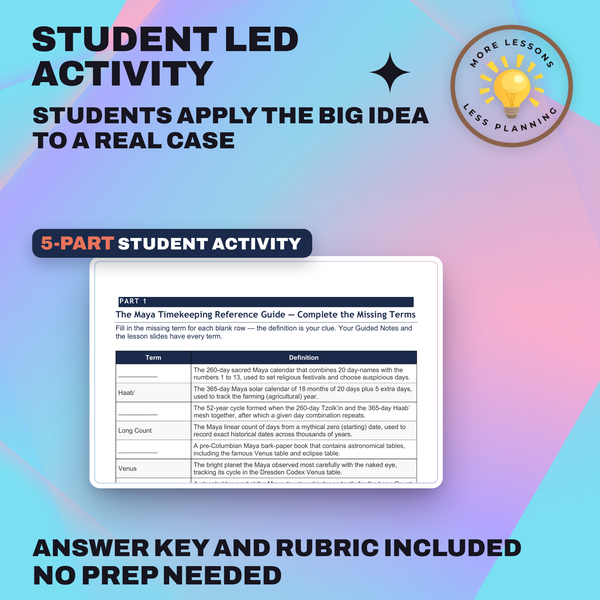
- Activity + answer key
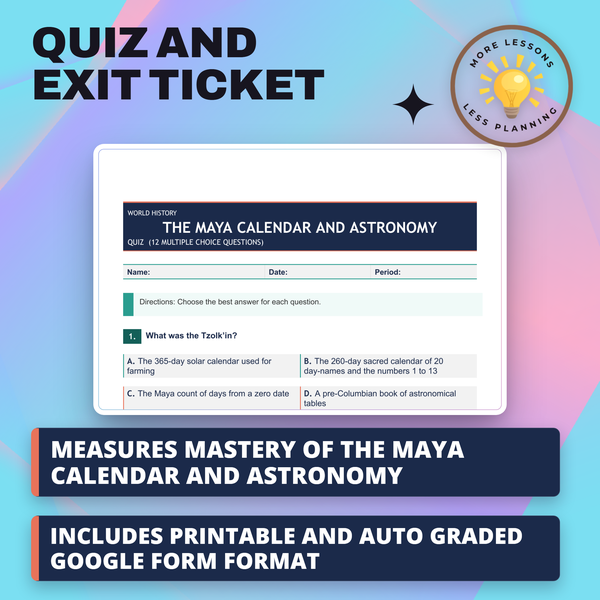
- Quiz + answer key
- Exit ticket + answer key
- Teacher guide
- Teacher presentation notes
What students do
- Explain how the Tzolk'in and the Haab' mesh into the 52-year Calendar Round, and how the Long Count uses a zero placeholder to fix exact dates
- Distinguish the pre-Columbian Dresden Codex from the colonial-era Books of Chilam Balam and explain what each source can tell a historian
- Read an excerpt from the Books of Chilam Balam and identify what it says about cyclical time and the end of a count
- Use the reading and their notes to explain why the 13th b'ak'tun ending in December 2012 was not a Maya doomsday prediction
What it covers
- The interlocking Tzolk'in, Haab', Calendar Round, and Long Count, and the zero placeholder that made the Long Count possible
- Maya naked-eye astronomy, including the Venus and eclipse tables recorded in the Dresden Codex
- A primary source excerpt from the Books of Chilam Balam (Daniel Brinton's 1882 translation) with sourcing, comprehension, and analysis questions
- Correcting the popular 2012 doomsday myth using the source and the lesson's own explanation of cyclical time
Learning targets
- Describe the interlocking Maya calendars - the 260-day Tzolk’in (sacred/ritual), the 365-day Haab’ (solar/agricultural), and the Calendar Round that meshes them into a 52-year cycle.
- Explain the Long Count - a linear count of days from a mythical zero date - including how the Maya used a zero/placeholder to record exact historical dates over thousands of years.
- Explain Maya astronomy as careful naked-eye observation of the Sun, Moon, and especially Venus, recorded in the Dresden Codex Venus and eclipse tables, and how it tied to farming and religion.
- Analyze a primary source (Brinton's 1882 translation of the Books of Chilam Balam) and distinguish colonial-era Maya texts that preserved calendar knowledge from ancient pre-Columbian codices, while correcting the modern '2012 end of the world' misconception.
Peek inside
Tzolk’in (260 days)
The sacred/ritual calendar.
20 day-names paired with numbers 1 to 13.
Set festivals and lucky (auspicious) days.
Haab’ (365 days)
The Sacred and the Solar Calendars
is the 260-day sacred Maya calendar that combines 20 day-names with the numbers 1 to 13, used to set religious festivals and choose auspicious days.
is the 365-day Maya solar calendar of 18 months of 20 days plus 5 extra days, used to track the farming year.
1. Q1. What is the name of the 260-day sacred Maya calendar that combined 20 day-names with the numbers 1 to 13 and set festivals and auspicious days? (one word)
Why this matters
Predicting an eclipse with nothing but naked-eye observation is not guesswork, and the Dresden Codex records Maya astronomers doing exactly that: tracking Venus and eclipses precisely enough to put the results in writing centuries before modern instruments.
Daniel Brinton's 1882 translation turns colonial-era Maya writing into English, and that is a different thing from a pre-Columbian codex like the Dresden, made by Maya scribes with no colonial hand involved. Asking students to notice which category of source they are reading is what keeps them from treating any old-looking text as equally reliable.
From one teacher to another
I built this one to fix a myth I still hear from students every year, so the whole lesson leads to it. The guided notes lay out how the Maya ran two calendars at once - the 260-day Tzolk'in and the 365-day Haab' - meshing into the 52-year Calendar Round, plus the Long Count and the zero placeholder that let them track exact dates across thousands of years. The primary source is a real excerpt from the Books of Chilam Balam, a colonial-era Maya text, and I make students source it carefully: who wrote it, who translated it, and why it isn't the same thing as an ancient codex. The reading itself says time moves in a circle and that "when the count is finished it begins again" - which is exactly the evidence students use to explain why December 2012 was a cycle turning over, not a prophecy of the end of the world. Guided notes, activity, quiz, and exit ticket all come with answer keys, along with a teacher guide.
Every file in this toolkit
Download
Where should I send the next one?
Everything here is free and it stays that way. Leave your email and I'll send you the new lessons as they go up. You can unsubscribe from any one of them.
Related resources
Ashoka and the Edicts of a Warrior King
Chavín de Huántar and Early Andean Civilization
Indian Mathematics and the Invention of Zero
Paper and Papermaking in Han China
The Golden Age of the Gupta Empire
The Han Dynasty and Confucian Government
Every lesson on this site is free to download and use. If one of them saved you a prep period, you can chip in a few bucks toward my three kids' daycare fund. That's genuinely where tips go.