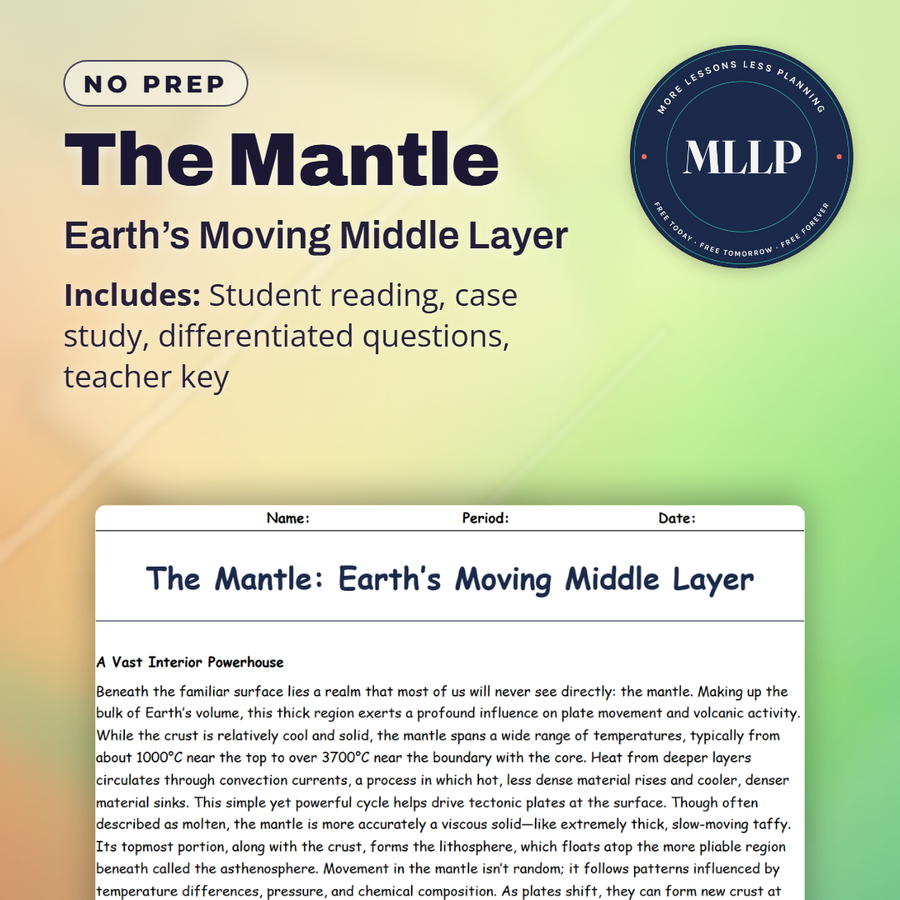
The Mantle: Earth’s Moving Middle Layer
Quality reviewed September 2026
Facts verified September 14, 2026
- Subject
- Social Studies
- Grades
- Grades 9-12
- Length
- 8-page student worksheet
- Time
- About one 50-minute class period
- Great for
- Sub plans and independent work
- Includes
- Reading passage, comprehension questions + full answer key
- Format
- Print-and-go PDF
What students do
- Match terms like Asthenosphere, Hotspot, and Convection to their correct descriptions
- Fill in the blank sentences on the upper mantle's partial melting and how mantle plumes build volcanic island chains
- Answer multiple choice questions on the asthenosphere, what drives convection currents, and how mantle plumes form hotspots
- Write short answers on why the mantle matters for earthquakes and volcanic activity and how scientists study it without direct access
What it covers
- The mantle's structure, temperature range, and convection currents, including the lithosphere and asthenosphere
- The differences between the upper mantle and lower mantle, from depth and pressure to mineral state
- A case study on a mantle plume beneath East Africa's rift valleys and its effects on local communities
Start reading this worksheet
A Vast Interior Powerhouse
Beneath the familiar surface lies a realm that most of us will never see directly: the mantle. Making up the bulk of Earth’s volume, this thick region exerts a profound influence on plate movement and volcanic activity. While the crust is relatively cool and solid, the mantle spans a wide range of temperatures, typically from about 1000°C near the top to over 3700°C near the boundary with the core. Heat from deeper layers circulates through convection currents, a process in which hot, less dense material rises and cooler, denser material sinks. This simple yet powerful cycle helps drive tectonic plates at the surface. Though often described as molten, the mantle is more accurately a viscous solid—like extremely thick, slow-moving taffy. Its topmost portion, along with the crust, forms the lithosphere, which floats atop the more pliable region beneath called the asthenosphere. Movement in the mantle isn’t random; it follows patterns influenced by temperature differences, pressure, and chemical composition. As plates shift, they can form new crust at mid-ocean ridges or subduct old crust back into the Earth at trenches. All of this is guided by the mantle’s incessant churning. Our understanding of the mantle has grown significantly through seismology. By analyzing earthquake waves, geologists detect changes in wave speed that reveal the mantle’s layers. When waves travel through denser or hotter material, they speed up or slow down. Though this provides valuable clues, direct sampling of the mantle remains an enormous challenge. Drilling projects can only reach a few kilometers beneath the crust, nowhere near the thousands of kilometers needed to penetrate the full mantle. Instead, scientists rely on rocks from the ocean floor and volcanic eruptions that sometimes carry mantle-derived material to the surface.
Convection and Its Effects on Earth’s Surface
The concept of convection currents in the mantle can be visualized by imagining a pot of water simmering on the stove. Heated water at the bottom rises to the top, cools, then sinks back down. In Earth’s mantle, this process happens at a geologic timescale, but the principle is the same. These currents create dynamic forces that spread tectonic plates apart at divergent boundaries or force them to collide at convergent boundaries. In places like the Mid-Atlantic Ridge, new crust continuously forms as the mantle’s heat pushes molten rock upward. Volcanic activity also originates from mantle processes. Mantle plumes—columns of extra-hot material—can pierce the lithosphere, creating hotspots like Hawaii or Yellowstone. As the tectonic plate drifts over these hotspots, volcanic chains form. In time, these volcanoes can become islands or formidable mountain ranges. The location of volcanic zones can usually be traced back to underlying mantle anomalies, making volcanic hazard maps closely tied to an understanding of mantle dynamics.
Upper vs. Lower Mantle
Geologists divide the mantle into two main regions: the upper mantle and the lower mantle. The upper mantle (including the asthenosphere) is cooler and less pressurized compared to the deeper layers. It’s also where rock is more prone to partial melting, giving rise to magma that can breach the Earth’s crust. Below about 660 kilometers, conditions change dramatically. The lower mantle experiences pressures so intense that minerals transform into denser structures. Despite the lower mantle being hotter, the extreme pressure keeps it largely solid. Over millions of years, these deep materials can still flow, albeit at an incredibly slow rate. This slow flow transfers heat and mass, affecting everything from the timing of supercontinent cycles to the frequency of certain volcanic eruptions. Studying these layers is essential for any holistic view of Earth’s geology, but it remains a formidable challenge that requires integrating seismic data, lab-based mineral physics, and global tectonic observations.
Like what you read? The full reading, the case study, and every question set are in the free download below, along with the answer key.
Why this matters
The mantle looks solid on any diagram, but it behaves more like slow-moving taffy than rock, flowing under heat and pressure through convection currents that never stop. Those currents rise as mantle plumes in places like East Africa's rift valleys, reshaping the land above and changing daily life for the people who live there.
The upper and lower mantle differ by depth, pressure, and mineral state, and students often flatten that split into one uniform layer. Once partial melting in the upper mantle gets connected to earthquakes and volcanic activity, a hotspot building a volcanic island chain stops feeling disconnected from something happening miles underground.
From one teacher to another
This one gets into the mantle beyond the basic liquid rock idea, comparing it to slow-moving taffy and breaking down convection currents in plain terms. I like how the case study ties the science to something concrete, a mantle plume under East Africa's rift valleys, complete with real risks and benefits for the people living there. The quick reference table makes the upper versus lower mantle split easy to review before the questions. This pairs well with a broader unit on plate tectonics.
What you get
Download
Where should I send the next one?
Everything here is free and it stays that way. Leave your email and I'll send you the new lessons as they go up. You can unsubscribe from any one of them.
Related resources
Biomes & Ecosystems: Life Across Earth’s Habitats
Climate vs. Weather: Understanding the Difference
Convergent Boundaries: Where Plates Collide
Deserts: Survival in the Harshest Climates
Divergent Boundaries: Where Plates Pull Apart
Earth’s Layers: From Crust to Core
Every lesson on this site is free to download and use. If one of them saved you a prep period, you can chip in a few bucks toward my three kids' daycare fund. That's genuinely where tips go.