The Islamic Golden Age
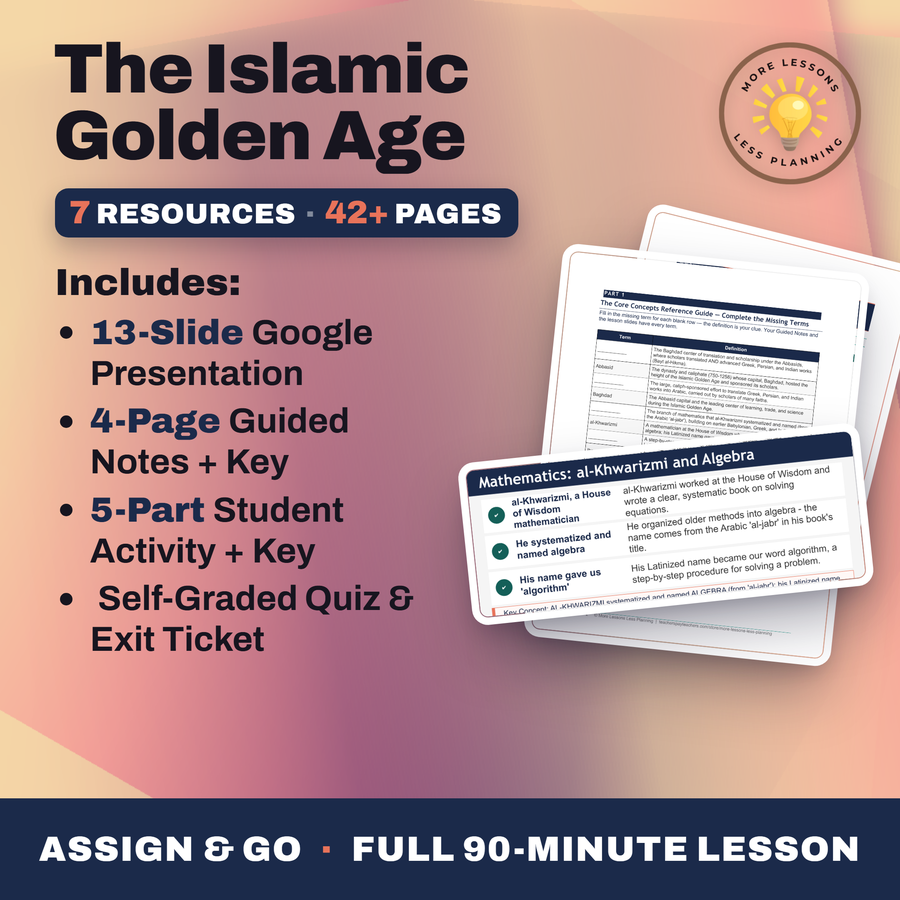
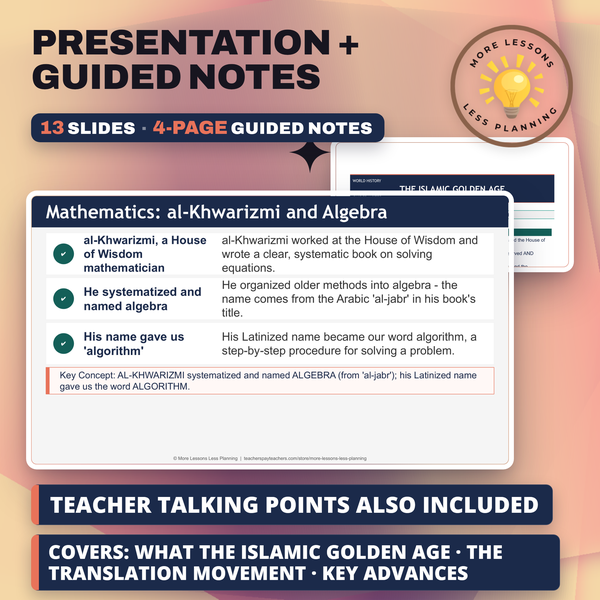
- Slide deck
- Guided notes
- Guided notes teacher key
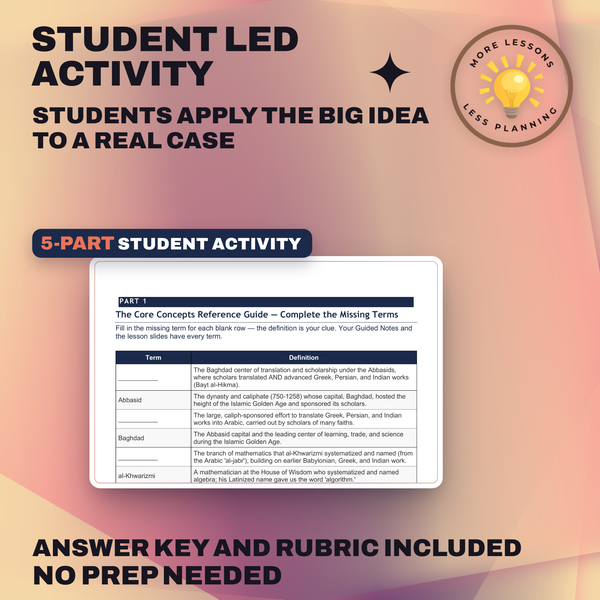
- Activity + answer key
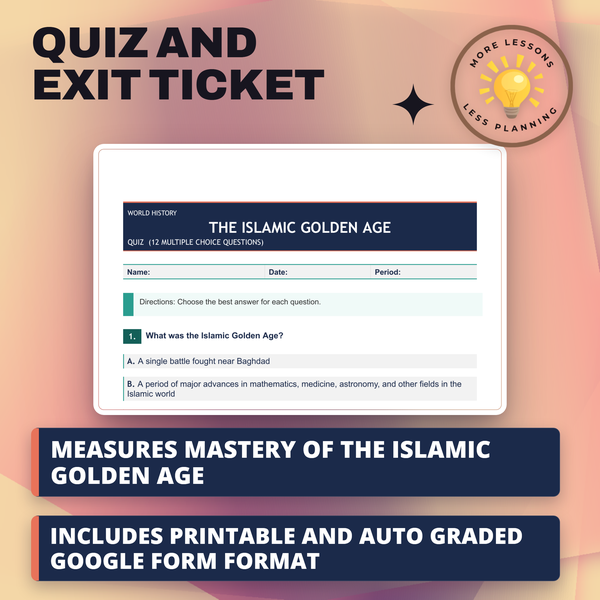
- Quiz + answer key
- Exit ticket + answer key
- Teacher guide
- Teacher presentation notes
Where should I send the next one?
Everything here is free and it stays that way. Leave your email and I'll send you the new lessons as they go up. You can unsubscribe from any one of them.
Every file in this toolkit
Related resources

Great Zimbabwe Stone City
Mansa Musa's Pilgrimage to Mecca
Songhai and Timbuktu Scholarship
The Great Schism of 1054
The Rise of Islam and the Caliphates

The Swahili Coast Trade Cities
What students do
- Analyze al-Khwarizmi's own 1831-translated introduction to his algebra book for why he wrote it
- Argue why "systematized and named algebra" is more accurate than "invented mathematics"
- Trace how numerals developed in India spread through the Islamic world and picked up the wrong name in Europe
- Explain how Ibn al-Haytham's insistence on testing ideas with evidence anticipated the scientific method
What it covers
- Why the House of Wisdom is better described as a translation-and-scholarship movement than one grand library
- Ibn Sina's Canon of Medicine and why European doctors still used it centuries later
- The multi-faith, multi-ethnic scholars who carried out the Baghdad translation movement
- A real medieval Islamic astrolabe, shown as the instrument it is, not a stand-in for a person
Learning targets
- Explain what the Islamic Golden Age was, and how the Abbasid caliphs and the House of Wisdom in Baghdad supported learning.
- Describe the translation movement and how scholars of many faiths preserved AND advanced Greek, Persian, and Indian knowledge.
- Identify key advances in mathematics (al-Khwarizmi, algebra, algorithms, and the Indian-origin 'Arabic' numerals), medicine (al-Razi, Ibn Sina), optics (Ibn al-Haytham), and astronomy - and explain how scholars built on earlier work.
- Analyze a primary source - al-Khwarizmi's own introduction to his algebra book (trans. Rosen, 1831) - to explain why scholars wrote clear, systematic, practical works.
From one teacher to another
Every student in this room has said the word algebra, and none of them know it traces back to one specific book title, so that's the connection I build the whole lesson around. Al-Khwarizmi systematized and named algebra; he didn't invent math from nothing, and that same honesty carries into the numerals slide once students realize what they call Arabic numerals actually started in India. By the time they read his own introduction to the algebra book, they already know exactly what he built on and what he added.
Every lesson on this site is free to download and use. If one of them saved you a prep period, you can chip in a few bucks toward my three kids' daycare fund. That's genuinely where tips go.