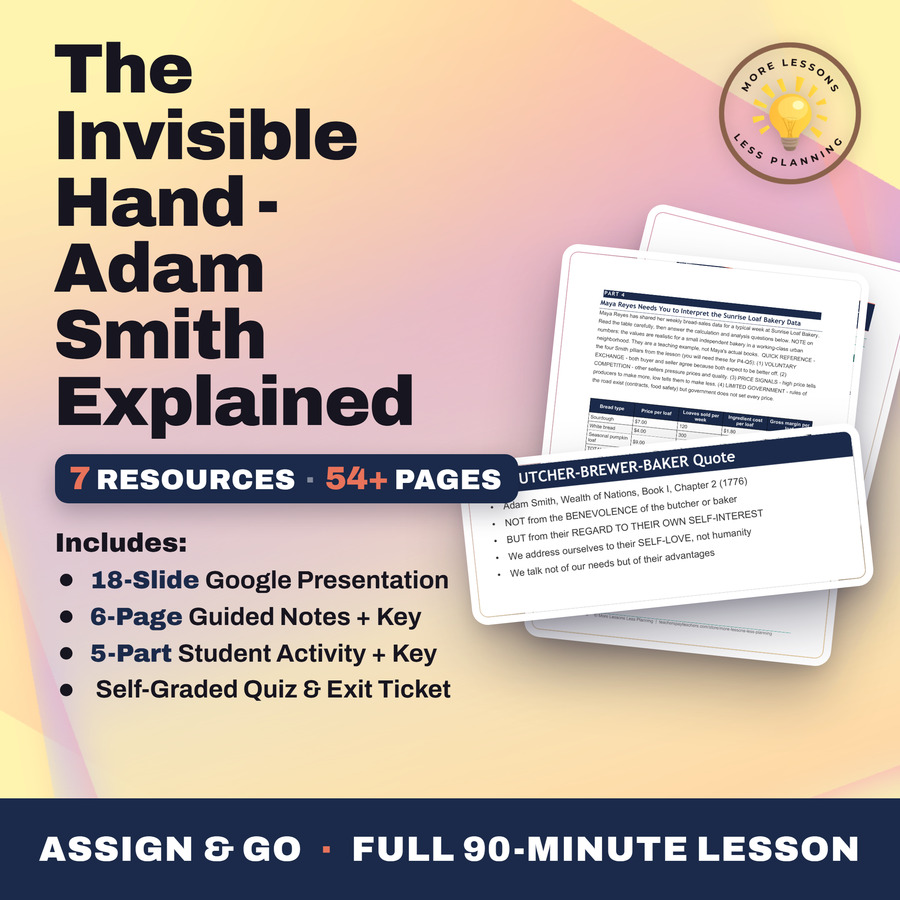

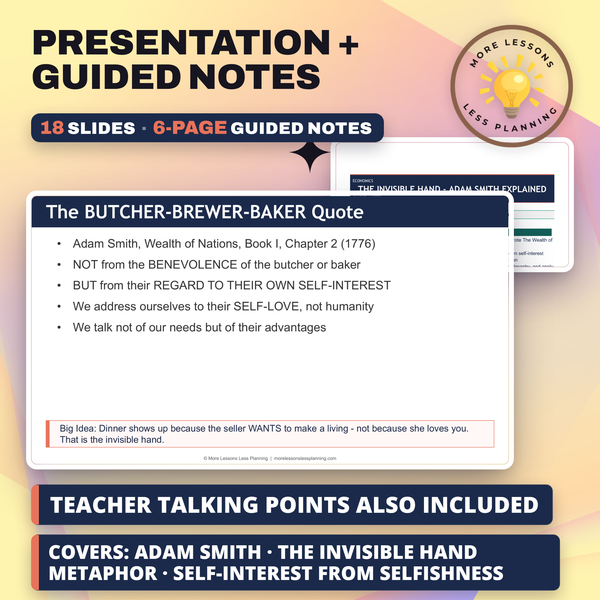
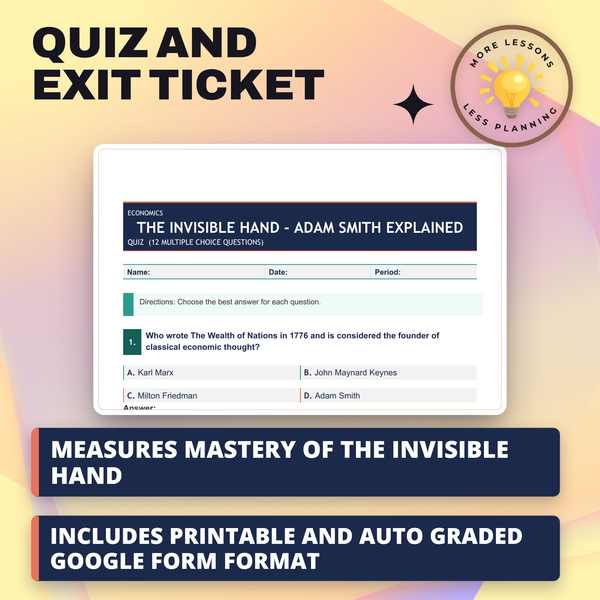
The Invisible Hand - Adam Smith Explained
- Slide deck
- Guided notes
- Guided notes teacher key
- Activity + answer key
- Quiz + answer key
- Exit ticket + answer key
- Teacher guide
- Teacher presentation notes
Where should I send the next one?
Everything here is free and it stays that way. Leave your email and I'll send you the new lessons as they go up. You can unsubscribe from any one of them.
Every file in this toolkit
Related resources
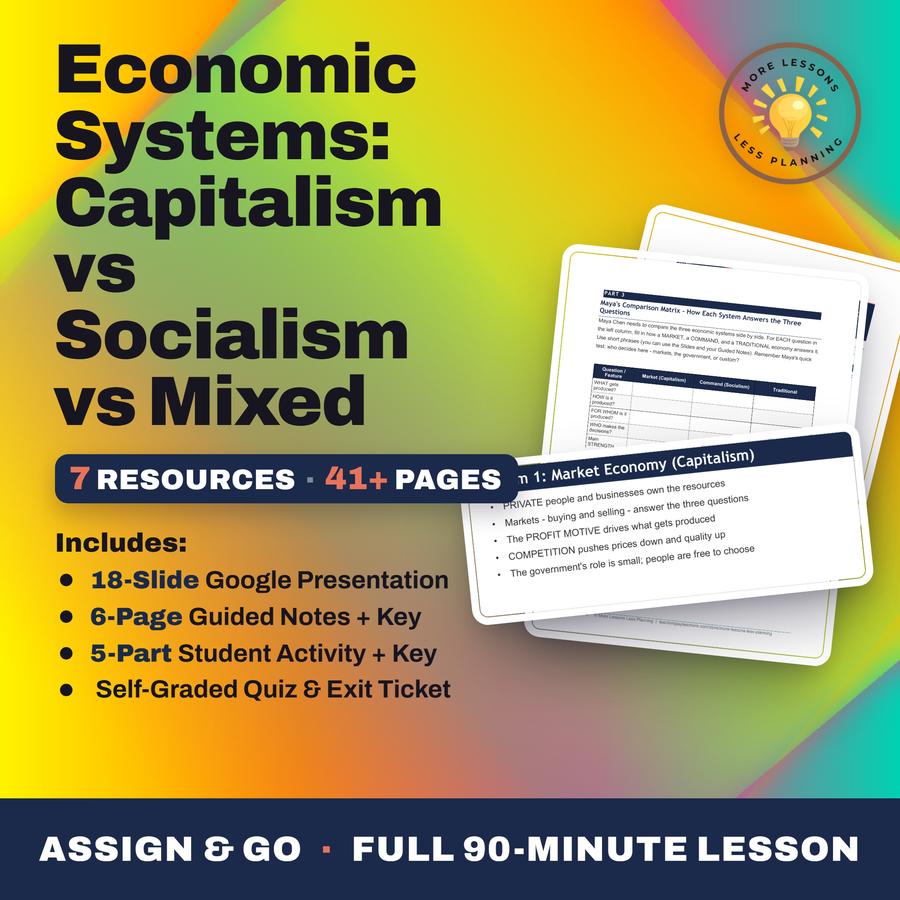
Economic Systems - Capitalism vs Socialism vs Mixed
Factors of Production - Land, Labor, Capital, and Entrepreneurship

Needs vs Wants - Marketings Biggest Trick
Opportunity Cost - The Real Price of Every Decision
Scarcity & Choice - Why You Cant Have Everything

Big Tech Antitrust - Google Apple Amazon Meta
What students do
- Trace how self-interest and price signals shape Maya Reyes's weekly baking decisions at Sunrise Loaf Bakery
- Explain the butcher-brewer-baker quote and connect it to why Maya bakes more sourdough when demand rises
- Distinguish self-interest from selfishness using Adam Smith's own moral philosophy
- Apply the pin factory's division of labor to explain why specialization made ten workers dramatically more productive
What it covers
- Adam Smith's 1776 Wealth of Nations and the invisible hand metaphor
- Why the pin factory example shows specialization multiplying output from about 20 pins to 48,000 pins a day
- Mercantilism versus free markets, and Smith's case for why free trade enriches both sides
- Where the invisible hand breaks down, externalities, monopolies, and market failures
Learning targets
- Identify Adam Smith (1723-1790) as the Scottish moral philosopher who wrote The Wealth of Nations (1776) and is the founder of classical economic thought
- Explain the INVISIBLE HAND metaphor - how individuals pursuing their own self-interest unintentionally promote the public good through prices, profits, and competition
- Distinguish SELF-INTEREST from SELFISHNESS using Smith's moral philosophy, and apply the DIVISION OF LABOR (the pin factory example) to explain why specialization makes everyone richer
- Contrast MERCANTILISM with FREE MARKETS, name at least one CRITIQUE of the invisible hand (market failures, externalities, monopolies), and apply Smith's framework to a real modern small-business decision
From one teacher to another
Adam Smith's 1776 ideas land better through a local business than through abstract theory, so I close this lesson on Sunrise Loaf Bakery. Maya Reyes bakes sourdough or white bread based on what actually sells that week, and tracing her decisions is how students watch self-interest and price signals do the coordinating. The critique slides matter just as much to me: I want students knowing where the invisible hand holds up and where it doesn't, rather than treating Smith as gospel.
Every lesson on this site is free to download and use. If one of them saved you a prep period, you can chip in a few bucks toward my three kids' daycare fund. That's genuinely where tips go.