Incentives - Why People Do What They Do
Quality reviewed September 2026
- Grades
- Grades 9-12
- Time
- About two 50-minute class periods
- Includes
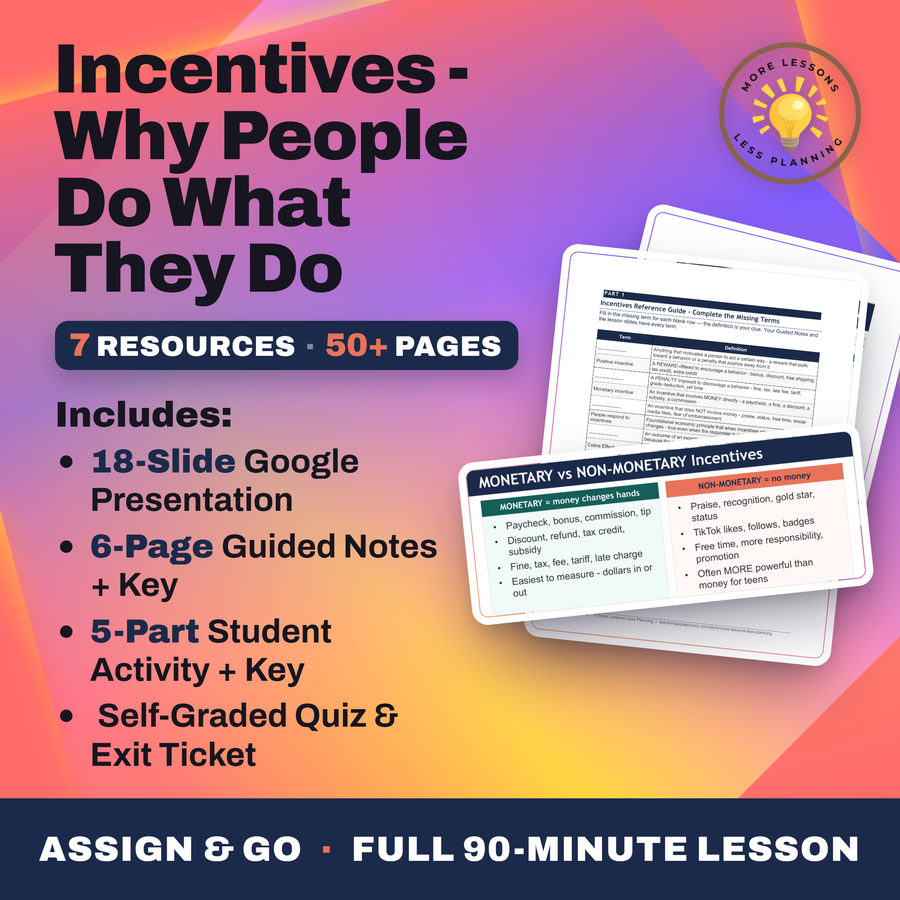
- 11 ready-to-teach files
- Format
- Word (.docx) · PowerPoint (.pptx)
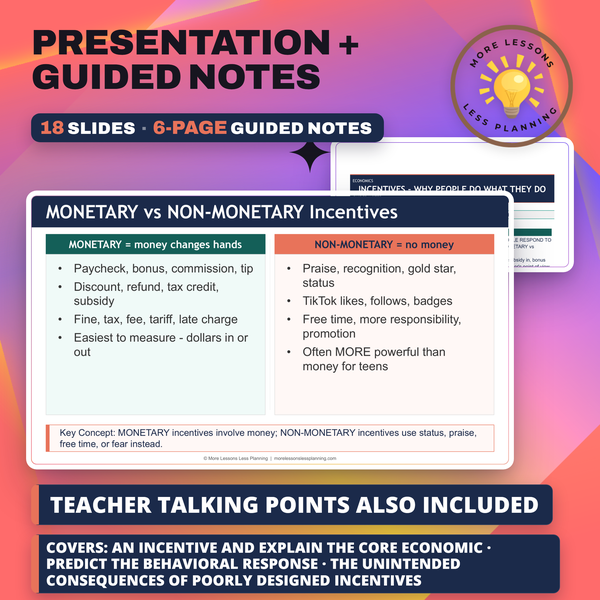
- Slide deck
- Guided notes
- Guided notes teacher key
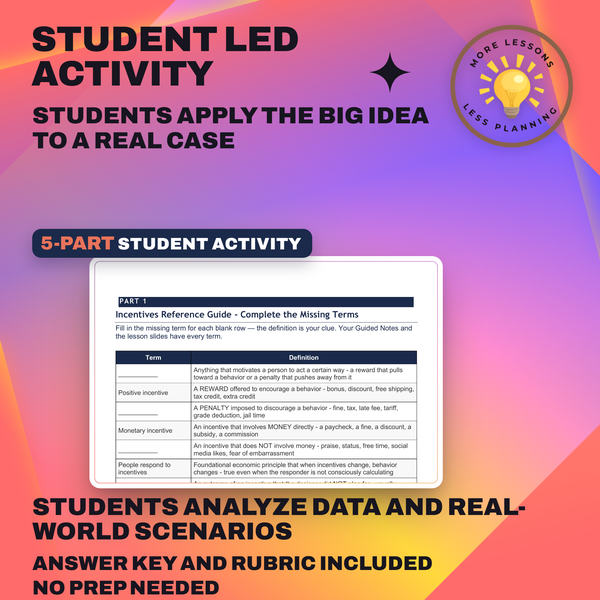
- Activity + answer key
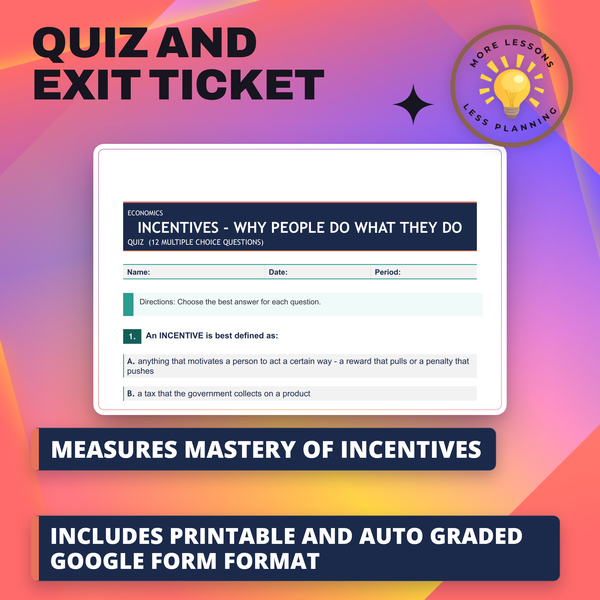
- Quiz + answer key
- Exit ticket + answer key
- Teacher guide
- Teacher presentation notes
What students do
- Classify real incentives as positive or negative and monetary or non-monetary
- Predict the behavioral response to five real incentive scenarios, from a cigarette tax to a fast-food bonus
- Interpret a real Mexico City data table showing a driving ban that actually increased vehicle emissions
- Write a memo redesigning a failed incentive program using the four design rules from the lesson
What it covers
- The original cobra effect, where a colonial bounty on dead cobras led people to breed them for the payout
- Mexico City's Hoy No Circula driving ban, which pushed households to buy a second, dirtier car
- The Wells Fargo bonus scandal, where sales targets led employees to open 3.5 million fake accounts
- Four design failures behind every backfired incentive, and four rules for building one that actually works
Learning targets
- Define an INCENTIVE and explain the core economic principle that PEOPLE RESPOND TO INCENTIVES; classify real incentives as POSITIVE vs NEGATIVE and MONETARY vs NON-MONETARY
- Predict the BEHAVIORAL RESPONSE to a change in incentive (tax up, subsidy in, bonus added, fine raised) and explain why the response is rational from the responder's point of view
- Identify the UNINTENDED CONSEQUENCES of poorly designed incentives using at least one real case (the COBRA EFFECT family - Mexico City Hoy No Circula 2008, the original British Cobra Effect, the Wells Fargo fake-accounts bonus scandal)
- Apply incentive thinking to YOUR OWN decisions (jobs, school, spending) and write a memo proposing a redesigned incentive that gets the behavior change without the backfire
Peek inside
Foundational principle of economics - taught in EVERY intro econ course
When the reward goes up, more people do the thing
When the penalty goes up, fewer people do the thing
Works even when the responder is not consciously calculating
Whoever DESIGNS the incentive is shaping the BEHAVIOR
The Foundational Principle
People respond to - the foundational principle of economics.
When the REWARD goes up, people do the thing.
When the PENALTY goes up, people do the thing.
Whoever DESIGNS the incentive is shaping the .
1. Anything that motivates a person to act a certain way - a reward that pulls you toward a behavior or a penalty that pushes you away from it - is called an .
Why this matters
A reward for good behavior and a rule against bad behavior can both backfire, which is what happened when Wells Fargo employees, chasing sales targets, opened 3.5 million fake accounts nobody asked for. The same failure shows up in government policy as easily as a bonus plan.
Blaming a backfired incentive on someone behaving badly is the easy answer, and Mexico City's driving-ban data closes that door for me every time: households bought a second, dirtier car instead. I hold students to naming the specific design flaw, instead of just calling it broken, since that is the skill that carries forward.
From one teacher to another
I tell the actual cobra story before anything else: colonial officials in India paid a bounty for every dead cobra, so people started breeding cobras to collect it, and when the bounty ended they dumped the now-worthless snakes into the wild, leaving more cobras than when the program started. That's the frame for the whole lesson, and students get to test it against a real 2008 dataset from Mexico City, where a one-day-a-week driving ban led households to buy a second, older, dirtier car. They work the actual percent-change math on that data table themselves to find out just how much emissions rose, so the surprise lands on them instead of me just narrating it. It closes with a memo redesigning a failed transportation-department pilot program, and I hold them to naming the specific design flaw, rewarding the wrong proxy, being easy to game, ignoring how the actual person would respond, rather than just saying the incentive "didn't work."
Every file in this toolkit
-
Activity (Student)
Anthony Cobb runs five behavioral predictions, a cigarette tax, an EV credit, a drive-thru bonus, a phone fine, and the Hoy No Circula car rule, then hands over registration and emissions numbers for the percent change math.
-
Activity (Answer Key)
Worked answers explain why smoking fell from 42 percent to 11 percent under the cigarette tax while the Hoy No Circula rule backfired, with the 28 percent jump in registered cars and the 13 percent rise in emissions shown in full.
-
Exit Ticket (Student)
One question sorts five real examples by incentive type, another names what the cobra effect describes, and a third points to which scenario best shows people responding to incentives. A real incentive from the student's own life gets classified on two separate scales.
-
Exit Ticket (Answer Key)
A discount coupon counts as positive and monetary, the cobra effect names an incentive that backfires when people game the rule, and falling smoking rates under rising cigarette taxes gives the incentive-response example. Scoring tracks the personal example's four parts.
-
Guided Notes (Student)
Every blank traces the incentive story from a British bounty that backfired on dead cobras in colonial India through a 2008 Mexico City driving ban that also backfired, then closes on a bank whose sales quotas pushed employees toward 3.5 million accounts nobody asked for.
-
Guided Notes (Teacher Key)
Case numbers fill in each backfire, the 2008 study by Lucas Davis on Mexico City's ban, a bank's roughly $3 billion in fines after its accounts scandal, and the $7,500 federal EV credit used as an example of a reward that works as intended.
-
Quiz (Student)
An incentive, a subsidy, and the cobra effect each get defined, then items ask what happened once Mexico City banned each car from the road one weekday a week based on its plate number.
-
Quiz (Answer Key)
Mexico City's driving ban backfires as households buy a second, older car instead, Wells Fargo's sales-target push leads to 3.5 million fake accounts and $3 billion in fines, and reward-the-outcome stands as the design rule that actually holds up.
-
Slides
A bounty on every dead cobra breeds more cobras first, then Hoy No Circula, the driving ban Mexico City tried in 1989, and the Wells Fargo scandal follow, sales targets that pushed employees toward 3.5 million fake accounts, before four design rules fix a backfired incentive.
-
Teacher Guide
Loss aversion versus reward-seeking opens the debate set, asking whether a fine changes behavior faster than a bonus ever could. A newsroom-style extension sends students hunting for a current incentive that backfired.
-
Teacher Presentation Notes
A colonial bounty program in Delhi sets up the opening story, then the script tracks the same failure into Wells Fargo's 5,300 firings and a resigned CEO. A 2014 Berkeley soda tax that cut sugary drink purchases by roughly 20 percent shows a fix that worked, before four design rules close the deck.
Download
Where should I send the next one?
Everything here is free and it stays that way. Leave your email and I'll send you the new lessons as they go up. You can unsubscribe from any one of them.
Related resources
Economic Goals - Growth, Stability, Equity, Freedom
Economic Systems - Capitalism vs Socialism vs Mixed
Factors of Production - Land, Labor, Capital, and Entrepreneurship
Needs vs Wants - Marketings Biggest Trick
Opportunity Cost - The Real Price of Every Decision
Scarcity & Choice - Why You Cant Have Everything
Every lesson on this site is free to download and use. If one of them saved you a prep period, you can chip in a few bucks toward my three kids' daycare fund. That's genuinely where tips go.