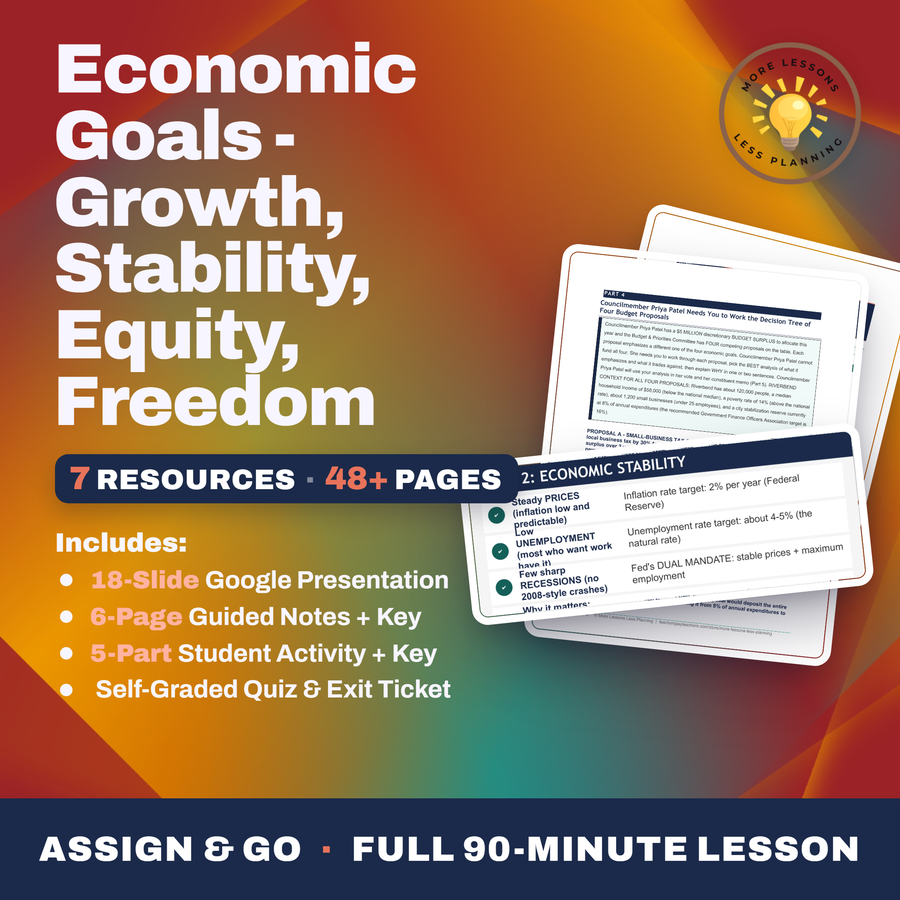

Economic Goals - Growth, Stability, Equity, Freedom
Quality reviewed September 2026
- Grades
- Grades 9-12
- Time
- About two 50-minute class periods
- Includes
- 11 ready-to-teach files
- Format
- Word (.docx) · PowerPoint (.pptx)
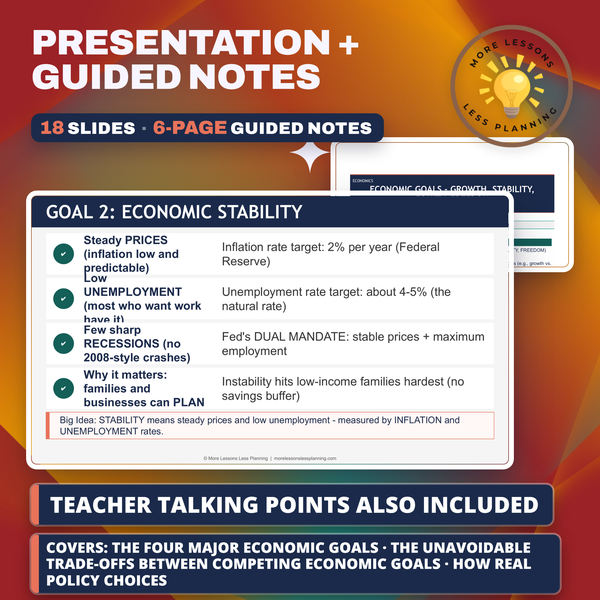
- Slide deck
- Guided notes
- Guided notes teacher key
- Activity + answer key
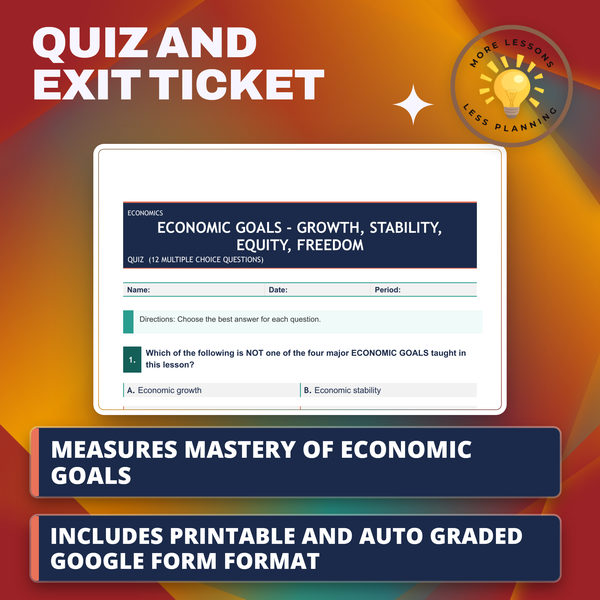
- Quiz + answer key
- Exit ticket + answer key
- Teacher guide
- Teacher presentation notes
What students do
- Define each of the four economic goals and name its headline measure, from GDP to the Gini coefficient
- Analyze real policies, including progressive taxation, antitrust enforcement, and the 2009 stimulus, as goal-priority statements
- Work through four competing proposals for a $5 million city budget surplus and name what each advances and trades against
- Write a constituent memo defending a councilmember's budget vote using the four-goals framework
What it covers
- The four goals, growth, stability, equity, and freedom, and their headline measures, including the Gini coefficient
- Two classic trade-offs, growth versus equity in tax-cut debates and freedom versus stability in deregulation
- Real policy case studies, the 1981 tax cuts, the 1999 Glass-Steagall repeal and 2008 crisis, and the 2009 stimulus
- A four-proposal city budget decision, a tax credit, a rainy-day fund, equity programs, and deregulation, with real trade-offs
Learning targets
- Identify the four major ECONOMIC GOALS (GROWTH, STABILITY, EQUITY, FREEDOM) and define each in plain terms a high school student can use
- Explain the unavoidable TRADE-OFFS between competing economic goals (e.g., growth vs. equity, freedom vs. stability) using concrete examples
- Analyze how real policy choices (progressive taxation, stimulus spending, deregulation, antitrust enforcement, minimum-wage laws) reflect a society's GOAL PRIORITIES
- Apply the four-goals framework to a real local-government budget decision and defend a prioritized allocation in writing
Peek inside
Every economy needs a way to MEASURE whether it is working
Without GOALS you cannot evaluate any policy or system
Goals are the shared definition of economic success
Different societies prioritize different goals
Most economists agree on the SAME FOUR goals
Why Goals Matter
Every economy needs a way to whether it is working.
Without GOALS you cannot any policy or system.
Goals are the shared definition of economic .
Different prioritize different goals.
Most economists agree on the same goals.
1. Economists say you cannot maximize all four economic goals at once because advancing one usually means giving up some of another. Giving up some of one goal to get more of another is called a - .
Why this matters
Government policy always secretly picks favorites among four goals, growth, stability, equity, and freedom, even when no candidate ever says so out loud. The 1999 repeal of Glass-Steagall traded stability for freedom and helped produce the 2008 crisis less than a decade later.
Handing students an actual five million dollar city surplus and four competing proposals keeps the four goals from staying abstract. A tax credit, a rainy-day fund, and an equity program all sound reasonable alone, so the real skill is naming what each one sacrifices.
From one teacher to another
I challenge students to name one policy that advances all four economic goals at once, and by the end of the lesson they can't, because that policy doesn't exist. Every real choice trades some growth, stability, equity, or freedom for more of another. They see it play out in three actual policies, progressive taxation prioritizing equity over freedom, the 1999 banking deregulation that helped trigger 2008, and the 2009 stimulus trading long-term debt for short-term stability, and then they become budget advisors to a city councilmember with a $5 million surplus and four competing proposals, from a small-business tax credit to a rainy-day fund. What I like about the final vote is that any of the four answers earns full credit as long as the student can name what it advances and what it costs. I'm grading the trade-off reasoning, not the politics.
Every file in this toolkit
-
Activity (Student)
Councilmember Priya Patel needs a four-goals matrix filled in before students score four surplus proposals worth $5 million, a small-business tax cut, a stabilization deposit, a housing and after-school package, and a permitting overhaul, then defend one using Riverbend's own numbers.
-
Activity (Answer Key)
Full credit in this key goes to any of the four surplus votes as long as students name the specific goal each advances and what it trades away, with sample defenses citing Riverbend's 14 percent poverty rate and its 8 percent reserve fund.
-
Exit Ticket (Student)
The three items ask which item on the list is not a real economic goal, which goal progressive taxation most clearly serves, and how the four goals relate to each other in practice. The quick write ties a current policy to one goal it advances and one it trades against.
-
Exit Ticket (Answer Key)
Dominance is the false fourth goal listed, equity is the one progressive taxation serves, and trade-offs describe the relationship tying all four together. Scoring the quick write means naming the policy, the goal advanced, the goal traded against, and the vote defense.
-
Guided Notes (Student)
Four blanks name the framework behind economic growth, price and job stability, a fair distribution of income, and market freedom, then trade-offs get worked through the 1981 tax cuts that widened inequality and a $787 billion stimulus weighed against future debt.
-
Guided Notes (Teacher Key)
Answer keys fix the Gini coefficient at 0.41 for the U.S. against 0.27 for Scandinavia, rank the U.S. at 25th on freedom's global index, and name the 1911 Standard Oil breakup plus the 2001 Microsoft case as antitrust examples of that framework.
-
Quiz (Student)
A dozen items test the Gini coefficient as a headline measure, ask which goal progressive taxation and deregulation each advance, and revisit Councilmember Priya Patel's $5 million surplus vote.
-
Quiz (Answer Key)
The Gini coefficient ties to the equity goal, antitrust gets marked as advancing growth and freedom at once, and the workforce-housing grant stands as Councilmember Patel's clearest pick for the surplus.
-
Slides
A Gini coefficient near 0.41 appears on the equity slide while three real policies run through the same four-goal test, the 1999 Glass-Steagall repeal, tax brackets from 10% to 37%, and the 2009 stimulus, before a closing slide names all four goals again.
-
Teacher Guide
A country-comparison extension has students rank Norway, Singapore, Cuba, and South Korea on real GDP per capita, inflation, unemployment, and the Gini coefficient, then name which goal each nation prioritizes.
-
Teacher Presentation Notes
Standard Oil's 1911 breakup and a 2001 Microsoft case get cited as the same antitrust logic in miniature, and the script then pairs the 1999 Glass-Steagall repeal with the 2008 crisis it preceded by nine years.
Download
Where should I send the next one?
Everything here is free and it stays that way. Leave your email and I'll send you the new lessons as they go up. You can unsubscribe from any one of them.
Related resources
Economic Systems - Capitalism vs Socialism vs Mixed
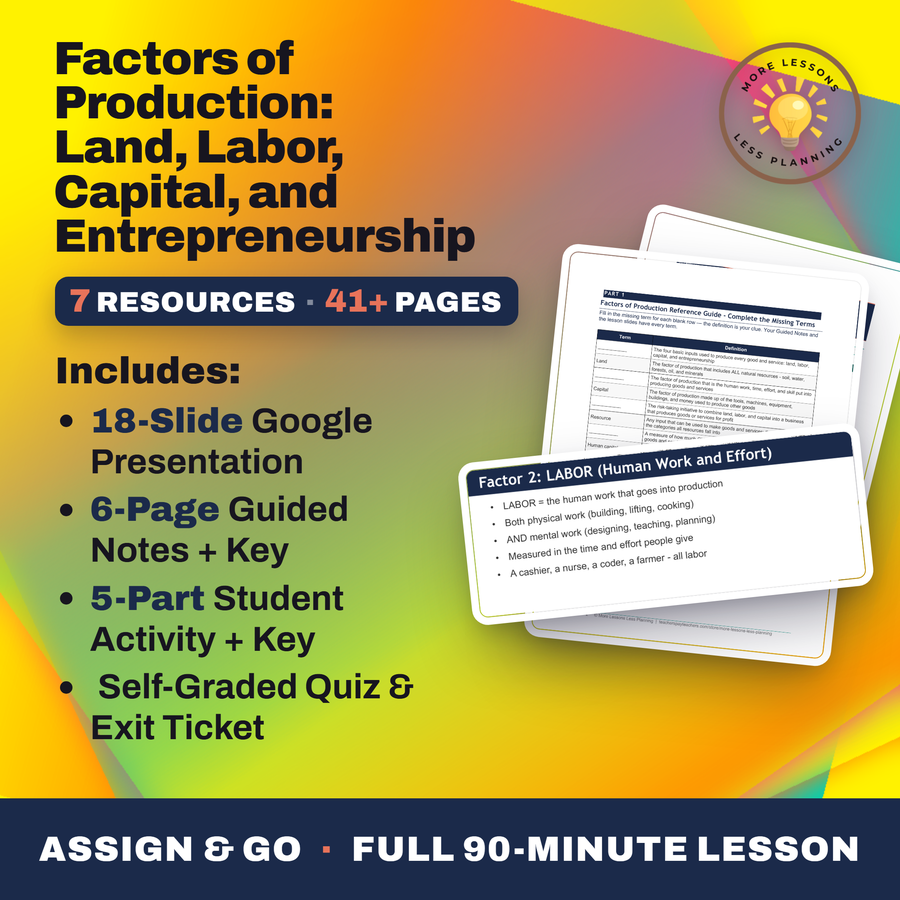
Factors of Production - Land, Labor, Capital, and Entrepreneurship
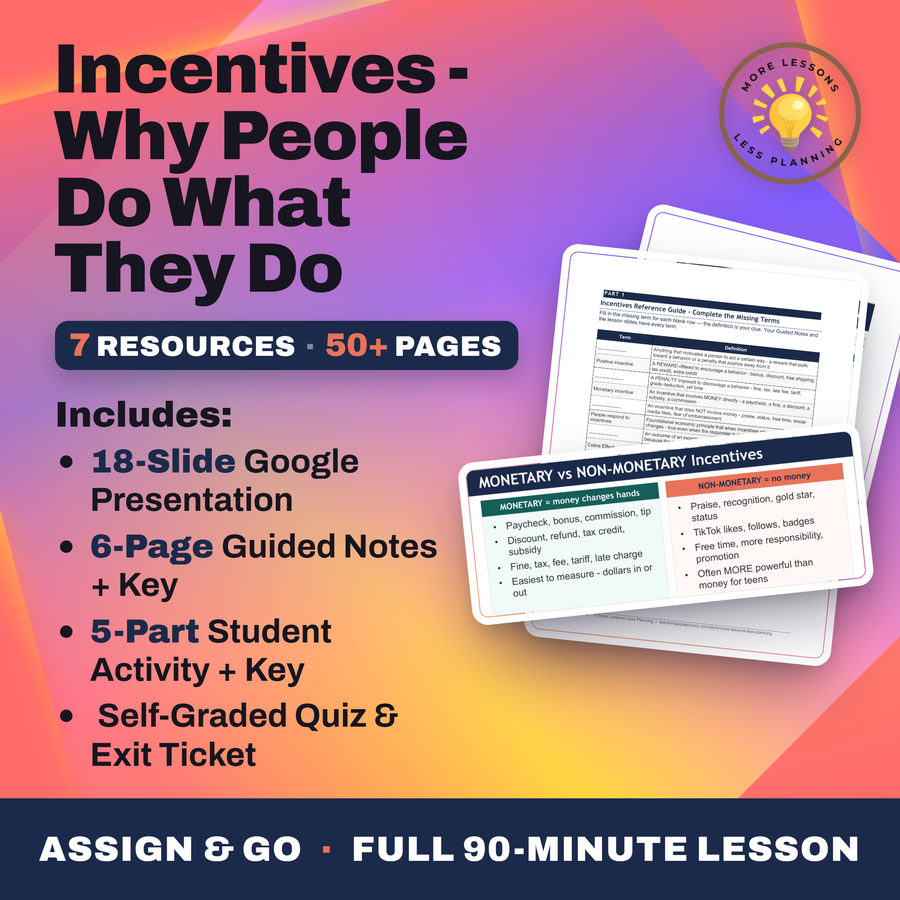
Incentives - Why People Do What They Do

Needs vs Wants - Marketings Biggest Trick
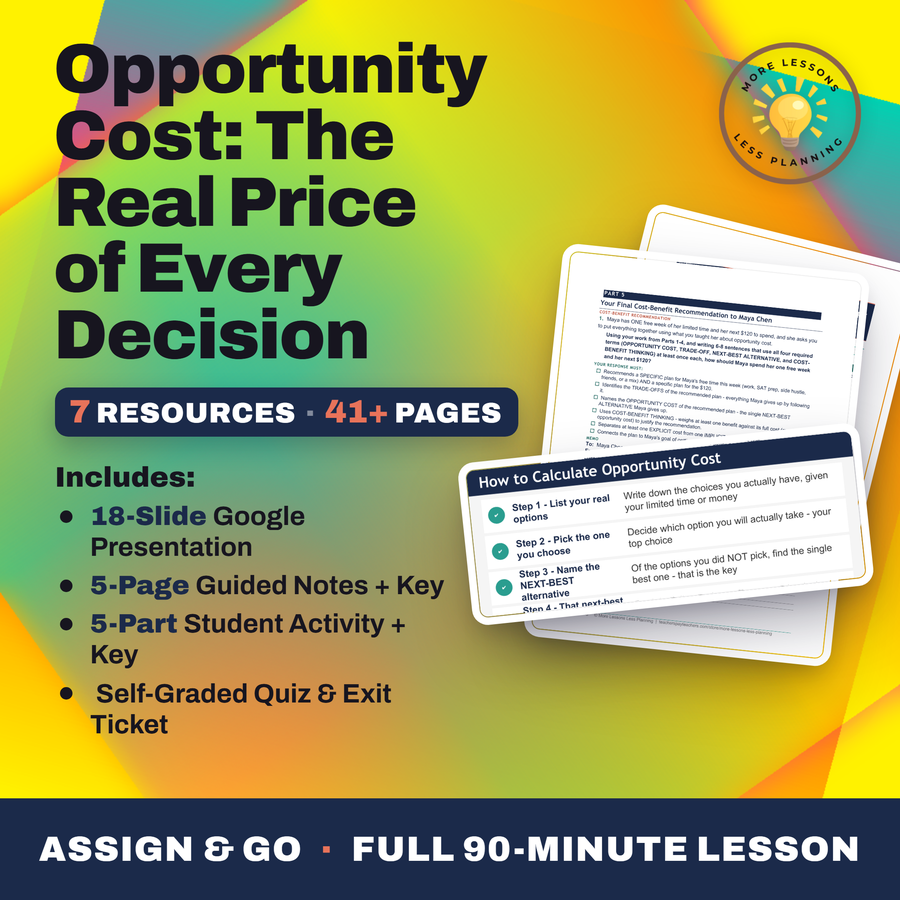
Opportunity Cost - The Real Price of Every Decision
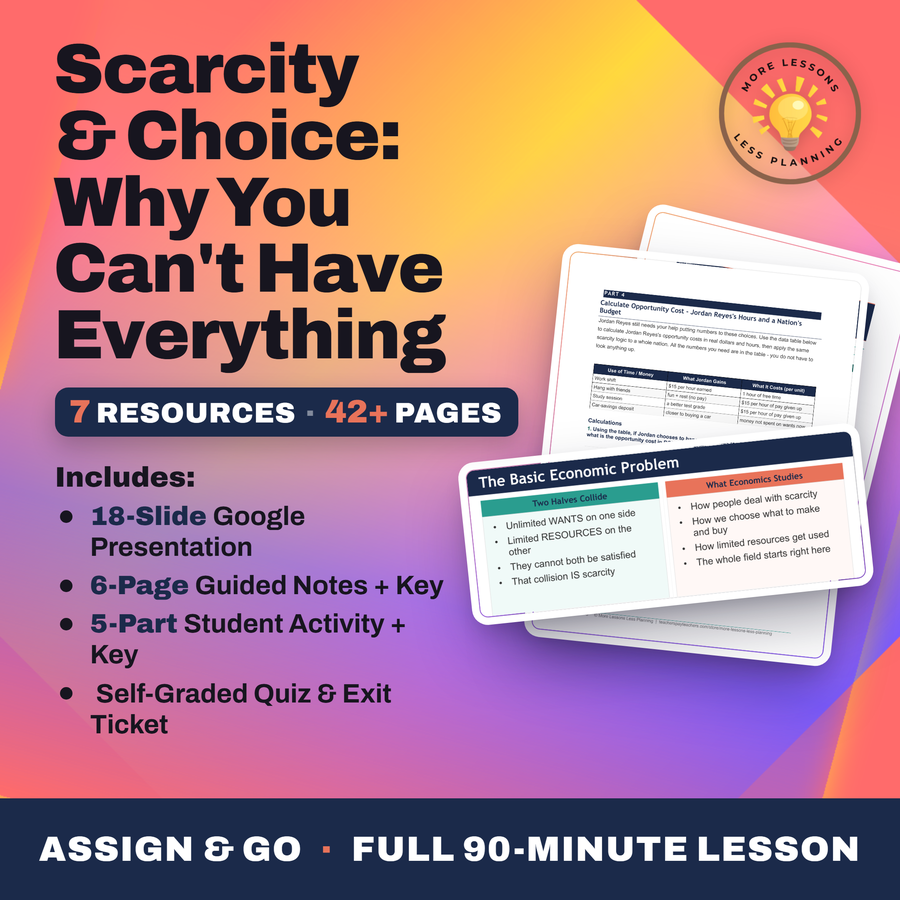
Scarcity & Choice - Why You Cant Have Everything
Every lesson on this site is free to download and use. If one of them saved you a prep period, you can chip in a few bucks toward my three kids' daycare fund. That's genuinely where tips go.