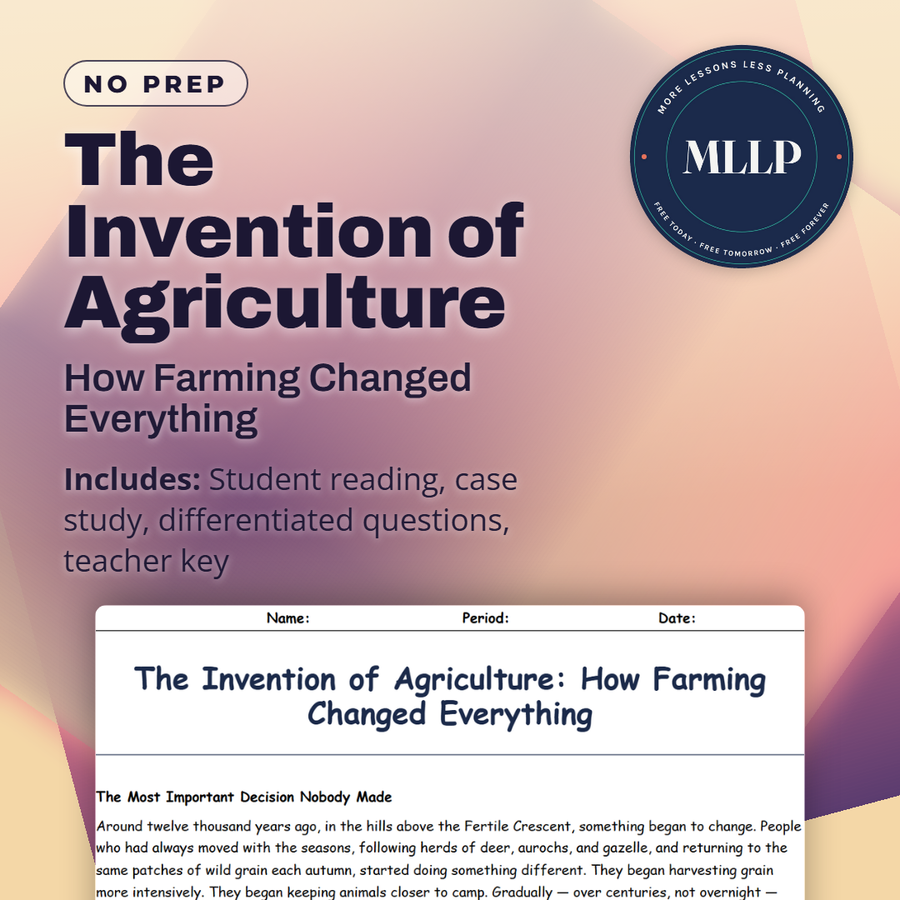
The Invention of Agriculture: How Farming Changed Everything
Quality reviewed September 2026
Facts verified September 21, 2026
- Subject
- Social Studies
- Grades
- Grades 9-12
- Length
- 9-page student worksheet
- Time
- About one 50-minute class period
- Great for
- Sub plans and independent work
- Includes
- Reading passage, comprehension questions + full answer key
- Format
- Print-and-go PDF
What students do
- Domesticated wheat's non-shattering grain gets compared with its wild ancestor to show what selective breeding actually changed
- Compare the health costs early farmers faced, more cavities, more disease, longer hours, against what foragers experienced
- Mira and Dannu's argument at Jericho gets used to weigh farming's benefits against what foraging still offered
- Explain how food storage created the first conditions for social inequality in early farming communities
What it covers
- The real difference between taming an animal and fully domesticating it
- Health costs of farming, including more cavities and disease, compared to foraging
- How food storage at early sites like Jericho created the first conditions for inequality
Start reading this worksheet
The Most Important Decision Nobody Made
Around twelve thousand years ago, in the hills above the Fertile Crescent, something began to change. People who had always moved with the seasons, following herds of deer, aurochs, and gazelle, and returning to the same patches of wild grain each autumn, started doing something different. They began harvesting grain more intensively. They began keeping animals closer to camp. Gradually, over centuries and not overnight, they began to plant seeds deliberately and tend the resulting crops. They began to stay. The transition from foraging to farming, called the Neolithic Revolution, was not a sudden invention or a deliberate decision by any individual or group. It was a slow, gradual process that unfolded independently in multiple locations around the world: in the Fertile Crescent around 10000 BCE, in China around 7000 BCE, in Mexico around 5000 BCE, in West Africa around 3000 BCE. In the Fertile Crescent, the wild ancestors of wheat (emmer and einkorn), barley, lentils, peas, and flax grew naturally in the hills. The wild ancestors of goats, sheep, pigs, and cattle roamed the same landscape. The region was almost uniquely suited for the transition to agriculture, which is one reason why it happened there first.
Domestication: What It Actually Means
Domestication is not simply taming. A tamed animal is one that has learned to tolerate human presence. A domesticated animal is one that has been genetically changed through selective breeding, deliberately or unconsciously, so that it is fundamentally different from its wild ancestor. Domesticated wheat does not shatter when its grain heads ripen, because shattering would cause the seeds to fall to the ground before humans could harvest them; wild wheat shatters because that is how it disperses its seeds. Domesticated sheep are less aggressive, more docile, and produce more wool than their wild ancestors. These changes happened because humans, over many generations, kept the individuals that were easiest to work with and planted seeds from the highest-yielding plants. The process of domestication was gradual and partly unconscious. Early farmers were not conducting deliberate breeding experiments. They were simply harvesting what was available, tending what grew, and keeping animals that were useful. But the cumulative effect of these choices, over hundreds of generations, was profound genetic change. By about 8000 BCE, the wheat grown in the Fertile Crescent was already distinctly different from its wild ancestor, and it was being grown in places far from where wild wheat naturally occurred, meaning people were deliberately planting and tending it rather than just harvesting what appeared naturally.
The Price of Farming: Health, Labor, and Inequality
Agriculture transformed human life in ways both positive and deeply negative. On the positive side: it allowed much larger populations to live in one place. A farming community could support perhaps 50 to 100 people per square kilometer, far more than a foraging group, which might require several square kilometers per person. This made possible the growth of villages, then towns, then cities. It created the surplus food that freed some people from farming to specialize in crafts, religion, administration, and military service. But the health consequences of the transition to farming were often severe. Archaeological evidence from skeletal remains at early agricultural sites shows dramatic increases in dental cavities (from the carbohydrate-rich grain diet), evidence of nutritional deficiencies, and signs of infectious disease spreading more easily in densely settled communities. Foragers generally had more diverse diets and better overall health than early farmers. They also worked fewer hours. Studies of modern foraging groups suggest that foragers spend approximately 20 hours per week obtaining food, far less than early farmers, who faced the physical demands of plowing, planting, weeding, harvesting, and processing grain. Agriculture also created the conditions for social inequality in ways that foraging generally did not. When food can be stored, it can be owned. When it can be owned, some people can accumulate more than others. When accumulation is possible, hierarchies emerge, and those hierarchies tend to become self-reinforcing. The domestication of plants and animals eventually led to the domestication of human labor as well, in the form of slavery and serfdom.
Like what you read? The full reading, the case study, and every question set are in the free download below, along with the answer key.
Why this matters
Every student eating lunch today is living with the consequences of a decision nobody actually made on purpose, according to this reading, a slow drift from foraging into farming that started because storable grain and manageable herds were sitting in the same hills people already knew. The case study's Mira and Dannu argue about it directly, better health and shorter hours on Dannu's side, walls and stored grain against hunger on Mira's. The reading does not resolve who was right, and that is worth sitting with, because most of what feels permanent about how people live, cities, property, stored wealth, even inequality, traces back to choices this small and this gradual. Recognizing that big structural change in a society often starts with something as unglamorous as which hillside had good wild barley is a useful habit of mind well beyond this one topic.
From one teacher to another
Farming began slowly and independently in several parts of the world, starting around 10000 BCE in the Fertile Crescent, where wild wheat, barley, and the ancestors of goats and sheep already grew and lived in the same hills where people were gathering and hunting. The reading draws a sharp line between taming an animal and domesticating it, showing how traits like non-shattering wheat grains developed over hundreds of generations of humans simply keeping what worked best. Students then weigh the actual costs of the shift: skeletal evidence shows early farmers had more cavities, more nutritional deficiencies, and worked longer hours than foragers did, and the ability to store food created the first real conditions for owning more than your neighbor. A case study puts a brother and sister at Jericho on opposite sides of that exact argument, one wanting to keep building walls and granaries, the other wanting to leave for better hunting.
What you get
Download
Where should I send the next one?
Everything here is free and it stays that way. Leave your email and I'll send you the new lessons as they go up. You can unsubscribe from any one of them.
Related resources

Babylon and the Hanging Gardens: Myth or Reality?

Cuneiform: The World's First Writing System

Gobekli Tepe: The Temple That Rewrote History

Hammurabi's Code: Justice Carved in Stone

Looting and Loss: The Destruction of Iraq's Heritage
Mesopotamia and the Fertile Crescent: Where Civilization Began
Every lesson on this site is free to download and use. If one of them saved you a prep period, you can chip in a few bucks toward my three kids' daycare fund. That's genuinely where tips go.