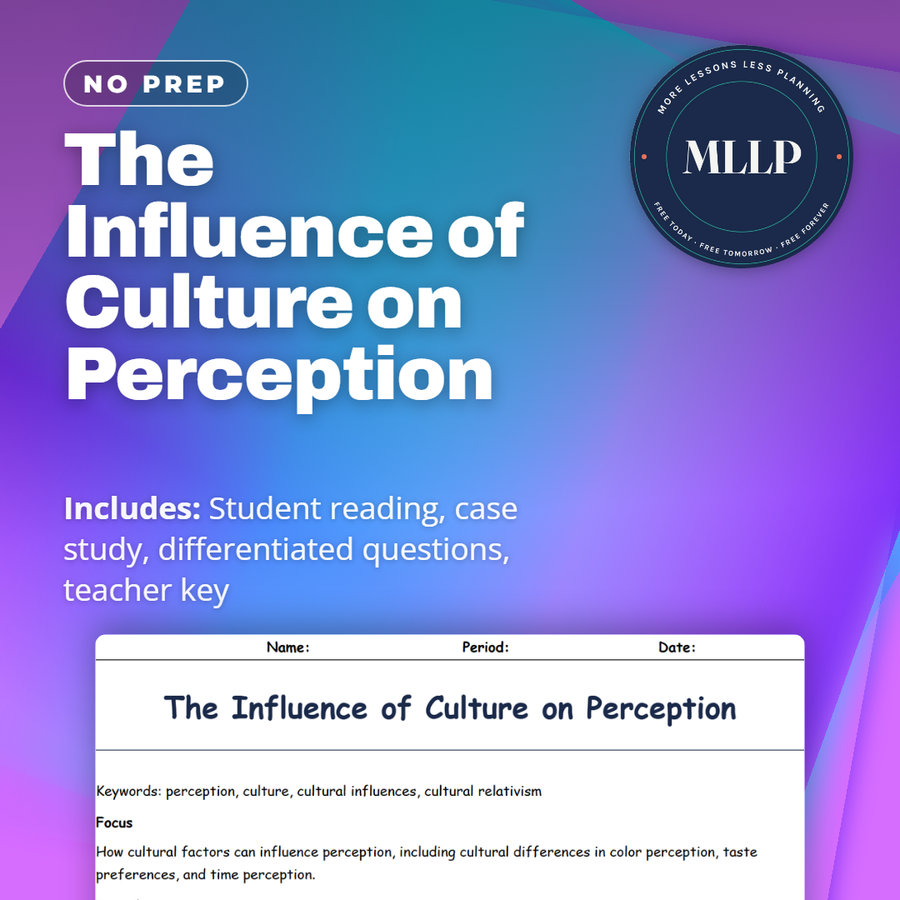
The Influence of Culture on Perception
Quality reviewed September 2026
Facts verified September 10, 2026
- Subject
- Social Studies
- Grades
- Grades 9-12
- Length
- 6-page student worksheet
- Time
- About one 50-minute class period
- Great for
- Sub plans and independent work
- Includes
- Reading passage, comprehension questions + full answer key
- Format
- Print-and-go PDF
What students do
- Match monochronic time, polychronic time, cultural relativism, and taste preferences to their definitions
- Fill in the blank naming perception, time perception, and color perception
- Explain the role of socialization in shaping taste preferences in a short-answer response
- Read the Kelly case study excerpt and explain how his view of perception differs from a purely biological approach
What it covers
- Cultural differences in color perception, including the Berlin and Kay color-term study
- Cultural influences on taste preferences and the use of spices across cultures
- Monochronic and polychronic views of time and how they shape business practices
Start reading this worksheet
Keywords: perception, culture, cultural influences, cultural relativism
Focus
How cultural factors can influence perception, including cultural differences in color perception, taste preferences, and time perception.
Introduction
Perception, the process of interpreting sensory information, is not solely a biological function. It is deeply intertwined with our cultural experiences. Culture, the shared beliefs, values, and customs of a group, shapes how we perceive the world around us. This reading will explore how cultural factors can influence perception, focusing on color perception, taste preferences, and time perception.
Like what you read? The full reading, the case study, and every question set are in the free download below, along with the answer key.
Why this matters
Color is not a fixed list waiting to be perceived the same way everywhere. The Berlin and Kay color-term study in this reading shows that the vocabulary a culture has for color shapes what gets noticed, the opposite of how most students assume vision works.
By the time students reach the Kelly case study and compare his account of perception to a purely biological one, the color-term study has already unsettled the idea that perception happens the same way in every brain. Monochronic and polychronic views of time carry that same point into the business world, where whether a schedule feels fixed or flexible turns out to be a perceptual habit, not a universal rule.
From one teacher to another
I use this reading when we talk about how much of perception is learned rather than hardwired, since students are usually surprised that something like color vocabulary differs by culture. My students match terms like monochronic time and cultural relativism to their definitions, then read the Kelly case study excerpt to explain how his view of perception differs from a purely biological one. The short-answer questions ask them to discuss how time perception can shape business practices and how socialization shapes taste preferences.
What you get
Download
Where should I send the next one?
Everything here is free and it stays that way. Leave your email and I'll send you the new lessons as they go up. You can unsubscribe from any one of them.
Related resources

Illusions: The Mind's Tricks
Perception: The Brain's Interpretation
Sensation: The Gateway to Perception

Sensory Disorders and Challenges

The Five Senses: A Closer Look
The Future of Perception Technology
Every lesson on this site is free to download and use. If one of them saved you a prep period, you can chip in a few bucks toward my three kids' daycare fund. That's genuinely where tips go.