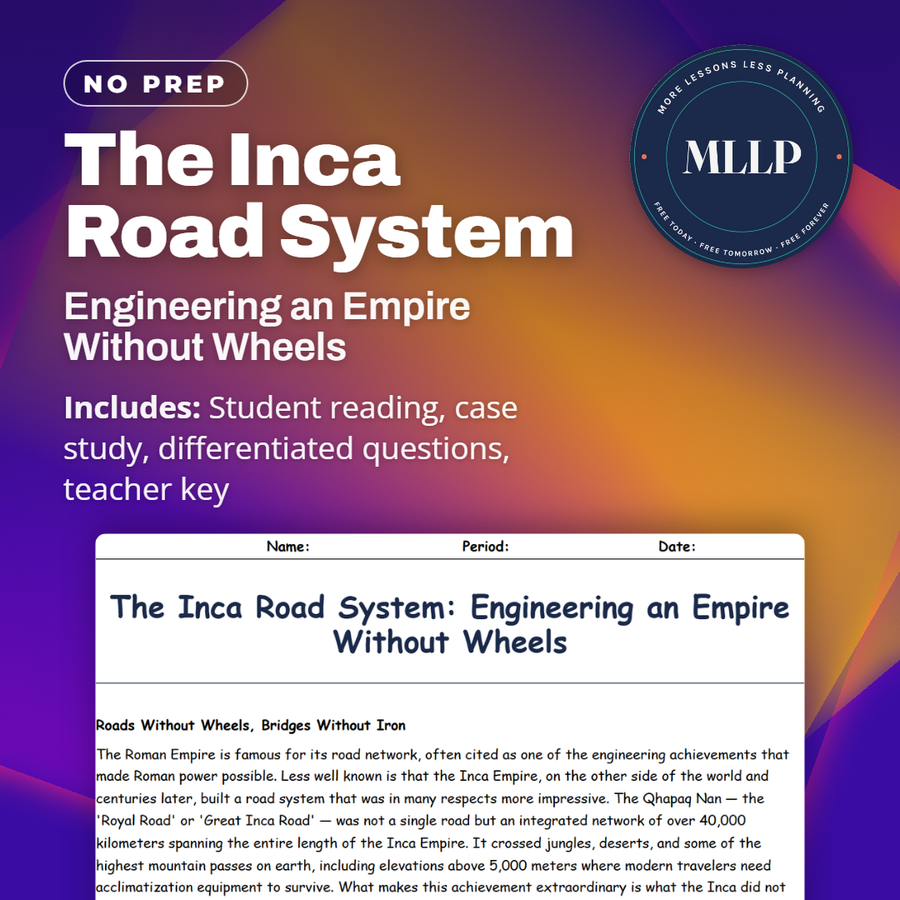
The Inca Road System: Engineering an Empire Without Wheels
Quality reviewed September 2026
Facts verified September 21, 2026
- Subject
- Social Studies
- Grades
- Grades 9-12
- Length
- 9-page student worksheet
- Time
- About one 50-minute class period
- Great for
- Sub plans and independent work
- Includes
- Reading passage, comprehension questions + full answer key
- Format
- Print-and-go PDF
What students do
- Kusi crosses a rope bridge two hundred meters above a gorge as part of an ordinary chasqui workday
- Explain how tambos let Inca armies march without carrying or foraging for food
- Quito-to-Cusco message times of five to seven days get set against a road built with no wheels
- Match terms like Qhapaq Nan and Q'eswachaka to the part of the system each describes
What it covers
- Over 40,000 kilometers of Inca road built without wheels, iron, or draft animals
- The chasqui relay system that could move a message 2,000 kilometers in a week
- Tambo supply stations and the annual rebuilding of the Q'eswachaka rope bridge today
Start reading this worksheet
Roads Without Wheels, Bridges Without Iron
The Roman Empire is famous for its road network, often cited as one of the engineering achievements that made Roman power possible. Less well known is that the Inca Empire, on the other side of the world and centuries later, built a road system that was in many respects more impressive. The Qhapaq Nan (the 'Royal Road' or 'Great Inca Road') was not a single road but an integrated network of over 40,000 kilometers spanning the entire length of the Inca Empire. It crossed jungles, deserts, and some of the highest mountain passes on earth, including elevations above 5,000 meters where modern travelers need acclimatization equipment to survive. What makes this achievement extraordinary is what the Inca did not have. They had no wheeled vehicles, a technology present in the Old World for thousands of years but independently uninvented in the Andes. They had no horses or oxen as draft animals; the largest domesticated animal in the Inca world was the llama, capable of carrying about 40 kilograms. They had no iron tools. The roads were built using stone, earth, and hand labor, organized through the mit'a system in which every community in the empire contributed labor to the state. The result was a communications and logistics network that allowed Inca armies to march, goods to move, and information to travel across thousands of kilometers at remarkable speed.
What the Road System Looked Like
The Qhapaq Nan had two main arterial routes running north-south: a coastal route along the Pacific lowlands and a highland route through the Andes mountains. These were connected by hundreds of lateral roads running east-west. The width of roads varied by terrain and function: major arteries might be 6-8 meters wide and paved with fitted stone; narrow mountain paths might be just 1-2 meters across, cut into cliff faces or crossed by stone steps carved directly into the rock. In flat desert regions, the road was marked by stone walls on either side. In marshy lowlands, it was built up on a raised causeway. In mountain areas, it was cut into the hillside or built out on stone retaining walls. The Inca solved the problem of river crossings (some of the most challenging engineering problems in pre-modern road building) with suspension bridges. These rope bridges, woven from ichu grass or other plant fibers, could span lengths of over 60 meters. They required regular maintenance and replacement and were the responsibility of local communities living near each bridge. The last Inca-design grass rope bridge still in operation, the Q'eswachaka bridge over the Apurimac River, is rebuilt annually by local Quechua communities as a living cultural practice.
The Chasqui: Human Internet of the Inca Empire
Information in the Inca Empire traveled via a relay system of runners called chasquis. Small stations called chasqui wasin were spaced approximately 2 kilometers apart along all major roads, close enough for a runner to sprint from one to the next at full speed. Each station held two or more runners who were always ready to receive a message and immediately sprint it to the next station. Using this relay system, a message or small package could travel from Quito (in modern Ecuador) to Cusco (in Peru), a distance of roughly 2,000 kilometers, in approximately five to seven days. This was comparable to, and in some conditions faster than, European message systems of the same era that relied on horses. The chasquis carried verbal messages (memorized and repeated at each station), quipus (the knotted cord records), and small physical items of high value. Historical accounts describe fresh fish from the coast arriving in Cusco for the emperor's table within two days of being caught, a journey that would take weeks on foot without the relay system. The physical evidence for chasqui stations comes from archaeological surveys of the road network, which have identified hundreds of small structures at regular intervals along the main routes.
Like what you read? The full reading, the case study, and every question set are in the free download below, along with the answer key.
Why this matters
It is easy to assume that wheels and horses are what make large scale infrastructure possible, and the Inca road system is direct evidence against that assumption. Every kilometer of the Qhapaq Nan, every tambo, and every chasqui relay ran on organized human labor contributed through the mit'a system, coordination that modern logistics students would recognize immediately. Kusi getting scolded for a bridge delay caused by a flood nobody could control says something bigger about how demanding that system was on the people who kept it running. The Q'eswachaka bridge shows that some of that same knowledge is still alive and rebuilt by hand every year.
From one teacher to another
Kusi runs a section of Inca road for a living, sprinting a fixed stretch between two stations before handing a quipu record to the next chasqui in line. His ordinary workday is the reading's way into a road network most students have never heard of. The Qhapaq Nan covered more than 40,000 kilometers of desert, jungle, and mountain pass, built by a civilization with no wheeled vehicles, no horses, and no iron tools. Students see how the pieces worked together, tambos stocked with food and gear roughly a day's march apart, rope bridges woven from ichu grass that could span more than 60 meters, and a chasqui relay fast enough to get a message from Quito to Cusco in about a week. The reading ends with the Q'eswachaka bridge, the last one still rebuilt every year using the original technique by a Quechua community that treats the rebuild as a living tradition rather than a museum exhibit.
What you get
Download
Where should I send the next one?
Everything here is free and it stays that way. Leave your email and I'll send you the new lessons as they go up. You can unsubscribe from any one of them.
Related resources
Aztec Daily Life: Markets, Schools, and Chocolate
Aztec Human Sacrifice: Separating Fact from Propaganda

Descendant Communities Today: Living Heritage of the Americas
Inca Child Sacrifice: Capacocha and the Mountain Mummies
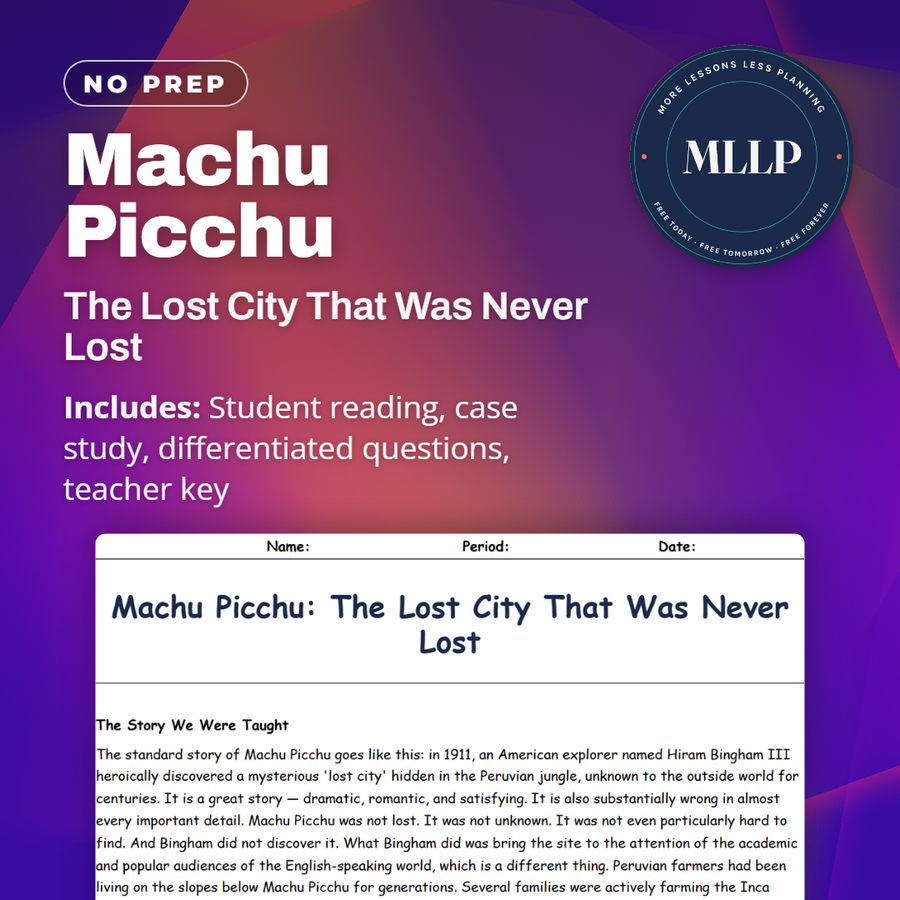
Machu Picchu: The Lost City That Was Never Lost
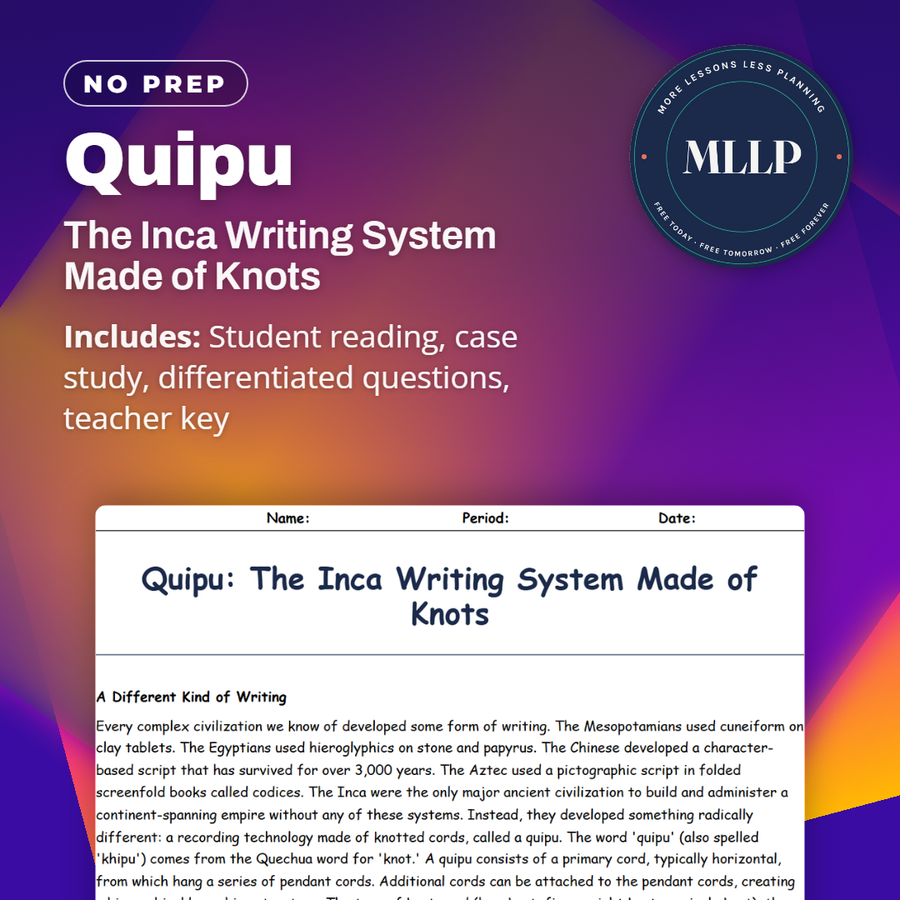
Quipu: The Inca Writing System Made of Knots
Every lesson on this site is free to download and use. If one of them saved you a prep period, you can chip in a few bucks toward my three kids' daycare fund. That's genuinely where tips go.