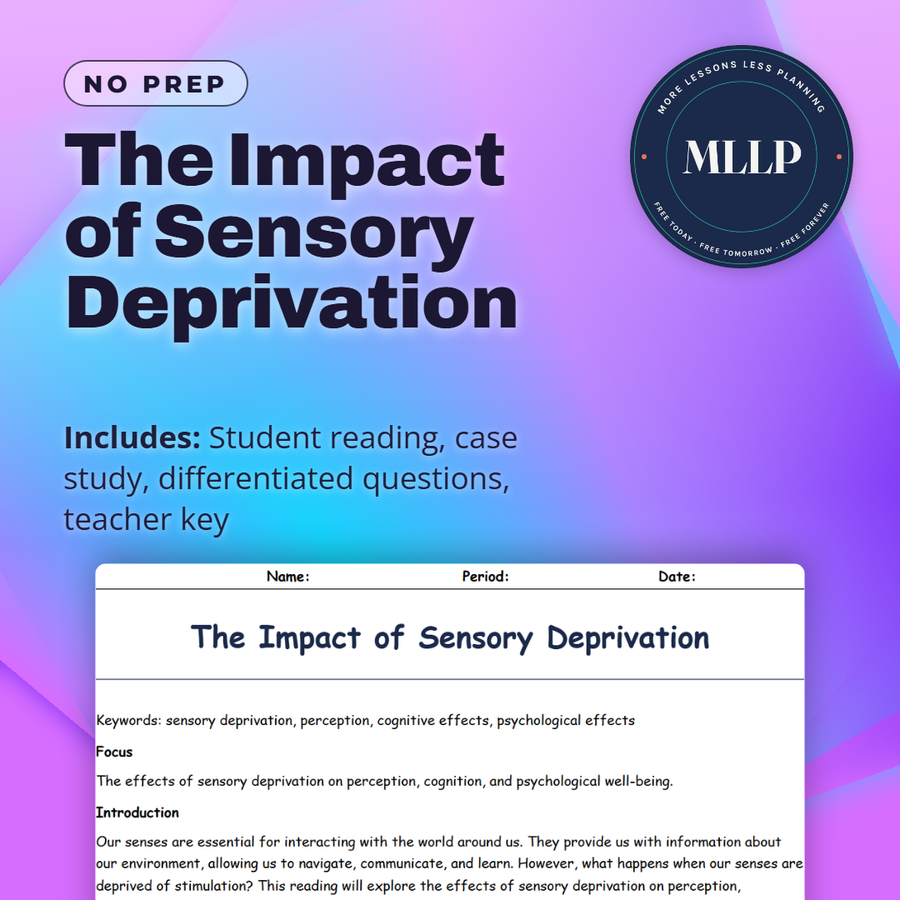
The Impact of Sensory Deprivation
Quality reviewed September 2026
Facts verified September 10, 2026
- Subject
- Social Studies
- Grades
- Grades 9-12
- Length
- 6-page student worksheet
- Time
- About one 50-minute class period
- Great for
- Sub plans and independent work
- Includes
- Reading passage, comprehension questions + full answer key
- Format
- Print-and-go PDF
What students do
- Match sensory deprivation, hallucinations, cognitive impairments, and emotional disturbances to their definitions
- Fill in the blank naming hallucinations and cognitive impairments
- Explain why the results of sensory deprivation experiments may not reflect everyday experience in a short-answer response
- Read the Zuckerman case study excerpt and describe the cognitive effects observed after 24 hours without sensory input
What it covers
- Sensory deprivation experiments and how researchers minimize sensory stimulation
- The effects of sensory deprivation on perception, including hallucinations and distorted time sense
- The cognitive and emotional effects of sensory deprivation, such as difficulty concentrating and anxiety
Start reading this worksheet
Keywords: sensory deprivation, perception, cognitive effects, psychological effects
Focus
The effects of sensory deprivation on perception, cognition, and psychological well-being.
Introduction
Our senses are essential for interacting with the world around us. They provide us with information about our environment, allowing us to navigate, communicate, and learn. However, what happens when our senses are deprived of stimulation? This reading will explore the effects of sensory deprivation on perception, cognition, and psychological well-being.
Like what you read? The full reading, the case study, and every question set are in the free download below, along with the answer key.
Why this matters
A lab that removes almost every sensory input for a full day sounds like an experiment in boredom, but the effects run further: hallucinations, a distorted sense of time, trouble concentrating, real anxiety. The Zuckerman case study in this reading tracks the cognitive side of that stretch, describing what changed after 24 hours with almost no sensory input to process.
I like watching students push back on the experiment itself once they see how extreme the conditions were: a result from near-total sensory shutdown may not predict much about an ordinary quiet room. That skepticism is the payoff: hallucinations and a warped sense of time become claims worth doubting, not settled facts.
From one teacher to another
I use this reading after we cover the basics of sensation, since it shows students what happens when the senses get almost nothing to work with. My students match terms like hallucinations and cognitive impairments to their definitions, then read the Zuckerman case study excerpt to describe what happened to his subjects after 24 hours without sensory input. The short-answer questions ask them to explain why findings from these experiments may not reflect everyday life, since most people never face prolonged deprivation.
What you get
Download
Where should I send the next one?
Everything here is free and it stays that way. Leave your email and I'll send you the new lessons as they go up. You can unsubscribe from any one of them.
Related resources
Illusions: The Mind's Tricks
Perception: The Brain's Interpretation
Sensation: The Gateway to Perception
Sensory Disorders and Challenges
The Five Senses: A Closer Look
The Future of Perception Technology
Every lesson on this site is free to download and use. If one of them saved you a prep period, you can chip in a few bucks toward my three kids' daycare fund. That's genuinely where tips go.