The Home Front
Quality reviewed September 2026
- Grades
- Grades 9-12
- Time
- About two 50-minute class periods
- Includes
- 11 ready-to-teach files
- Format
- Word (.docx) · PowerPoint (.pptx)
- Slide deck
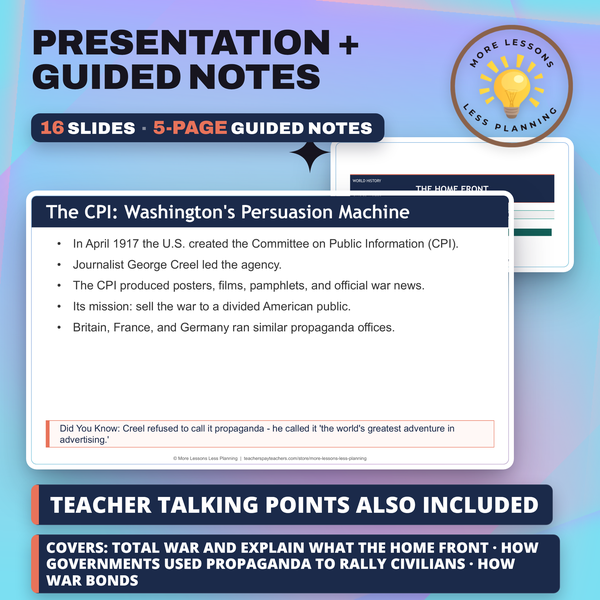
- Guided notes
- Guided notes teacher key
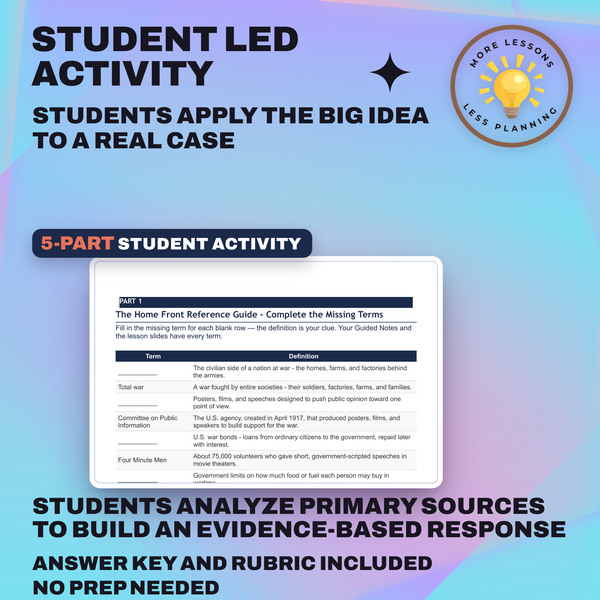
- Activity + answer key
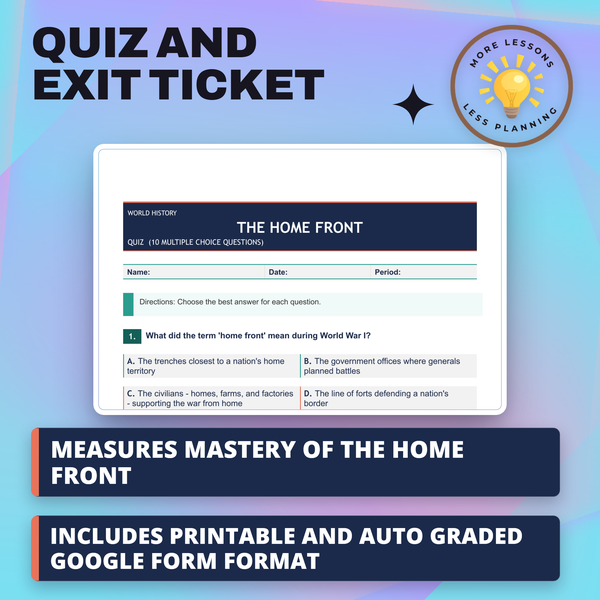
- Quiz + answer key
- Exit ticket + answer key
- Teacher guide
- Teacher presentation notes
What students do
- Define total war and explain what the home front was
- Explain how the Committee on Public Information used propaganda to rally civilians
- Compare food conservation in the United States with rationing in Europe
- Argue how the war changed work, rights, and free speech at home
What it covers
- How war bonds and the Four Minute Men's short theater speeches financed and sold the war
- Government rationing, victory gardens, and conscription on the home front
- Key vocabulary including total war, propaganda, Liberty Bonds, and censorship
Learning targets
- Define total war and explain what the home front was.
- Explain how governments used propaganda to rally civilians.
- Describe how war bonds and the Four Minute Men financed the war.
- Compare food conservation in the United States with rationing in Europe.
- Analyze how the war changed work, rights, and free speech at home.
Peek inside
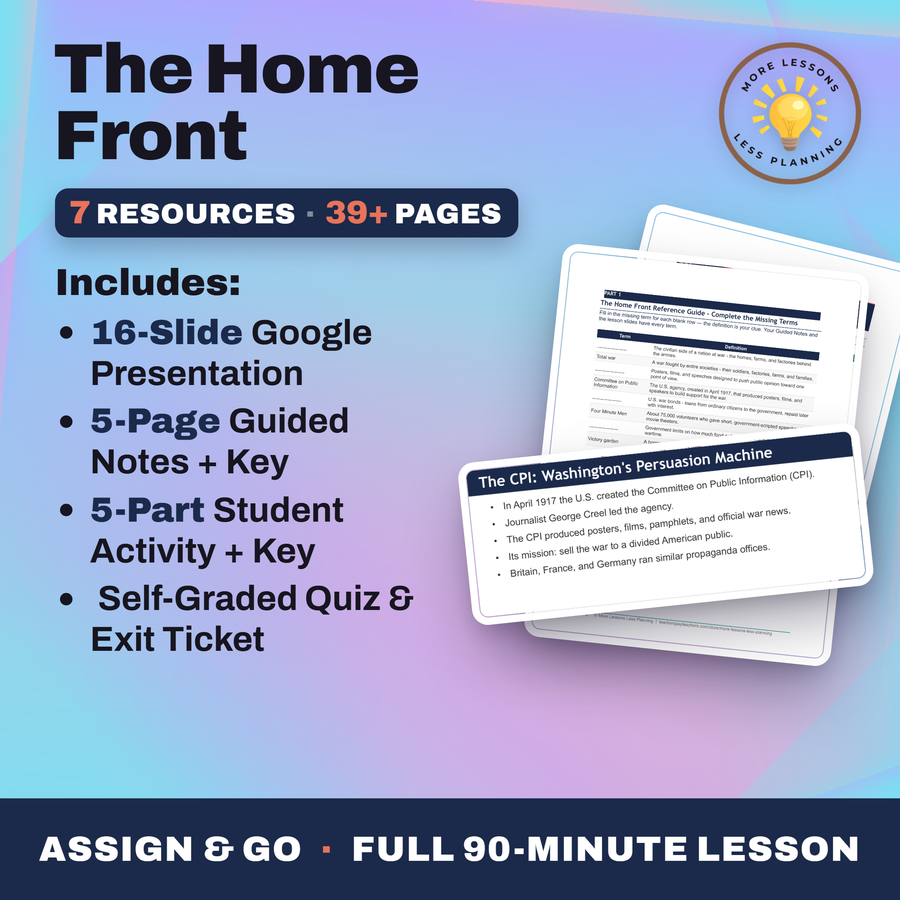
By 1917 the Great War was swallowing whole economies, not just armies.
Historians call this total war: a war fought by entire societies.
The home front: the civilians - homes, farms, factories - behind the armies.
Every shell, uniform, and loaf of bread began as civilian work.
Governments needed civilians' money, food, labor, and loyalty.
A War Fought by Whole Societies
Historians call a war fought by entire societies war.
The front means the civilians - homes, farms, and factories - behind the armies.
Governments needed civilians' money, food, , and loyalty.
1. A British family's weekly sugar and meat were limited by government coupon books in 1918. This system was called .
Why this matters
A theater speech squeezed between movie reels did as much to keep World War I funded as any battlefield, and this lesson keeps the fighting offstage to make that point. The Committee on Public Information sent Four Minute Men into movie houses to sell Liberty Bonds, while rationing and victory gardens turned kitchens into another front nobody enlisted for.
What a war asks of people who never leave home is easy to miss in a battle-focused unit, and students tend to underrate it until they see how much of the effort ran through theaters and kitchens. Food conservation here, set against rationing in Europe, gives them a way to measure that sacrifice rather than just assert it.
From one teacher to another
This lesson keeps the war off the battlefield entirely and puts it in kitchens, movie theaters, and factory floors instead, because that's where most people actually experienced it. Students read a real Four Minute Men script, then have to weigh it against food conservation and rationing back home before answering the question the exit ticket asks straight out: do posters and speeches win wars, or do armies? I like ending on a question without a clean answer.
Every file in this toolkit
Download
Where should I send the next one?
Everything here is free and it stays that way. Leave your email and I'll send you the new lessons as they go up. You can unsubscribe from any one of them.
Related resources
Alliances and the Causes of WWI
America Enters the War
New Weapons of War
Rise of Totalitarianism
The Assassination at Sarajevo
The Great Depression
Every lesson on this site is free to download and use. If one of them saved you a prep period, you can chip in a few bucks toward my three kids' daycare fund. That's genuinely where tips go.