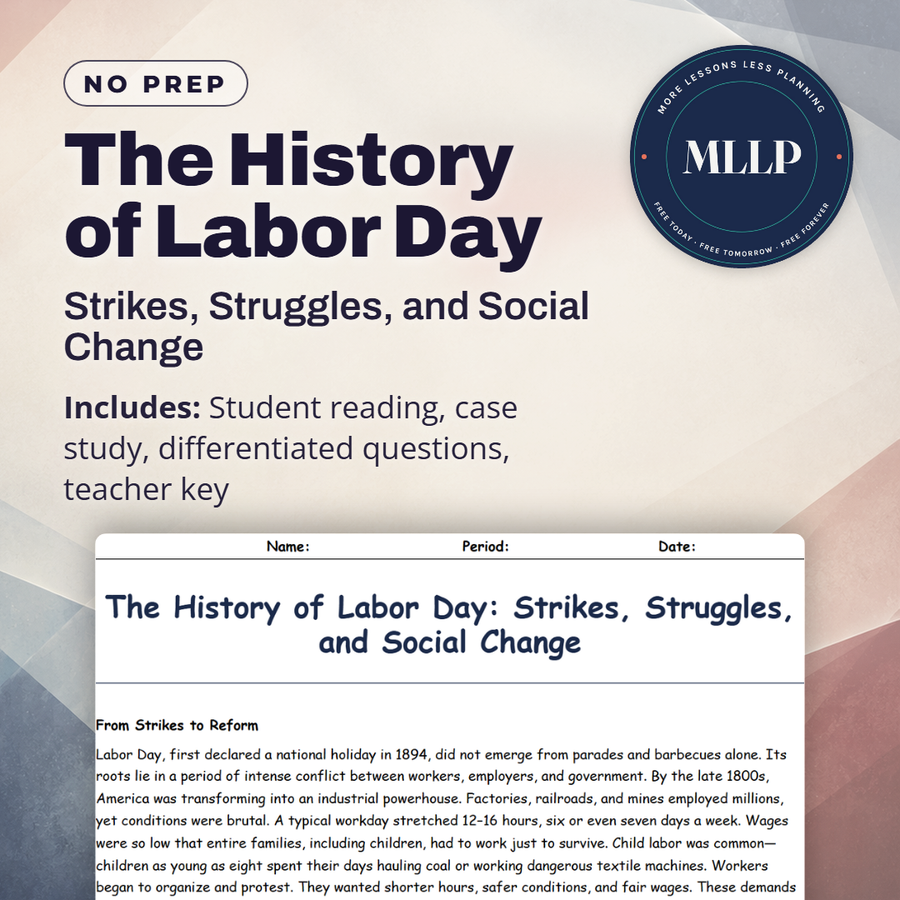
The History of Labor Day: Strikes, Struggles, and Social Change
Quality reviewed September 2026
Facts verified September 9, 2026
- Subject
- Social Studies
- Grades
- Grades 9-12
- Length
- 7-page student worksheet
- Time
- About one 50-minute class period
- Great for
- Sub plans and independent work
- Includes
- Reading passage, comprehension questions + full answer key
- Format
- Print-and-go PDF
What students do
- Trace the connection between violent strikes and the reforms that followed
- Analyze a worker's 1890 speech to explain why people saw labor rights as tied to democracy
- Examine the Haymarket Affair and Memorial Day Massacre to understand the cost of organizing
- Evaluate whether reforms like the Fair Labor Standards Act answered workers' demands
What it covers
- Labor movement history from the 1880s to 1930s
- Major strikes and labor tragedies
- Labor legislation and worker victories
Start reading this worksheet
From Strikes to Reform
Labor Day, first declared a national holiday in 1894, did not emerge from parades and barbecues alone. Its roots lie in a period of intense conflict between workers, employers, and government. By the late 1800s, America was transforming into an industrial powerhouse. Factories, railroads, and mines employed millions, yet conditions were brutal. A typical workday stretched 12–16 hours, six or even seven days a week. Wages were so low that entire families, including children, had to work just to survive. Child labor was common—children as young as eight spent their days hauling coal or working dangerous textile machines. Workers began to organize and protest. They wanted shorter hours, safer conditions, and fair wages. These demands were not only economic but moral, rooted in the belief that democracy should extend into the workplace. If America prided itself on liberty, workers argued, then they deserved dignity and protection on the job. Yet business owners, backed by politicians and police, often resisted fiercely. Strikes and rallies were sometimes met with violence, arrests, or even deadly force. Out of this turbulent era came the idea of a holiday that honored the contributions of workers, but the path to that recognition was bloody.
The Haymarket Affair and the Eight-Hour Day
One of the earliest and most dramatic labor clashes was the Haymarket Affair of 1886. That year, workers across the nation launched strikes to demand an eight-hour workday. In Chicago, a city with a strong labor tradition, thousands marched and rallied. On May 4, a peaceful gathering in Haymarket Square turned chaotic when an unknown person threw a bomb at police officers. The explosion killed several officers and civilians, and police responded with gunfire, leaving more dead and injured. The aftermath shocked the nation. Eight anarchists, all labor activists, were arrested and accused of conspiracy, though evidence against them was weak. Four were executed, becoming martyrs for the labor movement. To many Americans, the bombing confirmed fears of radicalism and unrest, but to workers, it symbolized the high cost of demanding basic rights. The Haymarket Affair left a lasting legacy: it propelled the eight-hour workday into national debate and inspired May Day (International Workers’ Day) around the world. In the U.S., it deepened the sense that labor rights required recognition at the highest levels.
The Pullman Strike and the Birth of Labor Day
Just eight years later, another violent conflict forced the federal government to act. The Pullman Strike of 1894 began when workers at the Pullman Company near Chicago protested wage cuts without rent reductions in company-owned housing. The strike spread nationwide, halting railroad traffic and disrupting mail delivery. President Grover Cleveland faced enormous pressure. Railroads were vital to the economy, and when mail service stopped, the strike became a national crisis. Cleveland ordered federal troops to intervene. Violence erupted, leaving more than 20 workers dead. Public opinion split sharply—some blamed the strikers for lawlessness, while others condemned the government for siding with business. In an effort to calm tensions and acknowledge workers’ importance, Cleveland signed a law declaring Labor Day a federal holiday. While symbolic, the move showed that the government could not ignore the growing power of organized labor. Labor Day became a yearly recognition of workers’ contributions, even though the struggles for fair treatment were far from over.
Like what you read? The full reading, the case study, and every question set are in the free download below, along with the answer key.
Why this matters
Haymarket turned deadly when a bomb was thrown at police during a peaceful eight-hour-day rally, and four anarchist activists were executed as scapegoats afterward. The Pullman Strike killed more than twenty workers. The Triangle fire burned one hundred forty-six people to death in a single afternoon.
Those numbers are the reason this earns real class time rather than a passing mention on a timeline. Students read a worker's 1890 speech and start to understand that demanding an eight-hour day and a safer building was never framed as radical by the people asking for it, it was framed as survival, which is a harder claim to dismiss than a slogan.
From one teacher to another
Haymarket turned deadly when someone threw a bomb at police during a peaceful eight-hour-day rally, then four anarchist activists were executed as scapegoats. The Pullman Strike killed over 20 workers. Triangle burned 146 to death. Yet these tragedies pushed reforms that outlasted all the violence. Students read a worker's plea for fairness and see why demanding dignity in the workplace wasn't radical, it was survival.
What you get
Download
Where should I send the next one?
Everything here is free and it stays that way. Leave your email and I'll send you the new lessons as they go up. You can unsubscribe from any one of them.
Related resources
Forensic Files: Violence and Crime in America’s Labor Strikes
Labor Day and Government: Policy, Rights, and Reform
Labor Day and Health: Workplace Safety and the Human Body
The Economics of Labor Day: Wages, Unions, and the Marketplace
Altitude, Cold Stress, and Human Adaptation: How the Body Stays in Balance
American History and Cinco de Mayo: Cultural Exchange and Historical Narratives
Every lesson on this site is free to download and use. If one of them saved you a prep period, you can chip in a few bucks toward my three kids' daycare fund. That's genuinely where tips go.