
The Gutenberg Printing Press
Quality reviewed September 2026
- Grades
- Grades 9-12
- Time
- About two 50-minute class periods
- Includes
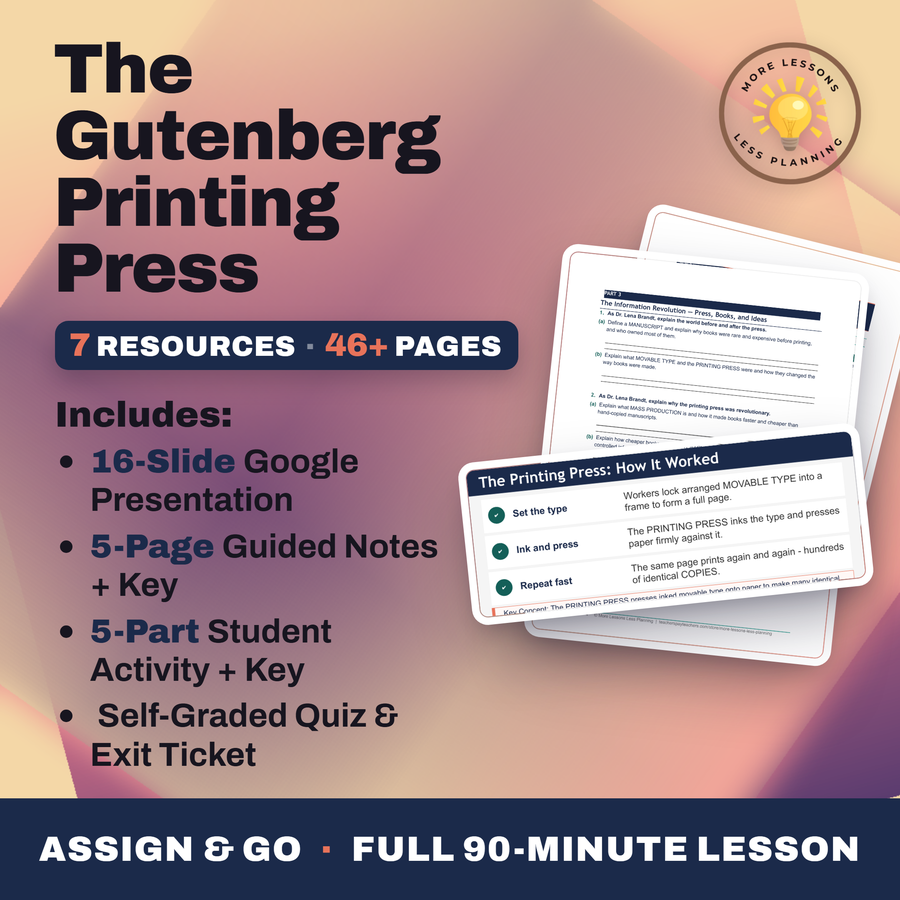
- 11 ready-to-teach files
- Format
- Word (.docx) · PowerPoint (.pptx)
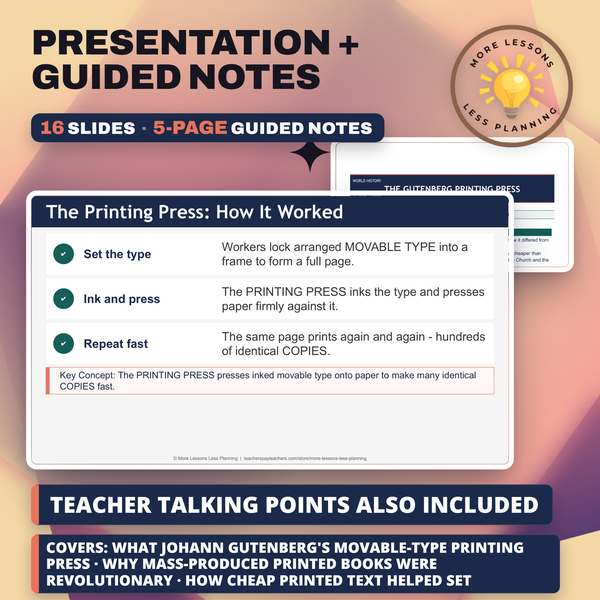
- Slide deck
- Guided notes
- Guided notes teacher key
- Activity + answer key
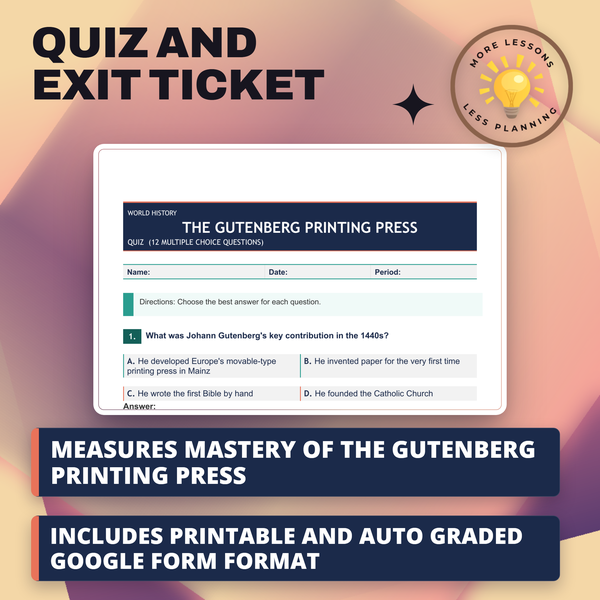
- Quiz + answer key
- Exit ticket + answer key
- Teacher guide
- Teacher presentation notes
What students do
- Define movable type and the printing press, then explain why mass production made books cheaper than hand-copied manuscripts
- Read the 1455 Helmasperger notarial instrument recording the Fust v. Gutenberg lawsuit and source it as a legal record
- Sort four true/false claims about Gutenberg, including whether he invented movable type or single-handedly caused the Reformation
- Write a 5-7 sentence museum exhibit report covering the press, mass production, honest framing, and one primary-source detail
What it covers
- How the printing press and movable type worked, and why the Gutenberg Bible of about 1455 was such a leap from hand-copied manuscripts
- The honest complication that movable type existed earlier in East Asia, including Korea's 1377 metal-type printing
- Why printing is called an enabler of the Reformation rather than its sole cause
- The 1455 court record of Fust v. Gutenberg, which shows the press as a risky, expensive business Gutenberg funded with loans and ultimately lost
Learning targets
- Explain what Johann Gutenberg's movable-type printing press was and how it differed from copying books by hand.
- Explain why mass-produced printed books were revolutionary - faster and cheaper than hand-copied manuscripts - and how this spread literacy and ideas beyond the Church and the wealthy elite.
- Describe how cheap printed text helped set the stage for the Reformation, while recognizing honestly that the press was an enabler rather than a single direct cause and that movable type existed earlier in East Asia.
- Analyze a primary source - the 1455 Helmasperger notarial instrument recording the Fust v. Gutenberg lawsuit - and explain what it reveals about the printing press as a risky, expensive new business, reading a legal record critically.
Peek inside
Before printing, every book was a MANUSCRIPT - copied by HAND.
Scribes copied books slowly, one page at a time, for months.
Hand-copied books were rare and very expensive to make.
Most books were owned by the Church, monasteries, and elites.
Ordinary people almost never owned or read their own books.
When Every Book Was Copied by Hand
Before printing, every book was a - a book or document written by hand, so books were rare and expensive.
A trained scribe copied every word by , one page at a time, for months, which is why most books were owned by the Church and elites.
1. What is the machine that presses inked movable type onto paper to make many identical pages quickly?
Why this matters
Books before this technology existed were copied by hand, one at a time, which is the fact that makes ‘mass production’ land as something real instead of a vague phrase. Once movable type made copies cheap enough to multiply fast, the same book could sit in dozens of hands within weeks instead of years.
Sorting out what Gutenberg actually did from what later generations credited him with rewards careful reading over a confident guess, since ‘he invented printing’ and ‘he caused the Reformation’ are both half right. What students should leave with is the discipline to credit a technology honestly instead of turning it into a single dramatic cause.
From one teacher to another
I don't let this one turn into "Gutenberg invented printing, the end," because that version skips the more interesting story. Students learn how movable type and the press actually worked, then get the honest complication up front: Korea printed with metal type in 1377, decades before Gutenberg, so his real achievement was building a full working system for Europe's alphabet, not a lone flash of genius. The centerpiece is the 1455 court record from the Fust v. Gutenberg lawsuit, an actual notarial document showing Gutenberg borrowed roughly 800 guilders, then 800 more, and ended up losing his own workshop when his financier sued him, and I have students read it as exactly what it is: solid proof of the money side of the story and nothing at all about how the press worked or how Gutenberg felt. Same discipline applies to the Reformation connection, where the lesson insists on "enabler, not sole cause" and backs it up with the timeline rather than a tidy one-line claim. Students finish by sorting true/false statements and writing a short exhibit report that has to hold two truths at once: Gutenberg wasn't the lone inventor, and his system still changed who controlled information in Europe.
Every file in this toolkit
Download
Where should I send the next one?
Everything here is free and it stays that way. Leave your email and I'll send you the new lessons as they go up. You can unsubscribe from any one of them.
Related resources
Leonardo da Vinci - The Renaissance Man
Luther's 95 Theses
Machiavelli's The Prince
Medici Florence and the Renaissance
Michelangelo and the Sistine Chapel Ceiling
Reformation Spreads
Every lesson on this site is free to download and use. If one of them saved you a prep period, you can chip in a few bucks toward my three kids' daycare fund. That's genuinely where tips go.