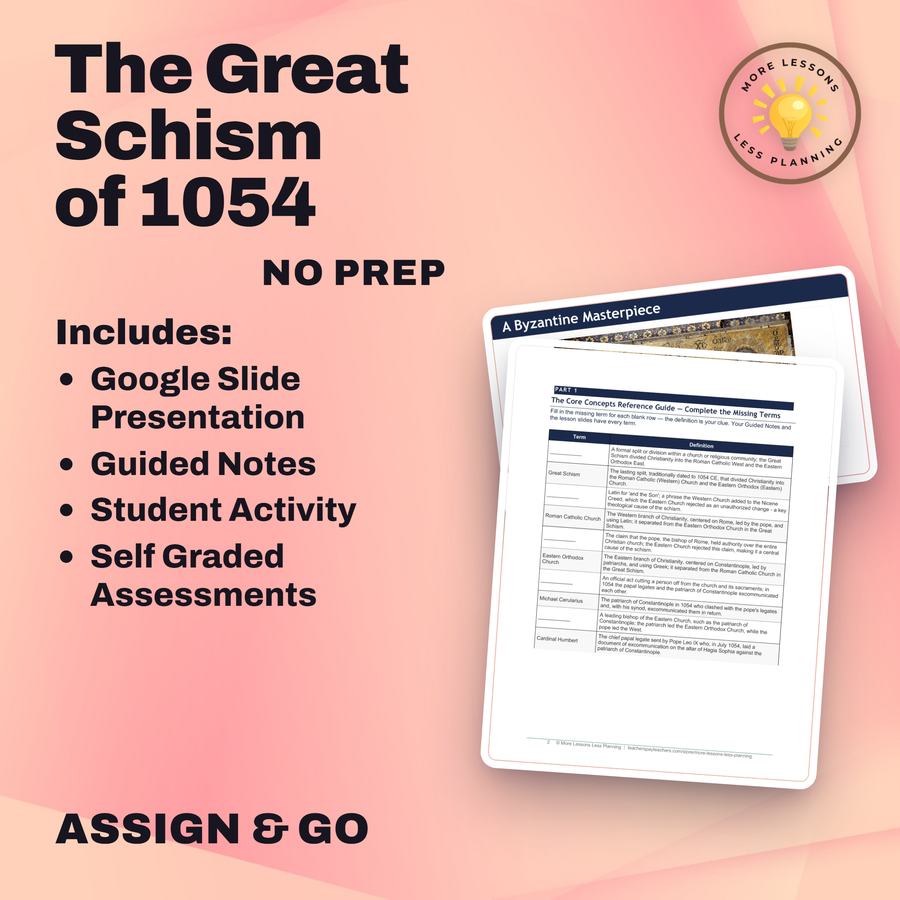

The Great Schism of 1054
- Slide deck
- Guided notes
- Guided notes teacher key
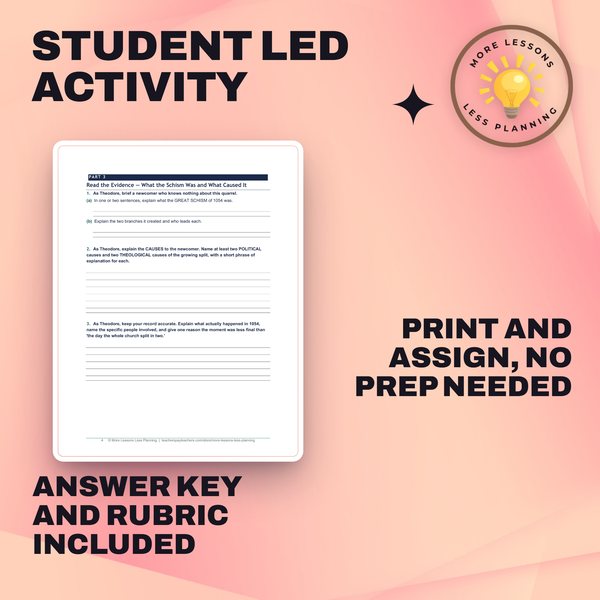
- Activity + answer key
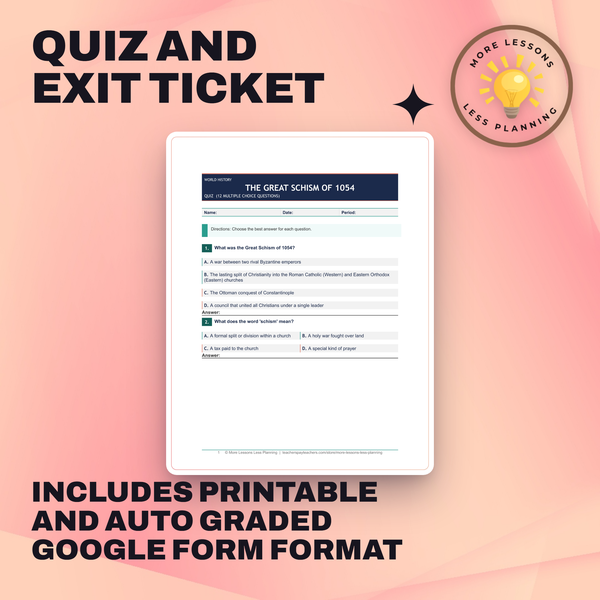
- Quiz + answer key
- Exit ticket + answer key
- Teacher guide
- Teacher presentation notes
Where should I send the next one?
Everything here is free and it stays that way. Leave your email and I'll send you the new lessons as they go up. You can unsubscribe from any one of them.
Every file in this toolkit
Related resources
Great Zimbabwe Stone City
Mansa Musa's Pilgrimage to Mecca
Songhai and Timbuktu Scholarship
The Islamic Golden Age
The Rise of Islam and the Caliphates
The Swahili Coast Trade Cities
What students do
- Analyze the actual 1054 excommunication documents as one-sided sources written to condemn the other side
- Distinguish the political causes of the split from the theological ones, like the filioque and papal supremacy
- Argue why 1054 works as a symbolic date rather than the day the churches actually broke apart
- Explain why Cardinal Humbert's excommunication was on shakier ground than students expect once they learn Pope Leo IX had already died
What it covers
- The Rome-Constantinople rivalry and what was lost when a single shared imperial authority collapsed
- The leavened-versus-unleavened bread dispute and why it mattered as much as it did
- Why many historians treat the 1204 sack of Constantinople as what truly sealed the split
- A Byzantine mosaic from Hagia Sophia shown honestly as postdating the schism by two centuries
Learning targets
- Explain what the Great Schism of 1054 was - the split of Christianity into the Roman Catholic (Western) and Eastern Orthodox (Eastern) churches - and why 1054 is a symbolic date rather than a single clean break.
- Identify the POLITICAL causes of the schism: the Rome-Constantinople rivalry, the collapse of a single shared imperial authority, and the Latin-West/Greek-East cultural divide.
- Identify the THEOLOGICAL causes of the schism: the filioque added to the Nicene Creed, the dispute over leavened versus unleavened bread, and the claim of papal supremacy.
- Analyze the mutual excommunication documents of 1054 as a primary source, reading them critically as one-sided church documents rather than neutral accounts.
From one teacher to another
Every textbook summary I've seen flattens 1054 into one clean date, so this lesson makes room for the mess instead. Students separate the political causes from the theological ones before they ever reach the actual excommunication documents, then hit the detail that gets a real reaction: Pope Leo IX was already dead when his own legate delivered the excommunication in his name. By the end they can explain why historians point to 1204, not 1054, as the year the split actually hardened.
Every lesson on this site is free to download and use. If one of them saved you a prep period, you can chip in a few bucks toward my three kids' daycare fund. That's genuinely where tips go.