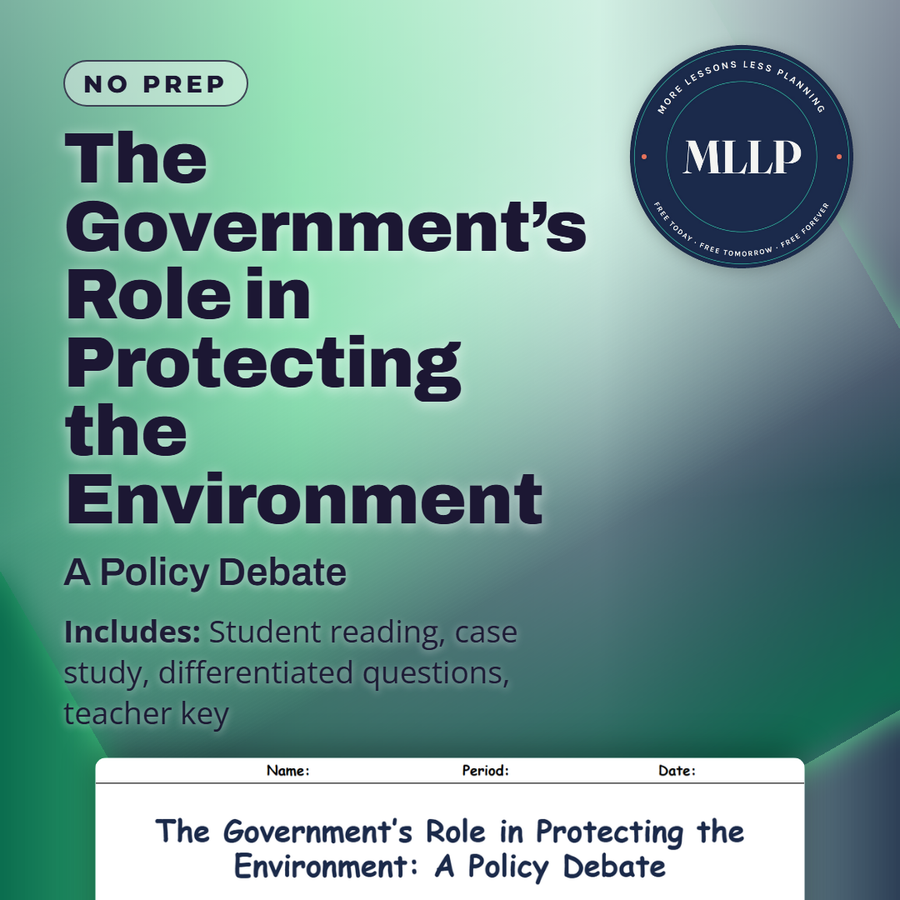
The Government’s Role in Protecting the Environment: A Policy Debate
Quality reviewed September 2026
Facts verified September 9, 2026
- Subject
- Social Studies
- Grades
- Grades 9-12
- Length
- 7-page student worksheet
- Time
- About one 50-minute class period
- Great for
- Sub plans and independent work
- Includes
- Reading passage, comprehension questions + full answer key
- Format
- Print-and-go PDF
What students do
- Debate competing positions on whether government should regulate environmental protection or rely on market forces
- Explain how the EPA enforces environmental laws using command-and-control regulations and permit systems
- Analyze a coastal community's recovery after Clean Water Act enforcement stopped industrial pollution
- Evaluate the trade-offs between economic growth and environmental protection in policy decisions
What it covers
- Environmental legislation and federal enforcement
- Regulatory approaches and economic incentives
- Balancing economic and environmental interests
Start reading this worksheet
Students analyze key environmental laws, such as the Clean Air Act, Clean Water Act, and Endangered Species Act, and evaluate their effectiveness. Includes a structured debate where students argue for or against government intervention in environmental issues.
Historical Emergence of Environmental Laws
Government involvement in environmental protection has steadily increased since the early 20th century, spurred by public concern over industrial pollution and natural resource depletion. Notable events like the Cuyahoga River catching fire in 1969 and the publication of Rachel Carson’s Silent Spring contributed to a growing awareness of pollution’s immediate and long-term dangers. Lawmakers responded by passing regulations aimed at preventing excessive emissions and water contamination. In the United States, landmark legislation such as the Clean Air Act (1970) and the Clean Water Act (1972) provided a foundational framework. These laws introduced limits on industrial discharges, set air quality standards, and established penalties for noncompliance. Over time, additional provisions were added to address emerging issues like acid rain and air toxics. The Endangered Species Act (1973) further expanded the government’s role, focusing on biodiversity protection. While industries complained of regulatory burdens, supporters argued these measures were necessary to safeguard public health and preserve natural habitats. Indeed, many credit these policies with drastically improving air and water quality, proving that targeted regulation can yield measurable results.
Mechanisms of Enforcement and Policy Tools
Environmental laws rely on enforcement agencies equipped with the authority to conduct inspections, levy fines, or halt operations in cases of serious violations. In the U.S., the Environmental Protection Agency (EPA) plays a pivotal role, coordinating with state and local entities. Policy tools vary: command-and-control regulations set strict standards, while market-based instruments—like cap-and-trade—provide economic incentives for pollution reduction. The Clean Water Act, for example, mandates technology-based effluent limits, requiring industries to adopt best available technologies to treat wastewater before releasing it into rivers or lakes. Another approach involves permit systems, where facilities obtain licenses contingent on meeting pollution thresholds. Violations can result in fines, revocation of permits, or even criminal charges. However, critics argue that enforcement can be inconsistent, especially when budget cuts limit oversight capacity. Politically motivated rollbacks also affect agencies’ abilities to enforce regulations effectively. Another issue arises from the complexity of environmental challenges that cross state and national boundaries. This reality underscores the importance of federal leadership and international cooperation in solving multifaceted environmental problems.
Like what you read? The full reading, the case study, and every question set are in the free download below, along with the answer key.
Why this matters
A coastal town's fishing industry collapsed under nitrogen pollution until Clean Water Act fines finally made compliance cheaper for the processing plants than fighting the regulation in court. The algal blooms disappeared, the fishermen got their water back, and the plants that fought hardest are still operating today.
I use this case because it refuses to let students stay comfortable on either side of the regulation argument. They start out ready to defend rules or freedom in the abstract, then have to explain why a policy that hurt one industry's short-term profits also saved another industry's long-term survival, in the same town, at the same time.
From one teacher to another
This worksheet sparks real debate. Students take sides on whether rules strangle businesses or save communities. The coastal town case is key: processing plants fought the nitrogen limits until fines made compliance cheaper than litigation. Students see that algal blooms disappeared, fishermen got their livelihoods back, but the plants still operate. It's not ideological; it's real. That's when they stop thinking regulation versus freedom and start thinking about what actually works.
What you get
Download
Where should I send the next one?
Everything here is free and it stays that way. Leave your email and I'll send you the new lessons as they go up. You can unsubscribe from any one of them.
Related resources
Earth Day: The 1970 Protest That Changed America
Environmental Crimes: The Forensic Science of Eco-Terrorism
Fast Fashion & the Environment: The Hidden Costs of Our Clothes
Land Use and Federal vs. State Power: Who Controls Natural Resources?
Oil Spills, Protests, and Policy: The Environmental Legacy of the 20th Century
The Carbon Footprint of Everyday Life: A Data Analysis Challenge
Every lesson on this site is free to download and use. If one of them saved you a prep period, you can chip in a few bucks toward my three kids' daycare fund. That's genuinely where tips go.