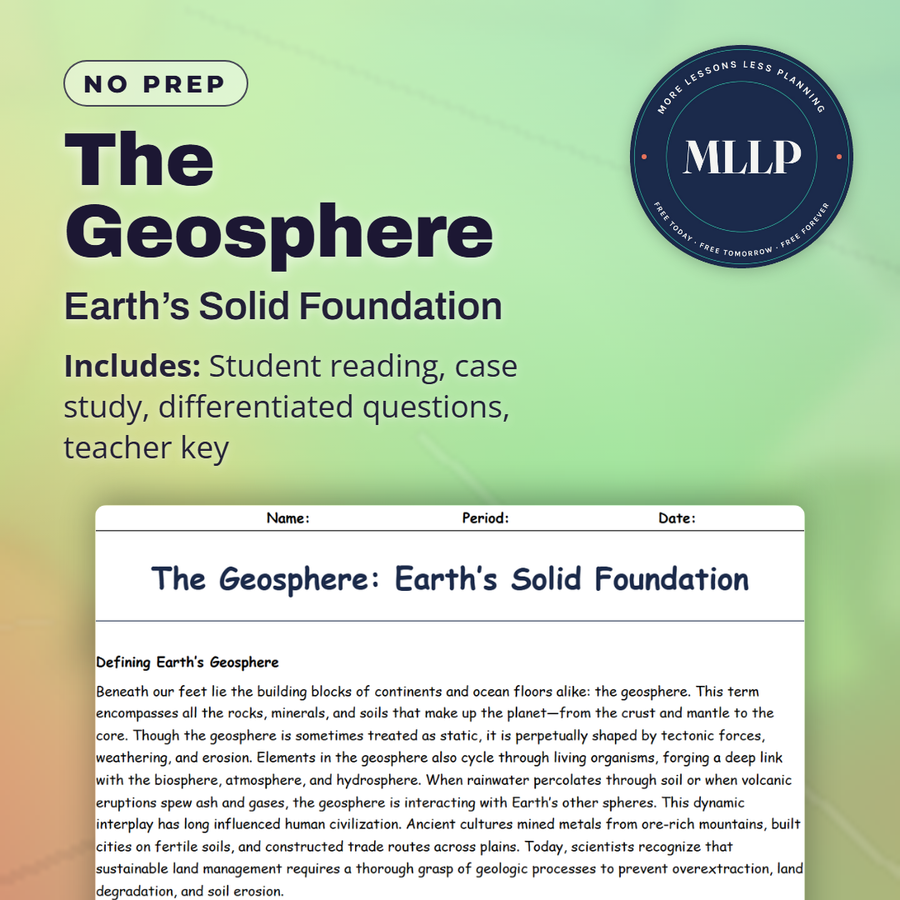
The Geosphere: Earth’s Solid Foundation
Quality reviewed September 2026
Facts verified September 14, 2026
- Subject
- Social Studies
- Grades
- Grades 9-12
- Length
- 7-page student worksheet
- Time
- About one 50-minute class period
- Great for
- Sub plans and independent work
- Includes
- Reading passage, comprehension questions + full answer key
- Format
- Print-and-go PDF
What students do
- Match terms like fault line, igneous rock, and divergent boundary to their correct definitions
- Fill in the blank sentences on the rock cycle, soil formation, and divergent boundaries
- Answer multiple choice questions on what the rock cycle explains, how soil develops, and what plate tectonics can lead to
- Write short answers on why the geosphere matters for sustainable resource management, how volcanic activity can be both helpful and hazardous, and what role soil plays in the biosphere
What it covers
- The geosphere as a whole system, including the rock cycle among igneous, sedimentary, and metamorphic rocks
- How soil forms from weathered rock and organic matter, and how earthquakes, volcanoes, and landslides reshape the land
- A case study on coastal erosion from sand mining in Drayman County, plus a reference table linking geosphere components to their processes and outcomes
Start reading this worksheet
Defining Earth’s Geosphere
Beneath our feet lie the building blocks of continents and ocean floors alike: the geosphere. This term encompasses all the rocks, minerals, and soils that make up the planet, from the crust and mantle to the core. Though the geosphere is sometimes treated as static, it is perpetually shaped by tectonic forces, weathering, and erosion. Elements in the geosphere also cycle through living organisms, forging a deep link with the biosphere, atmosphere, and hydrosphere. When rainwater percolates through soil or when volcanic eruptions spew ash and gases, the geosphere is interacting with Earth’s other spheres. This dynamic interplay has long influenced human civilization. Ancient cultures mined metals from ore-rich mountains, built cities on fertile soils, and constructed trade routes across plains. Today, scientists recognize that sustainable land management requires a thorough grasp of geologic processes to prevent overextraction, land degradation, and soil erosion.
The Rock Cycle
Central to understanding the geosphere is the rock cycle, a continuous transformation of igneous, sedimentary, and metamorphic rocks. Igneous rocks crystallize from cooling magma or lava. If this cooling occurs underground, rocks like granite form; if it happens on the surface, you may get basalt or obsidian. Sedimentary rocks emerge when sediments (such as sand, silt, or organic matter) are compacted over time. Think of limestone or sandstone. Meanwhile, metamorphic rocks like marble or gneiss develop from existing rocks that experience intense heat and pressure. Driving this cycle are plate tectonics and surface processes. Colliding plates can push rocks deep underground, heating and compressing them into new forms. Conversely, uplift brings rock layers to the surface, where wind and water break them down into sediments. Over vast timescales, no single rock remains the same. This continuous recycling shapes mountain belts, ocean floors, and even the soil we rely on for farming.
Soils and Their Formation
While rock underpins the geosphere, soil forms its fertile skin. Soil arises from weathered rock, organic matter, and countless microorganisms. Climate plays a crucial role: more rainfall accelerates chemical weathering, while cooler temperatures slow decomposition. Topography matters too, as steep slopes lose soil to erosion, while valleys accumulate thick layers. Soil composition influences agriculture, water filtration, and carbon storage. As human populations grow, the need to preserve topsoil becomes urgent. Over-farming, deforestation, and overgrazing can strip away the protective ground layer, leading to desertification or landslides. Conservation practices, such as crop rotation, contour plowing, and reforestation, help maintain this thin yet vital resource. Equally important is monitoring soil contamination from chemicals or industrial waste, ensuring the food chain remains safe.
Like what you read? The full reading, the case study, and every question set are in the free download below, along with the answer key.
Why this matters
Rock does not stay one kind of rock forever. The rock cycle moves it among igneous, sedimentary, and metamorphic forms, the same cycle that produces the soil the biosphere depends on. The Drayman County case study on coastal erosion from sand mining shows what happens when people interrupt that system.
Soil, rock, and hazards like earthquakes read as three unrelated topics until the reference table lines up each geosphere process with its outcome. I connect soil formation and coastal erosion as two ends of the same rock cycle so a mining decision in one county stops looking like an isolated story and starts looking like a system responding to pressure.
From one teacher to another
I like that this one frames the geosphere as one connected system instead of separate topics, so the rock cycle and soil formation sections build toward the hazards passage instead of feeling separate. The Drayman County case study on sand mining and coastal erosion gives students a concrete example of how disrupting the geosphere has real consequences. It works well as a wrap-up reading after units on rocks, soil, or plate tectonics.
What you get
Download
Where should I send the next one?
Everything here is free and it stays that way. Leave your email and I'll send you the new lessons as they go up. You can unsubscribe from any one of them.
Related resources
Biomes & Ecosystems: Life Across Earth’s Habitats
Climate vs. Weather: Understanding the Difference
Convergent Boundaries: Where Plates Collide
Deserts: Survival in the Harshest Climates

Divergent Boundaries: Where Plates Pull Apart
Earth’s Layers: From Crust to Core
Every lesson on this site is free to download and use. If one of them saved you a prep period, you can chip in a few bucks toward my three kids' daycare fund. That's genuinely where tips go.