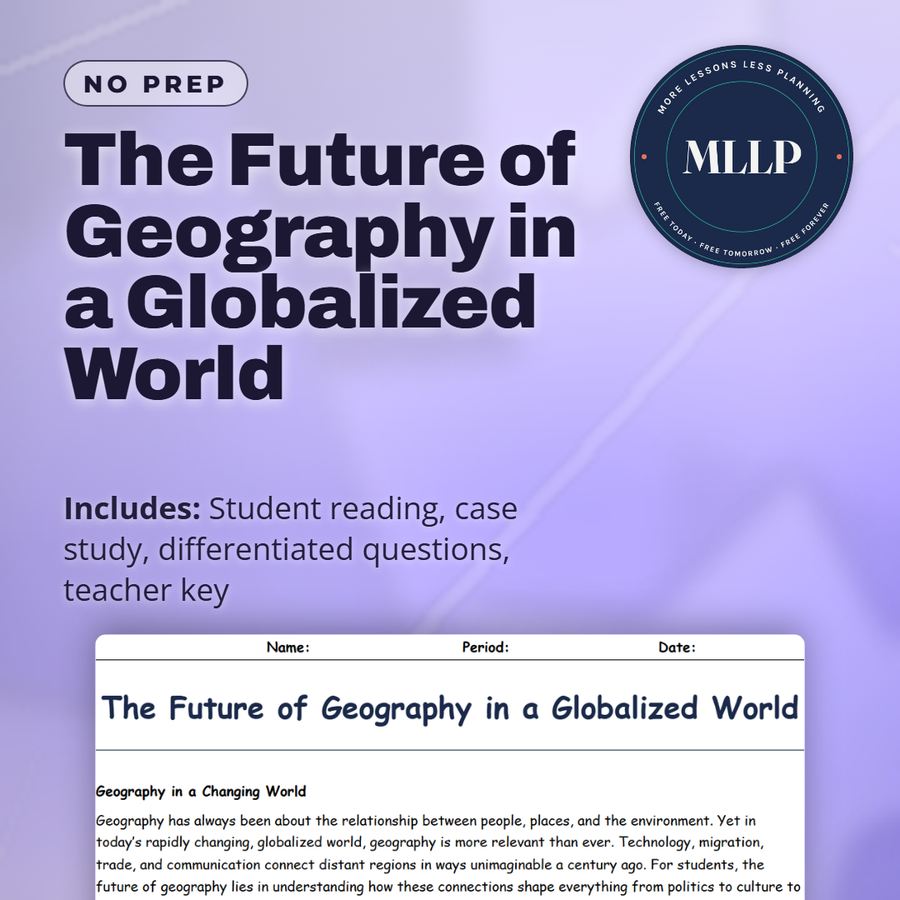
The Future of Geography in a Globalized World
Quality reviewed September 2026
Facts verified September 14, 2026
- Subject
- Social Studies
- Grades
- Grades 9-12
- Length
- 6-page student worksheet
- Time
- About one 50-minute class period
- Great for
- Sub plans and independent work
- Includes
- Reading passage, comprehension questions + full answer key
- Format
- Print-and-go PDF
What students do
- Match terms like climate change, technology, and globalization to how each will shape the future of geography
- Fill in the blank sentences on Geographic Information Systems, climate change, and smart cities of the future
- Answer multiple choice questions on which tool is central to modern geographic study, a downside of smart cities, and how geography builds problem-solving skills
- Write short answers on how geography helps address migration crises, why physical and human systems should be studied together, and what future challenge matters most
What it covers
- How tools like GIS and satellite imaging are transforming the way geographers track deforestation, urban sprawl, and disasters
- The interconnected global trends of climate change, migration, resource scarcity, and globalization that will shape where people live
- A case study on smart cities like Singapore, Barcelona, and Dubai, and the privacy and inequality questions their technology raises
Start reading this worksheet
Geography in a Changing World
Geography has always been about the relationship between people, places, and the environment. Yet in a rapidly changing, globalized world today, geography is more relevant than ever. Technology, migration, trade, and communication connect distant regions in ways unimaginable a century ago. For students, the future of geography lies in understanding how these connections shape everything from politics to culture to the environment. Globalization means that no region exists in isolation. Decisions made in one part of the world (whether about energy use, trade policies, or environmental protection) affect people everywhere. Geography provides the tools to analyze these patterns, showing how local issues tie into global systems. For example, climate change caused by emissions in industrial nations impacts small island countries facing rising seas. Likewise, consumer demand in North America or Europe can drive deforestation in the Amazon. Geography helps us connect the dots between these seemingly distant events.
Technology and the Future of Geographic Study
Technological advances are transforming how geographers study the world. Geographic Information Systems (GIS) and satellite imaging allow researchers to track deforestation, urban sprawl, or disaster damage in real time. Smartphones and apps have put maps and navigation into the hands of billions, changing how we move and interact with space. These technologies not only make geography more precise but also more interactive, allowing students and citizens to engage directly with their environment. At the same time, new technologies are creating challenges. For instance, surveillance systems raise questions about privacy, while artificial intelligence is beginning to reshape industries, transportation, and even warfare. Geography helps us evaluate where these technologies are used, who benefits, and who might be left behind. As students explore these trends, they see that geography is not just about physical maps but also about power, inequality, and global transformation.
Global Issues and Interconnected Futures
The future of geography also lies in addressing global challenges. Climate change, resource scarcity, and migration crises will shape where people live and how they survive. For example, rising seas may force coastal populations to relocate, creating new migration patterns and political tensions. Similarly, resource shortages, like fresh water, could spark conflicts between nations or regions. Geography equips us to examine these challenges holistically, considering physical environments, political systems, and cultural factors together. Students studying geography develop not only knowledge but also problem-solving skills. They learn to analyze maps, interpret data, and understand complex systems. In a world where challenges are interconnected, these skills are invaluable. The discipline encourages global citizenship, helping students see that their choices, from energy use to voting, ripple across borders.
Like what you read? The full reading, the case study, and every question set are in the free download below, along with the answer key.
Why this matters
Who collects the data from a city's traffic sensors and smart lighting, and who does it serve? This reading closes a geography course by turning big trends, climate change, migration, resource scarcity, globalization, into one forward-looking question, using GIS and satellite imaging as tools that track deforestation and urban sprawl.
I save this one for the end of the year because it asks students to weigh a trade-off instead of just describing one. The smart cities case study on Singapore, Barcelona, and Dubai shows sensors and smart lighting making cities efficient, then asks the harder question about privacy and unequal access that efficiency cannot answer.
From one teacher to another
This reading pulls together the big themes from the whole course and asks students to think forward instead of only backward. The key info table lines up five global trends with their geographic impact, which makes a good review before a final project or exam. The smart cities case study balances the promise of technology like traffic sensors and smart lighting against real concerns about privacy and unequal access. This pairs well as a wrap-up for a geography course or unit on global issues.
What you get
Download
Where should I send the next one?
Everything here is free and it stays that way. Leave your email and I'll send you the new lessons as they go up. You can unsubscribe from any one of them.
Related resources
Changing Political Boundaries: Shaping the World Map
Climate Change Impacts and Adaptation: Facing a Warming World
Disease and Global Health: Geography of Epidemics and Recovery
Globalization and Interdependence: How the World is Connected
International Cooperation and Sustainability: Working Together for a Better Future
Migration Crises: Movement in a Changing World
Every lesson on this site is free to download and use. If one of them saved you a prep period, you can chip in a few bucks toward my three kids' daycare fund. That's genuinely where tips go.