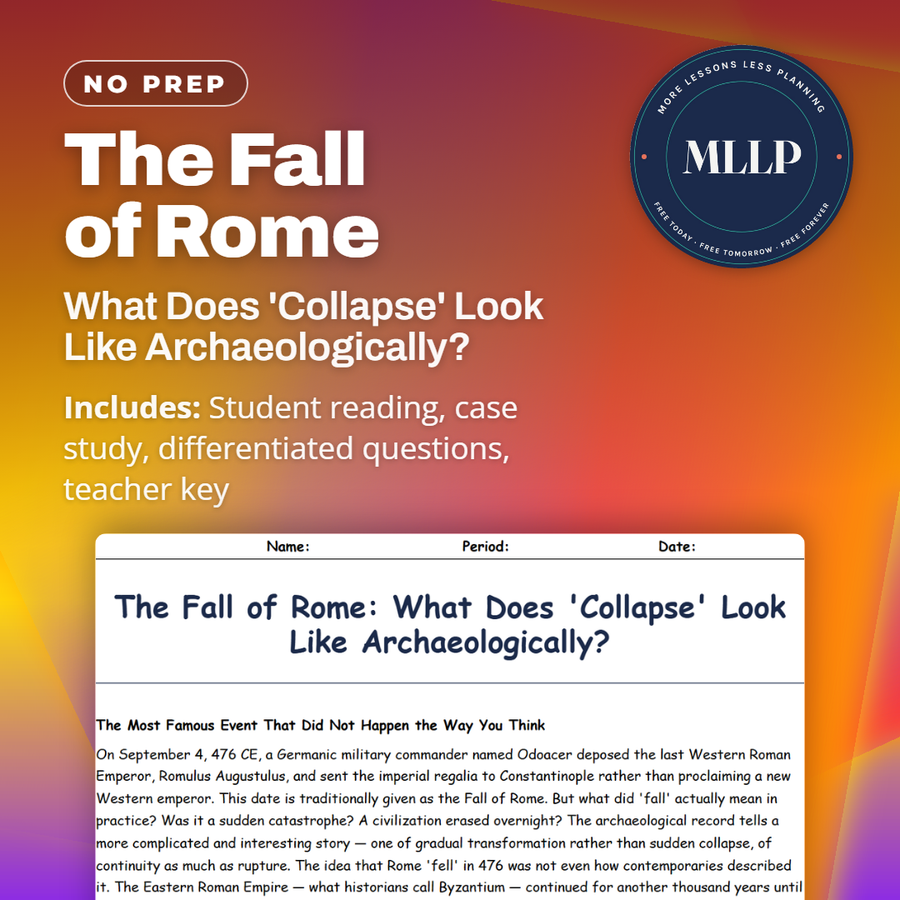
The Fall of Rome: What Does 'Collapse' Look Like Archaeologically?
Quality reviewed September 2026
Facts verified September 21, 2026
- Subject
- Social Studies
- Grades
- Grades 9-12
- Length
- 9-page student worksheet
- Time
- About one 50-minute class period
- Great for
- Sub plans and independent work
- Includes
- Reading passage, comprehension questions + full answer key
- Format
- Print-and-go PDF
What students do
- Lucius Antonius can't repair his family's heating system or explain the crumbling walls to his son
- Trace how the disappearance of standardized terra sigillata pottery maps the collapse of Roman trade networks
- Explain what spolia is and why its reuse signals an economy that could no longer produce new building stone
- The Catholic Church's survival of Latin, law, and literacy through the political collapse gets worked through as a counterpoint to decline
What it covers
- How disappearing terra sigillata pottery lets archaeologists track economic collapse layer by layer
- Spolia, or reused Roman stone, as evidence of an economy that stopped producing new building materials
- What survived Rome's political collapse, including the Catholic Church, Latin, and Roman law
Start reading this worksheet
The Most Famous Event That Did Not Happen the Way You Think
On September 4, 476 CE, a Germanic military commander named Odoacer deposed the last Western Roman Emperor, Romulus Augustulus, and sent the imperial regalia to Constantinople rather than proclaiming a new Western emperor. This date is traditionally given as the Fall of Rome. But what did 'fall' actually mean in practice? Was it a sudden catastrophe? A civilization erased overnight? The archaeological record tells a more complicated and interesting story: one of gradual transformation rather than sudden collapse, of continuity as much as rupture. The idea that Rome 'fell' in 476 was not even how contemporaries described it. The Eastern Roman Empire, which historians call Byzantium, continued for another thousand years until 1453 CE. Educated Romans living through the fifth century were aware of serious problems but did not necessarily feel they were witnessing the end of civilization. The historian Edward Gibbon's famous eighteenth-century narrative of Rome's 'decline and fall' shaped how later generations understood the period, but it was always partly a narrative construct.
What the Pottery Tells Us
Ceramic analysis is one of archaeology's most powerful tools for understanding economic and social change over time, and Roman pottery provides a remarkable case study in what gradual collapse actually looks like in material evidence. At the height of the Roman Empire, a type of fine red tableware called terra sigillata (also known as Samian ware) was produced at factories in modern France and Germany using highly standardized molds that mass-produced consistent, well-finished bowls, plates, and cups. This pottery has been found across the entire western empire, from Scotland to Morocco, evidence of a functioning pan-European trade network. In the late fourth and fifth centuries, the distribution of this pottery contracts. By the early sixth century, the high-quality standardized ware has essentially disappeared from the archaeological record in the west. What replaces it is locally produced pottery: technically cruder, less standardized, fired at lower temperatures, showing more variation between regions. This is not a sudden change but a gradual deterioration visible in the stratigraphy of excavated sites across Europe. Archaeologists can literally watch the collapse of the Roman economic system in the declining quality of dinner plates.
Abandoned Villas and Shrinking Cities
The Roman villa system, large agricultural estates worked by slaves and producing surplus for market, was the economic backbone of rural Roman life across Europe. Archaeological surveys using LiDAR, field walking, and targeted excavation have documented what happened to villas in the fifth century: many were abandoned. But the pattern of abandonment is not uniform. Some villas were abruptly abandoned at specific moments, perhaps during a particular barbarian raid or military crisis. Others show gradual decline: fewer luxury goods, declining maintenance, eventually abandonment. Some were reoccupied by squatters who built rough shelters inside the stone walls of the main building, using the old architecture as convenient ready-cut stone. Cities show a similar pattern of contraction. Late Roman cities in Britain, France, and Spain show archaeological evidence of public buildings falling out of use, streets narrowing as encroachments were tolerated, formerly public spaces converted to agricultural use. The impressive stone bath complexes that had defined Roman urban life ceased to function as the aqueducts supplying them fell into disrepair. The public forum (the commercial, legal, and social center of every Roman city) was often converted to other uses or simply abandoned.
Like what you read? The full reading, the case study, and every question set are in the free download below, along with the answer key.
Why this matters
Lucius Antonius can read Latin and still calls the crumbling estate walls both Roman and not Roman in the same breath, and that confusion is closer to how real historical change usually works than any clean date on a timeline. The reading's evidence, cruder pottery replacing standardized ware, old stone getting reused instead of quarried fresh, is a reminder that decline shows up first in small material details long before anyone agrees to call it a collapse. Students tracking Rome's transformation this way get practice reading change as a gradual process instead of a single dramatic headline, which is a more accurate way to understand almost any historical shift.
From one teacher to another
September 476 CE gets taught as the day Rome fell, but the reading treats that date skeptically, since the Eastern Empire kept going for another thousand years as Byzantium. Students trace how archaeologists actually measure collapse through pottery, watching standardized terra sigillata tableware vanish from the record and get replaced by cruder, locally made pieces, and through spolia, the reused stone that shows up in medieval walls once nobody could afford to quarry anything new. A passage on abandoned villas and shrinking cities describes streets narrowing and bathhouses going dark as aqueducts stopped being maintained. A Romano-British family living with a broken heating system and outdated tax records gives the case study its shape.
What you get
Download
Where should I send the next one?
Everything here is free and it stays that way. Leave your email and I'll send you the new lessons as they go up. You can unsubscribe from any one of them.
Related resources


Every lesson on this site is free to download and use. If one of them saved you a prep period, you can chip in a few bucks toward my three kids' daycare fund. That's genuinely where tips go.