Roman Baths and Social Life
Quality reviewed September 2026
Facts verified September 21, 2026
- Subject
- Social Studies
- Grades
- Grades 9-12
- Length
- 8-page student worksheet
- Time
- About one 50-minute class period
- Great for
- Sub plans and independent work
- Includes
- Reading passage, comprehension questions + full answer key
- Format
- Print-and-go PDF
What students do
- Novia scratches a curse onto a lead sheet after a neighbor steals her cloak and gets away with it
- Trace the bathing sequence from the changing room through the hot room to the final cold plunge
- The hypocaust system's furnace and raised floors get worked through as an actual heating solution, not background detail
- Explain what the curse tablets found at Bath reveal about ordinary Romans with no legal recourse
What it covers
- The hypocaust heating system and how a furnace and raised floors warmed an entire bathhouse
- Curse tablets thrown into the sacred spring at Aquae Sulis and what they reveal about ordinary grievances
- Roman baths as a social hub for business, politics, and everyday conversation among senators and tradespeople
Start reading this worksheet
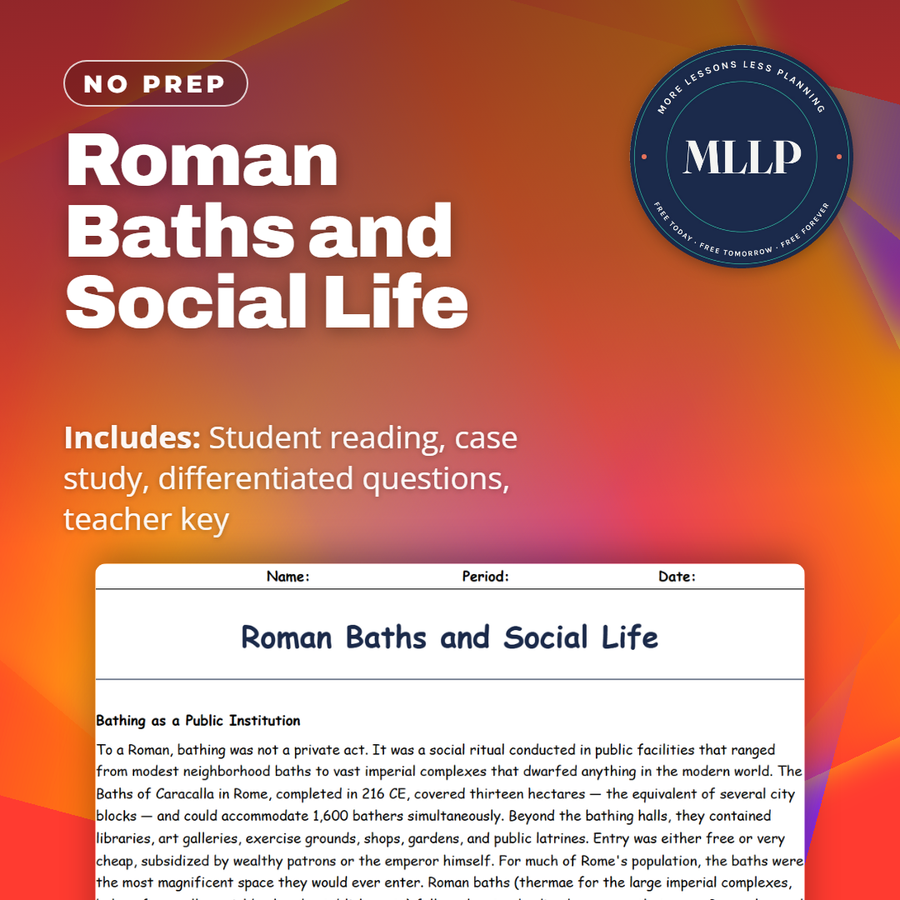
Bathing as a Public Institution
To a Roman, bathing was not a private act. It was a social ritual conducted in public facilities that ranged from modest neighborhood baths to vast imperial complexes that dwarfed anything in the modern world. The Baths of Caracalla in Rome, completed in 216 CE, covered thirteen hectares (the equivalent of several city blocks) and could accommodate 1,600 bathers simultaneously. Beyond the bathing halls, they contained libraries, art galleries, exercise grounds, shops, gardens, and public latrines. Entry was either free or very cheap, subsidized by wealthy patrons or the emperor himself. For much of Rome's population, the baths were the most magnificent space they would ever enter. Roman baths (thermae for the large imperial complexes, balnea for smaller neighborhood establishments) followed a standardized sequence that every Roman learned from childhood. You began in the apodyterium, the changing room, where you left your clothes, ideally with a trusted slave or friend watching them, since theft was a constant problem. Next came the tepidarium, the warm room, for acclimatization. Then the caldarium, the hot steamy room heated by the hypocaust system beneath the floor, where sweating and scraping with a bronze tool called a strigil replaced what modern bathers would accomplish with soap. Finally, many bathers finished in the frigidarium, the cold plunge pool, which closed the pores and left the bather feeling, as contemporary accounts describe, refreshed and invigorated.
The Hypocaust: Engineering for Comfort
The hypocaust system that heated Roman baths was an elegant engineering solution. The floor of the heated rooms was raised on columns of brick (pilae) typically 60-90 cm high, creating a hollow space beneath. A furnace called a praefurnium burned continuously outside the building, and the hot gases flowed through the hollow floor space and up through hollow tiles built into the walls, radiating heat throughout the room from below and from the sides simultaneously. The hypocaust was not exclusively a bathing technology (wealthy Roman houses used smaller versions to heat their floors in winter), but the baths required furnace systems on an industrial scale, with teams of slaves constantly feeding them fuel. Maintaining the correct temperature gradient from frigidarium to caldarium required careful management. The hottest rooms were positioned nearest the furnace, with the progressively cooler rooms farther away. Bath complexes consumed enormous quantities of wood: one estimate suggests the Baths of Caracalla required several tons of wood per day. The forest clearances needed to supply Roman bath complexes across the empire were an environmental consequence that modern archaeologists have documented through analysis of pollen records.
The Baths of Bath: Sacred Waters in Roman Britain
Among the most remarkable surviving Roman bath complexes is not in Rome or Italy but in the English city that still bears the name the Romans gave it: Aquae Sulis, meaning Waters of Sulis. The hot springs at Bath, unique in Britain, were sacred to the local goddess Sulis, whom the Romans identified with Minerva (Athena) and honored as Sulis Minerva. The Roman complex built around these springs from the first century CE combined a sacred spring, a temple, and elaborate bathing facilities in a way that made worship and bathing inseparable. The sacred spring itself fed into a large lead-lined pool where votives were thrown by worshippers: coins, small figurines, pieces of jewelry. But the most extraordinary finds from the Bath spring are the curse tablets. Written on thin sheets of lead, folded, and thrown into the sacred water, these tablets asked the goddess to punish specific individuals for specific wrongs. The thief who stole Docilianus's hooded cloak. The person who wronged Uricalus, Docilis his wife, Decentinus his son, and Alogiosa his daughter. The individual who failed to repay a debt to Exsupereus. The personal details recorded on these tablets (names, grievances, the things that mattered enough to petition a goddess) are an archive of ordinary Roman life available nowhere else.
Like what you read? The full reading, the case study, and every question set are in the free download below, along with the answer key.
Why this matters
Novia's curse tablet survives because she had no other way to get justice against a neighbor with more social standing than she had, and that gap between formal law and what ordinary people could actually do about being wronged is not a purely ancient problem. The reading's description of baths as a mixed space for senators and tradespeople side by side also raises a question worth sitting with: how much of public life depends on shared spaces that don't sort people by wealth first. Between the curse tablets and Seneca's complaints about the noise, students get a version of Roman life that is loud, petty, and recognizably human rather than marble and dignified.
From one teacher to another
Bathing in Rome was never a private errand, and the reading opens with the scale to prove it: the Baths of Caracalla covered thirteen hectares and held 1,600 people at once, complete with libraries and gardens. Students follow the standard bathing sequence from changing room to hot room to cold plunge, then learn how the hypocaust system used a furnace and raised floors to heat entire buildings from below. The reading turns to Aquae Sulis, the Roman baths at what is now the English city of Bath, where worshippers threw lead curse tablets into a sacred spring asking the goddess Sulis Minerva to punish thieves. Novia, who scratches her own curse onto a lead tablet after a theft she cannot prove, is the case study's central figure.
What you get
Download
Where should I send the next one?
Everything here is free and it stays that way. Leave your email and I'll send you the new lessons as they go up. You can unsubscribe from any one of them.
Related resources

Every lesson on this site is free to download and use. If one of them saved you a prep period, you can chip in a few bucks toward my three kids' daycare fund. That's genuinely where tips go.