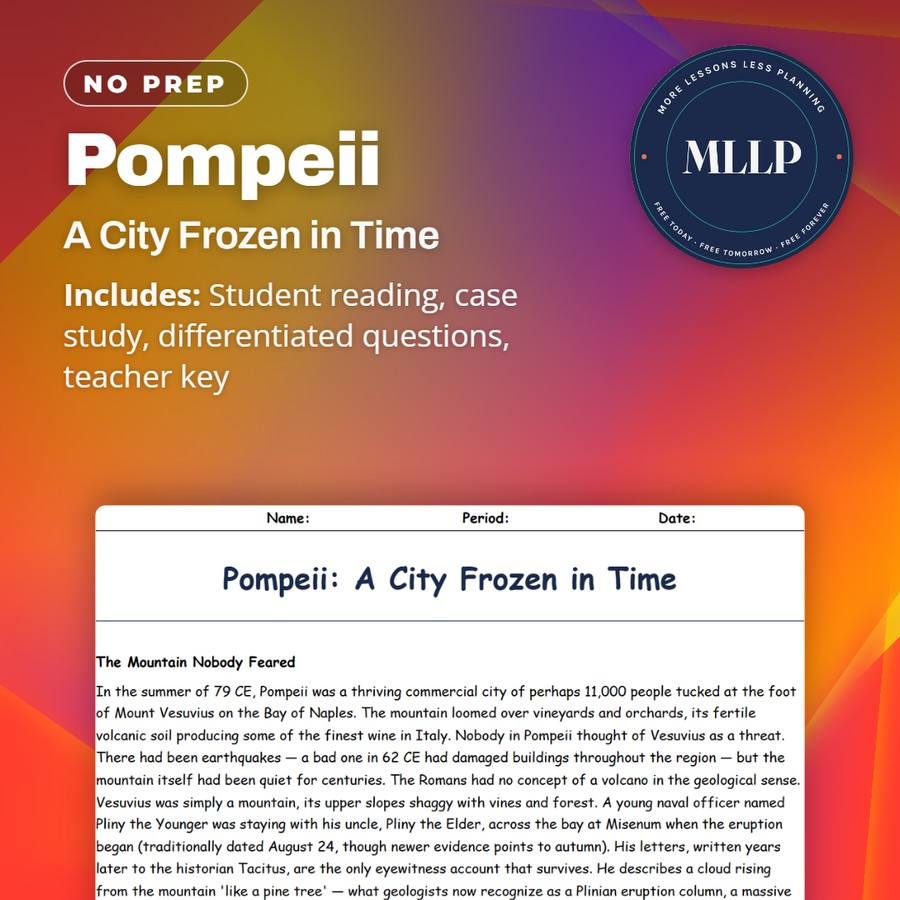
Pompeii: A City Frozen in Time
Quality reviewed September 2026
Facts verified September 21, 2026
- Subject
- Social Studies
- Grades
- Grades 9-12
- Length
- 8-page student worksheet
- Time
- About one 50-minute class period
- Great for
- Sub plans and independent work
- Includes
- Reading passage, comprehension questions + full answer key
- Format
- Print-and-go PDF
What students do
- Marcus the baker hesitates over a tray of bread while ash starts falling outside his shop
- Sequence the eruption's two phases and explain why the second one killed instantly
- Graffiti, bakeries, and Fiorelli's plaster casts reveal what ordinary daily life in Pompeii actually looked like
- Explain how early treasure hunters damaged the site before Fiorelli's more careful methods took over
What it covers
- Giuseppe Fiorelli's plaster cast technique and what it captured about victims' final moments
- Graffiti, food, and preserved buildings as evidence of ordinary daily life in Pompeii
- Why roughly one-third of Pompeii still remains unexcavated today
Start reading this worksheet
The Mountain Nobody Feared
In the summer of 79 CE, Pompeii was a thriving commercial city of perhaps 11,000 people tucked at the foot of Mount Vesuvius on the Bay of Naples. The mountain loomed over vineyards and orchards, its fertile volcanic soil producing some of the finest wine in Italy. Nobody in Pompeii thought of Vesuvius as a threat. There had been earthquakes, including a bad one in 62 CE that had damaged buildings throughout the region, but the mountain itself had been quiet for centuries. The Romans had no concept of a volcano in the geological sense. Vesuvius was simply a mountain, its upper slopes shaggy with vines and forest. A young naval officer named Pliny the Younger was staying with his uncle, Pliny the Elder, across the bay at Misenum when the eruption began (traditionally dated August 24, though newer evidence points to autumn). His letters, written years later to the historian Tacitus, are the only eyewitness account that survives. He describes a cloud rising from the mountain 'like a pine tree': what geologists now recognize as a Plinian eruption column, a massive pillar of ash and gas shooting tens of kilometers into the atmosphere. Pliny the Elder sailed toward the disaster to rescue survivors and to observe. He died on the beach, probably from volcanic gases.
Eighteen Hours That Erased a City
The eruption unfolded in two phases. During the first twelve hours, Vesuvius rained pumice and ash on Pompeii. This was survivable. Many residents fled during this phase, and the death toll at Pompeii might have been much lower if everyone had left immediately. But some stayed. They sheltered indoors, hoping the rain of rock and ash would stop. Roofs collapsed under the weight. People died of suffocation or crushing before the worst came. In the early morning hours of the second day, the eruption column collapsed. Pyroclastic flows, superheated avalanches of gas, ash, and rock traveling at hurricane speed, descended the mountain. The first surge to reach Pompeii killed everyone still alive almost instantly. Temperatures may have reached 300 degrees Celsius. The city was buried under four to six meters of volcanic material. By morning, Pompeii had ceased to exist in any practical sense. Its name survived only in Roman legal documents as property records that would never be acted on.
Rediscovery and the Making of Modern Archaeology
Pompeii was not completely forgotten (Roman writers mentioned it), but its exact location was uncertain for centuries. In 1748, workers digging a canal near Naples broke through into decorated Roman rooms. King Charles III of Naples recognized the significance and ordered systematic excavation, making Pompeii one of the earliest sites to receive organized archaeological attention. Early excavators, however, cared primarily about beautiful objects: frescoes, mosaics, bronzes. Stratigraphic context was ignored. Finds were routinely removed without recording their location. The real transformation came in the 1860s under Giuseppe Fiorelli. Noticing that the volcanic debris contained hollow spaces where organic material had decomposed, Fiorelli developed the plaster cast technique: workers pumped liquid plaster into the cavities, allowed it to set, and then excavated around the hardened form. The result was heartbreaking and extraordinary: the exact postures of Pompeians in their final moments, preserved in plaster. A dog straining against its chain. A family huddled together. A man shielding his face with his arm.
Like what you read? The full reading, the case study, and every question set are in the free download below, along with the answer key.
Why this matters
Marcus's hesitation over a tray of bread is a small, almost embarrassing decision, and that's exactly why it matters. The reading argues that Pompeii's real value is its ordinariness, the graffiti, the snack counters, the unfinished chores, and that argument holds up because most disasters are survived or not survived by exactly these kinds of small delays. Fiorelli's plaster casts turn that idea into something physical: a shape frozen mid-decision. Students get a rare chance to sit with a historical event at the scale of one person's normal Tuesday instead of the scale of an empire, which is often the harder and more honest way to understand what actually happened.
From one teacher to another
Vesuvius had been quiet for centuries, so nobody in Pompeii treated it as a threat until an eighteen-hour eruption buried the city under four to six meters of ash and rock. Students follow Pliny the Younger's eyewitness letters, the two-phase eruption that first rained pumice and then sent a pyroclastic flow that killed instantly, and the slow rediscovery of the site starting in 1748. Giuseppe Fiorelli's plaster cast technique gets its own focus: pumping liquid plaster into cavities left by decomposed bodies to capture the exact posture people died in. Marcus the baker gets the case study's attention: a man who hesitates over a tray of bread while the ash keeps falling, and never makes it out.
What you get
Download
Where should I send the next one?
Everything here is free and it stays that way. Leave your email and I'll send you the new lessons as they go up. You can unsubscribe from any one of them.
Related resources

Every lesson on this site is free to download and use. If one of them saved you a prep period, you can chip in a few bucks toward my three kids' daycare fund. That's genuinely where tips go.