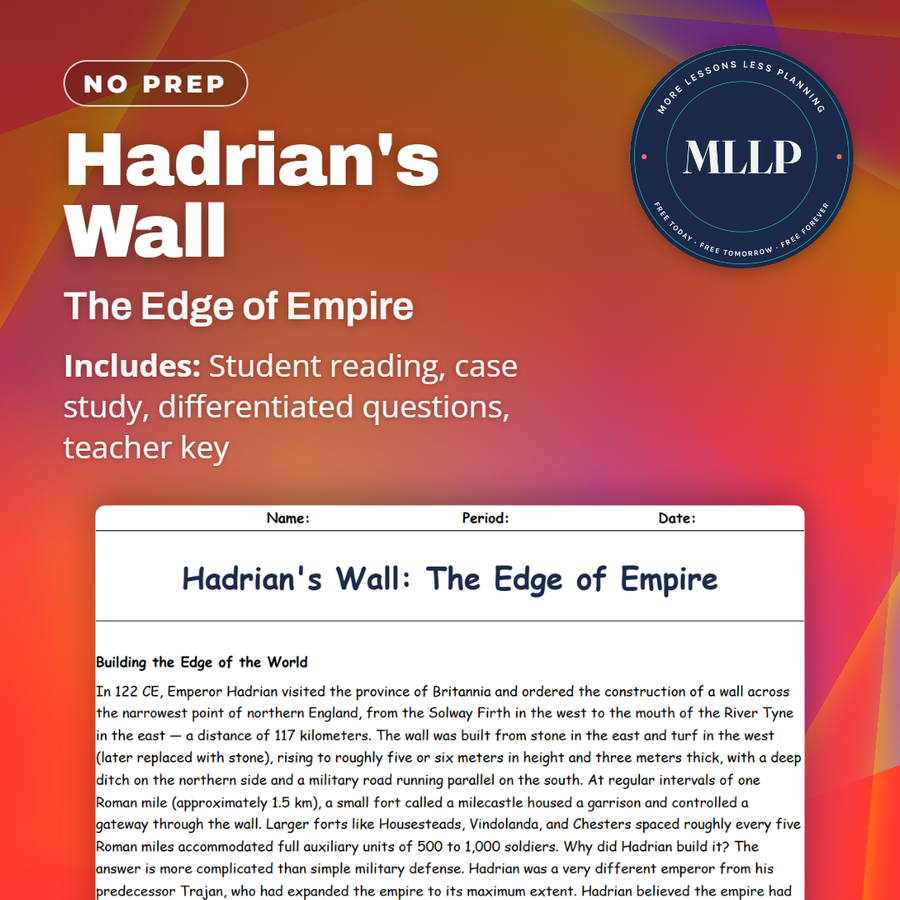
Hadrian's Wall: The Edge of Empire
Quality reviewed September 2026
Facts verified September 21, 2026
- Subject
- Social Studies
- Grades
- Grades 9-12
- Length
- 8-page student worksheet
- Time
- About one 50-minute class period
- Great for
- Sub plans and independent work
- Includes
- Reading passage, comprehension questions + full answer key
- Format
- Print-and-go PDF
What students do
- Soldiers from Syria, Spain, and the Danube region who staffed the wall get placed alongside where they actually served
- Explain why Hadrian chose consolidation over further conquest when he ordered the wall built
- A frontier officer's letter home covers frozen weather, a beer shortage, and an overdue request for socks
- Match wall vocabulary like milecastle and auxiliary to what each term actually controlled or meant
What it covers
- Why Hadrian built a wall instead of continuing to expand the empire northward
- The Vindolanda tablets and what they reveal about ordinary letters from a Roman frontier fort
- How auxiliary soldiers from across the empire earned Roman citizenship by serving on the wall
Start reading this worksheet
Building the Edge of the World
In 122 CE, Emperor Hadrian visited the province of Britannia and ordered the construction of a wall across the narrowest point of northern England, from the Solway Firth in the west to the mouth of the River Tyne in the east, a distance of 117 kilometers. The wall was built from stone in the east and turf in the west (later replaced with stone), rising to roughly five or six meters in height and three meters thick, with a deep ditch on the northern side and a military road running parallel on the south. At regular intervals of one Roman mile (approximately 1.5 km), a small fort called a milecastle housed a garrison and controlled a gateway through the wall. Larger forts like Housesteads, Vindolanda, and Chesters spaced roughly every five Roman miles accommodated full auxiliary units of 500 to 1,000 soldiers. Why did Hadrian build it? The answer is more complicated than simple military defense. Hadrian was a very different emperor from his predecessor Trajan, who had expanded the empire to its maximum extent. Hadrian believed the empire had overextended itself and pulled back in several regions, including Mesopotamia. The wall was part of his policy of consolidation: defining clear, manageable borders rather than pushing ever further into unknown territory. It may also have served economic functions, controlling trade and taxing movement across the border. Whether it was primarily a military barrier, a customs checkpoint, or a symbol of Roman power projected northward, it was an extraordinary organizational and engineering achievement.
Who Guarded the Wall?
The legions who built Hadrian's Wall did not garrison it. The daily work of maintaining the frontier fell to auxiliary units (soldiers recruited from across the empire, often from provinces far from Britain). Excavations along the wall have uncovered unit records and inscriptions showing soldiers from Spain, France, Belgium, North Africa, the Danube region, and the Middle East. A unit of archers from Syria, the First Cohort of Hamians, guarded the wall section near modern Carvoran. Soldiers from what is now Iraq and Iran were shivering in the North English drizzle, a fact that speaks volumes about the empire's logistical reach and cultural complexity. These auxiliary soldiers were not Roman citizens when they enlisted, though service earned citizenship after 25 years, a powerful incentive that Rome used to recruit broadly. They brought their home cultures with them. The Mithras cult, originating in Persia, had temples at several wall forts. Syrian soldiers imported their foods and religious practices into the most remote Roman frontier, creating a cultural mix that the Roman Empire fostered wherever it went.
The Vindolanda Tablets: Personal Letters from the Frontier
Of all the archaeological discoveries associated with Hadrian's Wall, none are more extraordinary than the Vindolanda tablets. Found at the fort of Vindolanda just south of the wall during excavations beginning in 1973, these are thin slivers of wood (roughly postcard-sized) on which Roman soldiers and their families wrote in ink using a pointed stylus. The waterlogged, oxygen-poor soil preserved them when almost nothing organic survives in British ground conditions. The tablets cover the period around 100 CE, slightly before the wall's construction, and provide a window into garrison life of unprecedented intimacy. One tablet, probably the most famous, is a birthday party invitation from Claudia Severa, wife of a fort commander, to her friend Sulpicia Lepidina: 'I give you a warm invitation to come to us on the 11th of September, sister, to make the day more enjoyable for me by your arrival.' The casual warmth of the letter, written nearly two thousand years ago, is startling. Other tablets include requests for beer and food supplies, complaints about local conditions, and a soldier's wish for underpants and socks: the cold British weather apparently being insufficiently accounted for in the imperial supply chain.
Like what you read? The full reading, the case study, and every question set are in the free download below, along with the answer key.
Why this matters
Hadrian's Wall is a reminder that empires spend as much energy deciding where to stop as where to expand, and that decision came from a real political argument about how much territory an empire could actually manage. The Vindolanda tablets matter for a different reason: they are personal mail, not official history, and they survived only because of an accident of wet soil. Archaeologists still argue about which sites might be hiding equally personal records, and students who read Flavius's complaint about frozen weather and missing beer are getting a version of ancient life that most textbooks skip because it isn't dramatic, just honest.
From one teacher to another
A 117-kilometer stone and turf barrier across northern England sounds like a simple military line, but the reading treats Hadrian's Wall as something closer to a policy statement. Students read why Hadrian pulled back from Trajan's conquests and built milecastles and forts instead of pushing further north, then meet the auxiliary soldiers, recruited from Syria to Spain to the Danube, who actually staffed the wall for centuries. The real centerpiece is the Vindolanda tablets: wooden letters preserved in waterlogged soil, including a birthday invitation from one officer's wife to another. A Batavian officer's actual letter home, griping about the cold, the beer shortage, and his need for socks, closes out the reading as the case study.
What you get
Download
Where should I send the next one?
Everything here is free and it stays that way. Leave your email and I'll send you the new lessons as they go up. You can unsubscribe from any one of them.
Related resources
Every lesson on this site is free to download and use. If one of them saved you a prep period, you can chip in a few bucks toward my three kids' daycare fund. That's genuinely where tips go.