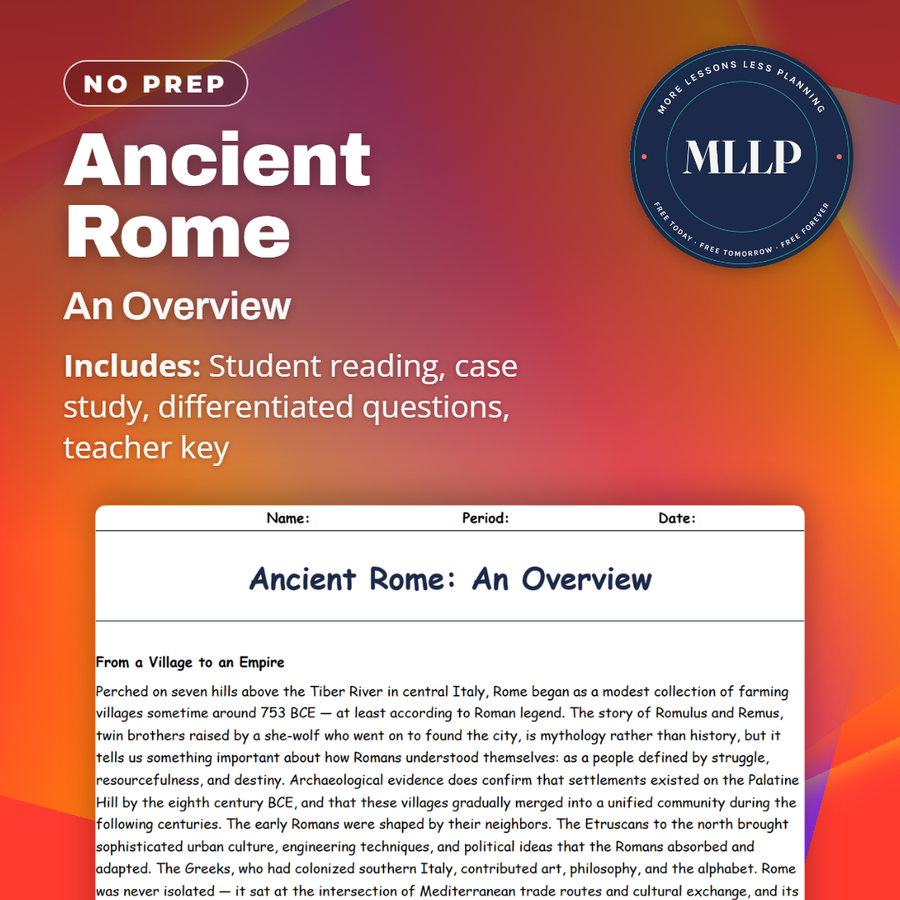
Ancient Rome: An Overview
Quality reviewed September 2026
Facts verified September 21, 2026
- Subject
- Social Studies
- Grades
- Grades 9-12
- Length
- 8-page student worksheet
- Time
- About one 50-minute class period
- Great for
- Sub plans and independent work
- Includes
- Reading passage, comprehension questions + full answer key
- Format
- Print-and-go PDF
What students do
- The Republic's consuls, Senate, and two centuries of plebeian pressure for equal rights get worked through step by step
- Trace how Octavian rebrands himself as Augustus without ever calling himself king
- A Rome city planner has to decide what to do about a buried Roman foundation stopping his metro project
- Answer questions on Rome's legal, linguistic, and architectural legacy, from Latin's descendant languages to the U.S. Capitol
What it covers
- The Republic's structure: consuls, the Senate, and the Conflict of the Orders between patricians and plebeians
- Augustus's rise from Octavian to first emperor and what his title change reveals about Roman politics
- Why modern Rome still finds Roman ruins under subway construction today
Start reading this worksheet
From a Village to an Empire
Perched on seven hills above the Tiber River in central Italy, Rome began as a modest collection of farming villages sometime around 753 BCE, at least according to Roman legend. The story of Romulus and Remus, twin brothers raised by a she-wolf who went on to found the city, is mythology rather than history, but it tells us something important about how Romans understood themselves: as a people defined by struggle, resourcefulness, and destiny. Archaeological evidence does confirm that settlements existed on the Palatine Hill by the eighth century BCE, and that these villages gradually merged into a unified community during the following centuries. The early Romans were shaped by their neighbors. The Etruscans to the north brought sophisticated urban culture, engineering techniques, and political ideas that the Romans absorbed and adapted. The Greeks, who had colonized southern Italy, contributed art, philosophy, and the alphabet. Rome was never isolated: it sat at the intersection of Mediterranean trade routes and cultural exchange, and its genius was the ability to borrow, adapt, and improve upon everything it encountered.
The Republic: Senate, Consuls, and Citizen Power
Around 509 BCE, the Romans expelled their last Etruscan king and established the Republic. This was a radical political experiment: instead of a single monarch, power would be shared among elected officials. Two consuls served for one year each, holding executive authority while keeping a check on each other. The Senate (an assembly of aristocrats) advised on legislation, foreign policy, and finances. Below them, assemblies of citizens could vote on laws and elect magistrates. The Republic was not a democracy in the modern sense. Wealthy landowners called patricians dominated political life, while plebeians (common citizens) struggled for centuries to gain equal rights. This class conflict (the Conflict of the Orders) reshaped Roman institutions over two hundred years, eventually giving plebeians access to all major offices. The result was a system of laws and constitutional precedents that Romans held with fierce pride. When Julius Caesar crossed the Rubicon River with his army in 49 BCE, triggering civil war, the Senate saw it as an attack not on a political rival but on the Republic itself.
From Republic to Empire: The Augustan Revolution
Caesar's assassination in 44 BCE did not restore the Republic. It plunged Rome into another round of civil wars. Caesar's adopted son Octavian emerged victorious, defeating Mark Antony and Cleopatra at the Battle of Actium in 31 BCE. Octavian was shrewd enough to understand that Romans hated kings, so he never called himself one. Instead, he accepted the title 'Augustus' (revered one) and presented himself as the restorer of Republican values even as he concentrated all real power in his own hands. This sleight of hand worked brilliantly. The Augustan Age that followed was a golden era of peace, prosperity, literature (Virgil, Horace, Livy), and architectural splendor. The Empire that Augustus created lasted, in various forms, for centuries. At its height under Trajan around 117 CE, Rome controlled territory from Scotland to Mesopotamia, from Morocco to the Crimea. Perhaps sixty million people lived within its borders, somewhere between a fifth and a quarter of the entire world's population. No other political entity in the ancient world came close to matching Rome's territorial extent or institutional sophistication.
Like what you read? The full reading, the case study, and every question set are in the free download below, along with the answer key.
Why this matters
Rome's Republic argued for two centuries over who got a real vote in government, and plenty of that argument, patricians versus plebeians, majority rule versus entrenched wealth, is still being fought out in different words today. The case study about Piazza Venezia is not ancient history either. Cities right now are choosing between fast infrastructure and protecting what's buried underneath it, and students who follow Marco's decision are practicing the same weighing of costs that shows up in local news whenever a construction project runs into something old.
From one teacher to another
Seven hills, a legendary set of twins, and centuries of quiet farming villages: that's how the reading opens Rome's story before it becomes an empire stretching from Scotland to Mesopotamia. Students trace the Republic's balance of consuls and Senate, the two-hundred-year fight between patricians and plebeians, and the moment Julius Caesar crossed the Rubicon. From there the reading follows Octavian's careful reinvention as Augustus, a man who held total power while insisting he had restored the old Republic. The case study drops students into a Rome city planner's actual Tuesday: a metro crew hits a stone foundation under Piazza Venezia, and he has to decide how a modern subway line handles a possible lost temple underneath it.
What you get
Download
Where should I send the next one?
Everything here is free and it stays that way. Leave your email and I'll send you the new lessons as they go up. You can unsubscribe from any one of them.
Related resources
Every lesson on this site is free to download and use. If one of them saved you a prep period, you can chip in a few bucks toward my three kids' daycare fund. That's genuinely where tips go.