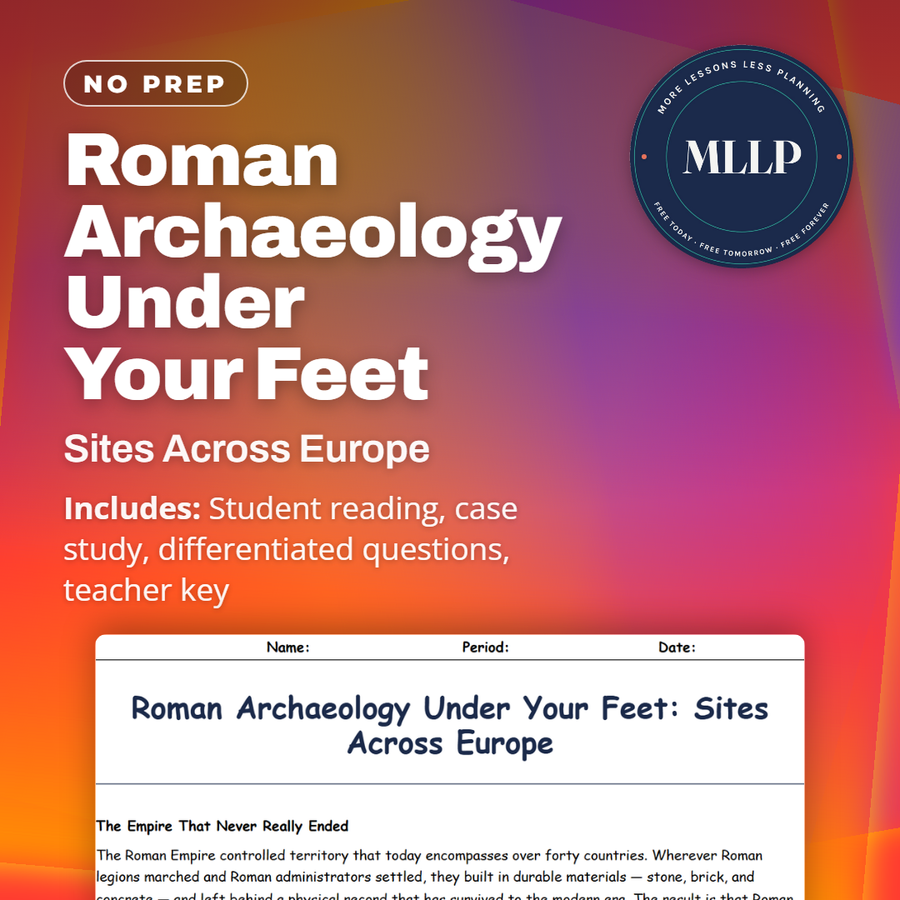
Roman Archaeology Under Your Feet: Sites Across Europe
Quality reviewed September 2026
Facts verified September 21, 2026
- Subject
- Social Studies
- Grades
- Grades 9-12
- Length
- 9-page student worksheet
- Time
- About one 50-minute class period
- Great for
- Sub plans and independent work
- Includes
- Reading passage, comprehension questions + full answer key
- Format
- Print-and-go PDF
What students do
- Septimius Severus's North African birth and his building program at Leptis Magna challenge assumptions about who counted as Roman
- Trace what the Bloomberg construction site in London revealed about Roman Londinium
- A London tunneling engineer has to halt a subway project the moment his crew hits a bronze helmet
- Explain why continuous use, not neglect, is what actually saved buildings like the Maison Carree
What it covers
- How construction projects in London, France, and Libya keep uncovering Roman remains
- Emperor Septimius Severus's North African origins and what they reveal about Rome's diversity
- Why continuous reuse, not abandonment, preserved buildings like the Maison Carree and Pont du Gard
Start reading this worksheet
The Empire That Never Really Ended
The Roman Empire controlled territory that today encompasses over forty countries. Wherever Roman legions marched and Roman administrators settled, they built in durable materials (stone, brick, and concrete) and left behind a physical record that has survived to the modern era. The result is that Roman archaeology is not confined to museums or excavated sites: it is literally present beneath the streets and buildings of virtually every major city in Western Europe, North Africa, and the Middle East. London, Paris, Cologne, Vienna, Lyon, Seville, Lisbon, Istanbul, Beirut, and Amman were all significant Roman cities. Their modern street grids often follow Roman originals. Their oldest churches sometimes stand on the foundations of Roman temples. This ubiquity creates a distinctive set of archaeological challenges and opportunities. Urban archaeology (conducted beneath and between occupied modern buildings) requires different techniques, different timelines, and different relationships with city governments and the public than field excavations in open countryside. It is archaeology conducted in the gaps, in the windows opened by construction projects, in the basements of new buildings, and in the moments when a city pauses long enough to let the past speak.
Londinium: Rome Under the City of London
When the Romans invaded Britain in 43 CE, they established a supply base on the north bank of the Thames at a point where the river could be bridged: the origin of what would become London. Roman London (Londinium) grew rapidly into the administrative capital of the province of Britannia, surrounded by a defensive wall whose course still shapes the street plan of the City of London today. The location of the original Roman bridge, roughly where London Bridge stands now, determined the pattern of roads radiating out from the city that has persisted for two thousand years. Modern construction in London's financial district, the City, regularly encounters Roman remains. The Bloomberg headquarters, built between 2010 and 2017, uncovered one of the most significant Roman finds in London's history: the remains of the Temple of Mithras, originally excavated in 1954 and now reconstructed in the building's basement. The construction project also yielded 405 Roman writing tablets, including what may be the earliest written document found in London, a commercial contract dated 57 CE. The Bloomberg tablet collection has been called one of the most important archaeological discoveries from Roman Britain in decades.
Leptis Magna: Rome in North Africa
The Roman forum, triumphal arches, temples, theater, and baths at Leptis Magna in modern Libya are among the best-preserved Roman monuments anywhere in the world, arguably better preserved than anything in Rome itself. Leptis Magna was the birthplace of Emperor Septimius Severus (reigned 193-211 CE), and he lavished the city with buildings that transformed it into one of the grandest cities of the Roman world. After the city's decline and abandonment in the seventh century CE, desert sand covered and protected the monuments for over a thousand years, preserving them in remarkable condition. The archaeological significance of Leptis Magna extends beyond its monuments. It demonstrates that Roman civilization was genuinely multicultural, not an Italian or even European export, but a system that produced emperors from North Africa, military commanders from the Danube, poets from Spain, and administrators from Syria. Septimius Severus spoke Latin with an African accent that Romans reportedly found amusing and never lost. That the greatest building campaign in Leptis Magna's history was ordered by an African emperor is a corrective to any assumption that Roman civilization belonged only to Mediterranean Europeans.
Like what you read? The full reading, the case study, and every question set are in the free download below, along with the answer key.
Why this matters
Every city built on top of a Roman one has to make a decision, over and over, about what happens when construction hits something old, and the reading's examples from London to Beirut show that decision looks different depending on money, politics, and who is doing the digging. Septimius Severus matters here too: an emperor born in North Africa who rebuilt his hometown into one of Rome's grandest cities complicates any assumption that Roman civilization was purely European. Students weighing Kaveh's choice to stop a subway project for a helmet are practicing the same judgment call cities everywhere still have to make when the past keeps turning up during construction.
From one teacher to another
Roman ruins sit under more than forty modern countries, and this reading treats that fact as a set of real archaeological problems rather than trivia. Students read how London's Bloomberg construction site uncovered a Temple of Mithras and over four hundred wooden writing tablets, how Leptis Magna in Libya survived because desert sand buried and protected it for a thousand years, and how the Maison Carree in France stayed standing because people kept finding new uses for it. Emperor Septimius Severus, born in North Africa, gets his own passage as proof that Rome was never a purely European story. A London tunneling engineer forced to halt a subway project over a Roman helmet closes the reading as its case study.
What you get
Download
Where should I send the next one?
Everything here is free and it stays that way. Leave your email and I'll send you the new lessons as they go up. You can unsubscribe from any one of them.
Related resources

Every lesson on this site is free to download and use. If one of them saved you a prep period, you can chip in a few bucks toward my three kids' daycare fund. That's genuinely where tips go.