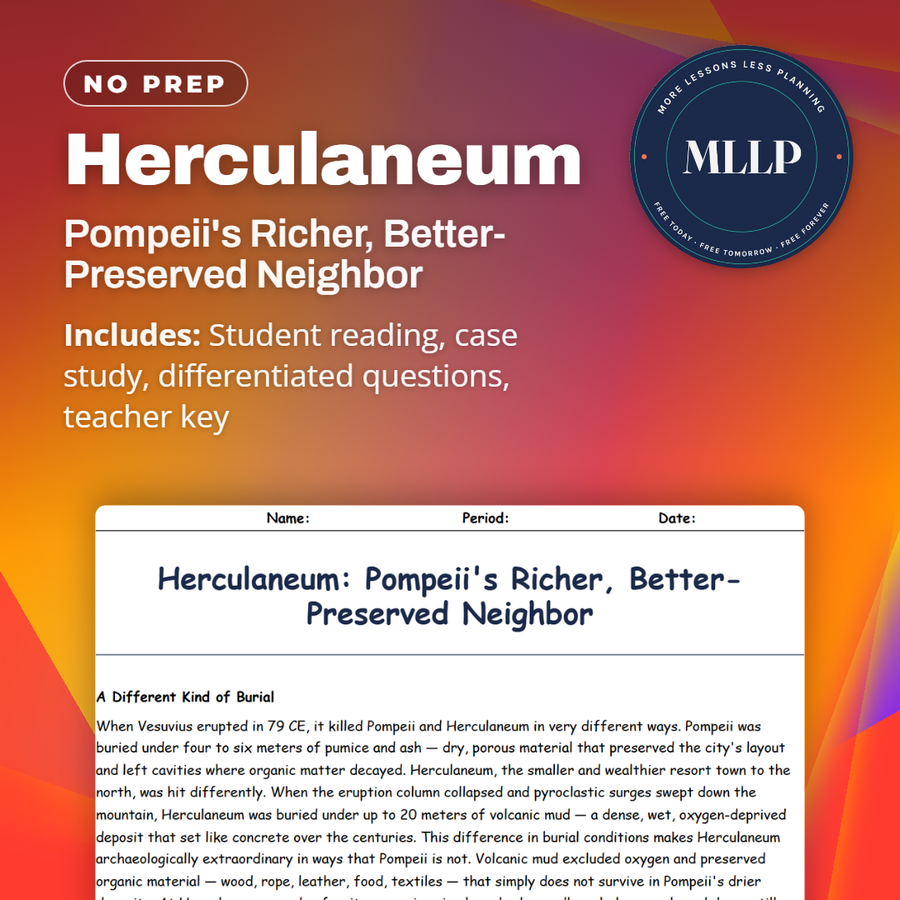
Herculaneum: Pompeii's Richer, Better-Preserved Neighbor
Quality reviewed September 2026
Facts verified September 21, 2026
- Subject
- Social Studies
- Grades
- Grades 9-12
- Length
- 8-page student worksheet
- Time
- About one 50-minute class period
- Great for
- Sub plans and independent work
- Includes
- Reading passage, comprehension questions + full answer key
- Format
- Print-and-go PDF
What students do
- Compare Pompeii's dry ash burial to Herculaneum's wet volcanic mud and what each one preserved
- The Villa of the Papyri's 1,800 carbonized scrolls and why they stayed unreadable for centuries anchor a full passage
- Explain how CT scans and AI let researchers read scroll text without physically unrolling it
- A modern computer scientist reading 1,945-year-old Greek text off a screen closes out the reading
What it covers
- How Herculaneum's volcanic mud preserved wood, food, and organic material that Pompeii's ash did not
- The Villa of the Papyri's carbonized scrolls and the Vesuvius Challenge's use of CT scans and AI to read them
- What the skeletons found near Herculaneum's ancient shoreline reveal about who was sheltering there
Start reading this worksheet
A Different Kind of Burial
When Vesuvius erupted in 79 CE, it killed Pompeii and Herculaneum in very different ways. Pompeii was buried under four to six meters of pumice and ash: dry, porous material that preserved the city's layout and left cavities where organic matter decayed. Herculaneum, the smaller and wealthier resort town to the north, was hit differently. When the eruption column collapsed and pyroclastic surges swept down the mountain, Herculaneum was buried under up to 20 meters of volcanic mud (a dense, wet, oxygen-deprived deposit that set like concrete over the centuries). This difference in burial conditions makes Herculaneum archaeologically extraordinary in ways that Pompeii is not. Volcanic mud excluded oxygen and preserved organic material (wood, rope, leather, food, textiles) that simply does not survive in Pompeii's drier deposits. At Herculaneum, wooden furniture survives in place: beds, cradles, shelves, cupboard doors still on their hinges. A wooden screen that divided a garden from a dining room. A rack of amphoras in a wine shop. The upper floors of buildings, which collapsed in Pompeii, were preserved in Herculaneum encased in the hardened mud and have been excavated intact.
The People of Herculaneum: A Wealthier Snapshot
While Pompeii was a busy commercial city with a mixed population of traders, craftspeople, slaves, and freed persons, Herculaneum appears to have been a resort destination for wealthy Romans: a place for second homes and retirement. The houses excavated there are generally larger, more elaborately decorated, and contain more expensive objects than their Pompeian counterparts. Mosaic floors, fine painted walls, and sophisticated plumbing appear throughout. The 'House of the Mosaic Atrium' and the 'House of the Deer' represent some of the finest surviving examples of Roman domestic architecture and decoration anywhere in the world. The skeletal remains found at Herculaneum tell a particular story. In the 1980s, excavations of the ancient shoreline (where 300 or more people had taken shelter in boat chambers, apparently waiting for rescue ships that never came) revealed a mass of skeletal material. Analysis showed that many of these people were relatively healthy and well-nourished compared to Roman populations elsewhere: evidence of a prosperous community. Some were found with jewelry and money, suggesting they had grabbed valuables before fleeing. At least one was a soldier, identified by his equipment and sword.
The Villa of the Papyri and the Carbonized Scrolls
The most remarkable find at Herculaneum, and perhaps in the entire history of classical scholarship, was the Villa of the Papyri, a massive luxury house excavated in the eighteenth century by tunneling through the hardened volcanic rock. Its library contained over 1,800 scrolls, all carbonized by the heat of the pyroclastic surge. For centuries these scrolls were unreadable. They crumbled at the slightest touch. Scholars knew they contained ancient texts but could not access them. Several strategies were attempted. A monk named Antonio Piaggio developed a machine in the 1750s that could gradually unroll carbonized scrolls without destroying them, allowing some to be read. But the process was agonizingly slow and many scrolls were too fragile to survive even gentle handling. Most remained in their carbonized state, sitting in museum collections as objects of tantalizing frustration for nearly three centuries. The breakthrough came with X-ray and CT scanning technology. Starting in the early 2000s and accelerating dramatically in 2023 with the Vesuvius Challenge (an open-source academic competition), researchers began using high-resolution CT scans and artificial intelligence to read the ink letters inside scrolls without unrolling them. In 2023-2024, the first extended passages were successfully read from previously intact scrolls. They contain philosophical texts from the Epicurean school, likely writings of Philodemus of Gadara. The possibility that entirely unknown works of ancient literature survive in the remaining unread scrolls has made the Herculaneum project one of the most exciting in current classical scholarship.
Like what you read? The full reading, the case study, and every question set are in the free download below, along with the answer key.
Why this matters
The Herculaneum scrolls sat in museum drawers for nearly three centuries because touching them destroyed them, and the fact that they are finally being read is a story about technology catching up to a problem rather than people trying harder. Dr. Chen's work in the case study uses the same kind of AI pattern recognition that shows up in medical imaging and self-driving research, applied to a two-thousand-year-old library instead. Every generation that left those scrolls alone rather than prying them open is the reason there is anything left to scan, which is a harder argument for restraint than any lecture about preservation.
From one teacher to another
Herculaneum died in the same eruption as Pompeii but was buried a completely different way, and that difference is the whole point of the reading. Volcanic mud sealed out oxygen and preserved wood, food, and even upper floors that Pompeii lost, which is why students spend a passage on beds, cradles, and cupboard doors still on their hinges. The reading's biggest reveal is the Villa of the Papyri, a library of eighteen hundred carbonized scrolls that sat unreadable for centuries until CT scans and AI in the Vesuvius Challenge started pulling Greek letters out of the darkness. Reading Greek letters off a CT scan of a scroll nobody has opened in 1,945 years is the case study's subject, following a computer scientist working the problem from a lab in California.
What you get
Download
Where should I send the next one?
Everything here is free and it stays that way. Leave your email and I'll send you the new lessons as they go up. You can unsubscribe from any one of them.
Related resources
Every lesson on this site is free to download and use. If one of them saved you a prep period, you can chip in a few bucks toward my three kids' daycare fund. That's genuinely where tips go.