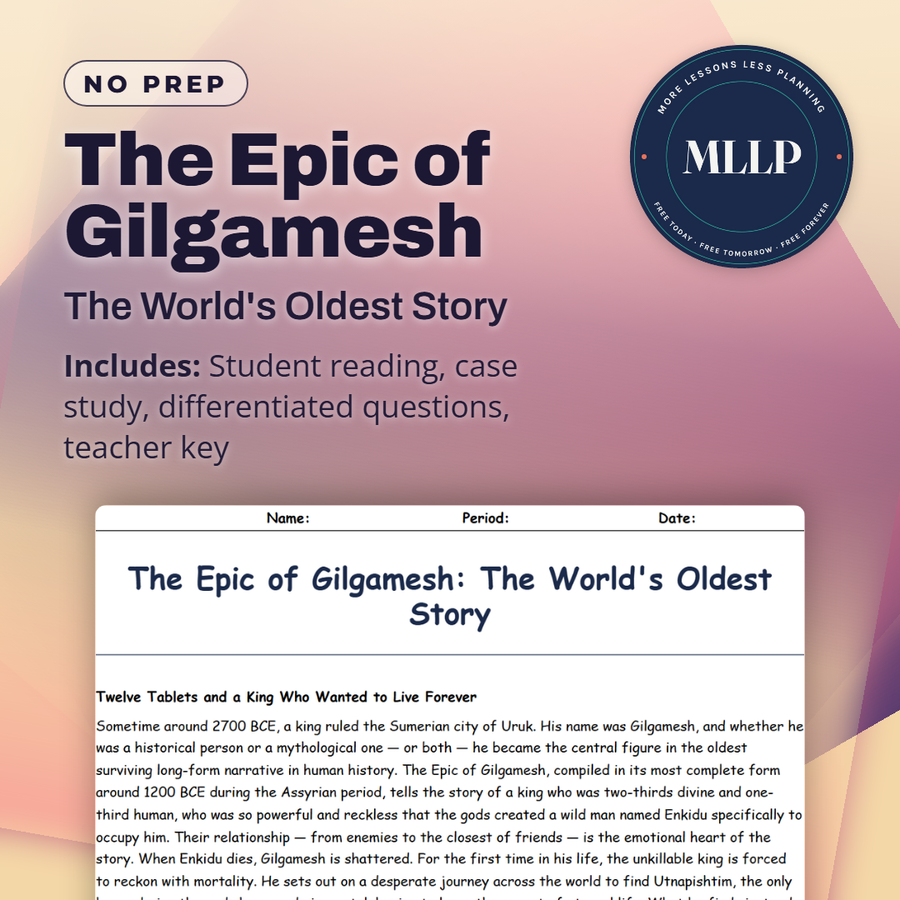
The Epic of Gilgamesh: The World's Oldest Story
Quality reviewed September 2026
Facts verified September 21, 2026
- Subject
- Social Studies
- Grades
- Grades 9-12
- Length
- 8-page student worksheet
- Time
- About one 50-minute class period
- Great for
- Sub plans and independent work
- Includes
- Reading passage, comprehension questions + full answer key
- Format
- Print-and-go PDF
What students do
- Gilgamesh's grief after Enkidu's death gets read against how the epic treats mortality as something no one can outrun
- Order the sequence of events between Utnapishtim's warning and Gilgamesh's failed attempt to bring the plant of youth back to Uruk
- George Smith's 1872 discovery gets weighed against the reasons a Mesopotamian flood story unsettled Victorian religious certainty
- Explain why the epic's ending points to Uruk's walls, not a magic plant, as the real form of immortality
What it covers
- George Smith's 1872 discovery of the flood tablet in the British Museum's collection
- Gilgamesh and Enkidu's friendship and what Enkidu's death changes in the king
- Why the epic's ending locates immortality in what a person builds rather than in the gods
Start reading this worksheet
Twelve Tablets and a King Who Wanted to Live Forever
Sometime around 2700 BCE, a king ruled the Sumerian city of Uruk. His name was Gilgamesh, and whether he was a historical person, a mythological one, or both, he became the central figure in the oldest surviving long-form narrative in human history. The Epic of Gilgamesh, compiled in its most complete form around 1200 BCE during the Assyrian period, tells the story of a king who was two-thirds divine and one-third human, who was so powerful and reckless that the gods created a wild man named Enkidu specifically to occupy him. Their relationship, from enemies to the closest of friends, is the emotional heart of the story. When Enkidu dies, Gilgamesh is shattered. For the first time in his life, the unkillable king is forced to reckon with mortality. He sets out on a desperate journey across the world to find Utnapishtim, the only human being the gods have made immortal, hoping to learn the secret of eternal life. What he finds instead is one of the oldest messages literature has ever delivered: that immortality is not available to humans, that death is the price of being alive, and that the proper response to that fact is to live fully, love those around you, and build something that lasts.
George Smith and the Flood Tablet
The Epic of Gilgamesh was lost for more than two thousand years. After the fall of Nineveh in 612 BCE, the tablets were buried under the rubble of Ashurbanipal's palace, where they remained until British excavators brought them to the British Museum in the 1850s. The tablets sat in storage, largely ignored, until a self-taught cuneiform scholar named George Smith sorted through a box of fragments in 1872 and recognized that he was reading a flood story. Tablet Eleven of the Epic, the one Smith found, describes how the god Ea warned a man named Utnapishtim that the gods intended to destroy humanity with a great flood. Utnapishtim was instructed to build a boat and fill it with all living creatures. After the flood receded, he released a dove, a swallow, and a raven to find dry land. The parallels to the biblical story of Noah were unmistakable, and Smith's announcement caused an international sensation. Here was evidence that biblical narratives had older Mesopotamian predecessors (a fact that profoundly unsettled Victorian religious certainty and opened new questions about the relationships between ancient cultures).
What the Epic Tells Us About Mesopotamian Values
The Epic of Gilgamesh is not just a flood story. It is a meditation on friendship, loss, hubris, and the human condition. Gilgamesh himself is portrayed as a deeply flawed figure: brilliant and courageous, but also arrogant and reckless. His relationship with Enkidu humanizes him. When Enkidu dies after they kill the Bull of Heaven, Gilgamesh's grief is portrayed with striking psychological realism: he refuses to acknowledge the death for days, unable to accept that his friend is gone. It is recognizably modern grief written more than three thousand years ago. The epic also reveals Mesopotamian ideas about the divine world. The gods in Gilgamesh are petty, quarrelsome, and sometimes cruel: they decide to send the flood not because humanity has sinned in any moral sense, but because humans have become too noisy and are disturbing the gods' sleep. This is a very different divine motivation than in the biblical account, and it reflects a Mesopotamian theology in which the relationship between humans and gods was more contractual than moral: humans served the gods, fed them through offerings, and the gods provided protection and fertility in return.
Like what you read? The full reading, the case study, and every question set are in the free download below, along with the answer key.
Why this matters
The Epic of Gilgamesh goes back to versions written around 2100 BCE and it is still about the thing every reader eventually has to face: someone they love is going to die, and so are they. Gilgamesh spends the second half of the story trying to avoid that fact and fails, which is exactly the point the epic is making. The case study adds a modern layer: Dr. Khalil examines a fragment of the same flood story that was looted from Iraq after 2003 and sold without documentation before being returned, which means part of its history is permanently gone even though the tablet itself survived. Reading a text this old about grief and mortality, and then seeing how fragile its physical record still is today, gives students two different kinds of history in a single lesson.
From one teacher to another
A Sumerian king named Gilgamesh, part man and part god according to the epic that carries his name, is the subject of the oldest long-form story that has survived from anywhere in the world. The reading follows Gilgamesh's friendship with Enkidu, the grief that follows Enkidu's death, and the doomed journey Gilgamesh makes afterward to find Utnapishtim, the one human being the gods ever made immortal. Students also meet George Smith, the self-taught cuneiform reader who realized in 1872 that a tablet in the British Museum's collection described a flood story with striking parallels to the Book of Genesis. A case study follows a modern tablet restorer, Dr. Amira Khalil, examining a newly repatriated fragment of the same flood story and working out what was lost when it left Iraq without documentation.
What you get
Download
Where should I send the next one?
Everything here is free and it stays that way. Leave your email and I'll send you the new lessons as they go up. You can unsubscribe from any one of them.
Related resources
Babylon and the Hanging Gardens: Myth or Reality?
Cuneiform: The World's First Writing System
Gobekli Tepe: The Temple That Rewrote History
Hammurabi's Code: Justice Carved in Stone
Looting and Loss: The Destruction of Iraq's Heritage
Mesopotamia and the Fertile Crescent: Where Civilization Began
Every lesson on this site is free to download and use. If one of them saved you a prep period, you can chip in a few bucks toward my three kids' daycare fund. That's genuinely where tips go.