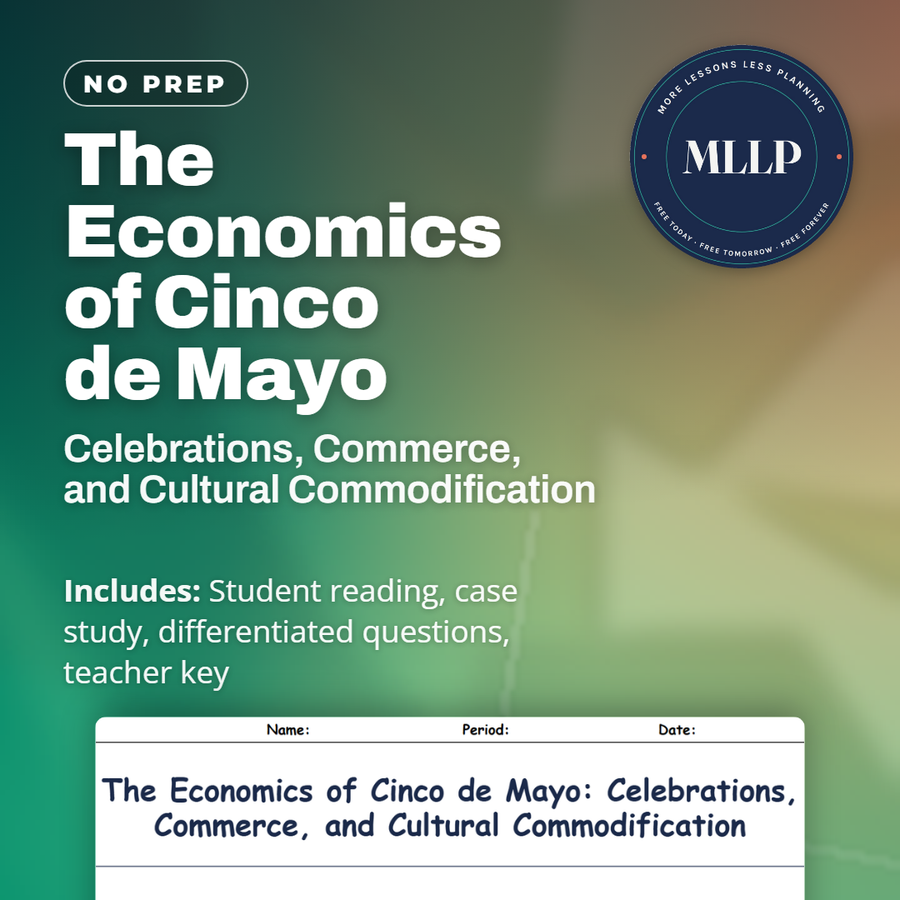
The Economics of Cinco de Mayo: Celebrations, Commerce, and Cultural Commodification
Quality reviewed September 2026
Facts verified September 9, 2026
- Subject
- Social Studies
- Grades
- Grades 9-12
- Length
- 9-page student worksheet
- Time
- About one 50-minute class period
- Great for
- Sub plans and independent work
- Includes
- Reading passage, comprehension questions + full answer key
- Format
- Print-and-go PDF
What students do
- Analyze supply and demand dynamics that drive price spikes and consumer spending on May 5
- Compare how chain stores and independent vendors each benefit from heightened foot traffic
- Evaluate the tension between cultural authenticity and commercial profit
- Trace how global advertising influences local Cinco de Mayo celebrations worldwide
What it covers
- Consumer behavior and seasonal economics
- Small business revenue and community resilience
- Cultural appropriation and market forces
Start reading this worksheet
Economic Foundations of the Holiday
When many think of Cinco de Mayo, they envision vibrant parades, lively music, and festive foods. Yet underlying these celebrations is a complex interplay of economics and consumer behavior. Each year, businesses ranging from restaurants to retail stores see an uptick in sales related to Cinco de Mayo-themed products. Market analysts often attribute this surge to the desire for cultural immersion, even among those who may not have deep historical knowledge of the day. As a result, industry sectors such as hospitality, beverage, and event planning align promotions with May 5, anticipating boosts in revenue. Studies of spending patterns reveal that supply and demand dynamics go into overdrive during this period. Limited-time menu items, special discounts, and themed merchandise create a sense of urgency, prompting consumers to spend more than they typically would. In some areas, local businesses join forces with community organizations to host street fairs, capitalizing on collective marketing that encourages visitors to linger and spend. The result can be a ripple effect, where one successful event draws additional tourism, fueling ancillary industries like transportation and lodging. These developments reflect a broader trend: the commercialization of cultural holidays. While there’s an authentic desire to celebrate Mexican heritage, there’s also an undeniable motivation to leverage the date for profit. The tension between cultural integrity and economic opportunity leads to debates about whether the holiday’s original meaning gets overshadowed. Observers note that balancing respect for tradition with business interests can be challenging, especially when massive advertising campaigns sometimes reduce Cinco de Mayo to a purely commercial spectacle.
Commercialization and Consumer Culture
Marketers have long understood that leveraging cultural events can boost brand recognition. Companies from beer manufacturers to fast-food chains often run Cinco de Mayo promotions, presenting the day as a festive occasion for everyone. While this approach can spread awareness of Mexican traditions, it can also lead to cultural commodification. Some critics argue that specific icons or traditions are repackaged for profit without adequately representing their true historical or social significance. Nevertheless, this commercialization also has benefits, particularly for small businesses in predominantly Latino neighborhoods. Celebrations may spotlight local restaurants serving authentic cuisine or shops selling traditional crafts. For these businesses, Cinco de Mayo can serve as a platform to reach a broader customer base eager to explore Mexican culture. The influx of revenue can help sustain these enterprises throughout the year, contributing to local economic resilience. However, economists caution that the hype surrounding May 5 can lead to price inflation. Vendors sometimes raise the cost of goods and services, knowing that demand will remain high. Similarly, cultural events may impose additional fees for entry or for “premium experiences.” While this strategy can yield short-term gains, it might alienate some community members who feel priced out of their own cultural festivities. Striking a balance between profitability and accessibility remains an ongoing challenge for those orchestrating Cinco de Mayo events.
Global Perspectives and Market Expansion
Although Cinco de Mayo is rooted in Mexican history, it has found resonance in countries far from the Americas. From Canada to parts of Asia, bars and restaurants have adopted the holiday as a theme night, offering deals on Mexican-inspired dishes and beverages. This global diffusion speaks to the power of cultural exchange but also demonstrates how market forces drive the expansion of popular holidays. Tourists traveling in May might encounter Cinco de Mayo promotions even in places with minimal Mexican populations. This worldwide interest has, in turn, affected how multinational corporations strategize. Global beverage companies, for instance, schedule marketing pushes in early May to coincide with the holiday, intensifying demand for products associated with Mexican culture. Retailers stock up on themed decorations, from sombreros to bright banners. While this phenomenon introduces elements of Mexican tradition to new audiences, it also presents a risk of oversimplification. Some worry that these simplified, sometimes stereotypical images may dilute genuine cultural appreciation. Nonetheless, for many people abroad, Cinco de Mayo can act as a gateway to exploring more profound aspects of Mexican history. As they sample traditional dishes or attend cultural events, they might spark an interest in understanding the Battle of Puebla and the broader story behind the holiday. Thus, while commercial forces drive the holiday’s global presence, there is potential for deeper engagement if communities and educators seize the opportunity to provide meaningful context.
Like what you read? The full reading, the case study, and every question set are in the free download below, along with the answer key.
Why this matters
Vendors on both sides of the same street compete for the same customer on May 5: independent sellers charge a premium for handcrafted goods and sell out, chain stores win instead on volume, and by the end of the day, tax revenue from both is already being routed toward a park renovation.
What makes this harder than a standard pricing lesson is the second question sitting underneath the first one: does turning a cultural holiday into a sales day cheapen it, or does it fund the community programs that keep the celebration going. Students calculate margins and elasticity, then have to sit with an answer that refuses to be simple.
From one teacher to another
This worksheet works in economics because Cinco de Mayo is a live experiment in market behavior. A case study set in a border town shows economists tracking spending in real time: independent vendors selling handcrafted goods charged premiums and thrived, while chain stores competed on volume. Students calculate profit margins, forecast inventory, and work through pricing decisions. If you lower ticket prices and attendance rises, does revenue go up? They examine price elasticity, how willing are people to pay more for perceived authenticity? They debate whether commercialization cheapens the holiday or funds important community programs. They see how tax revenue from May 5 sales got routed into park renovations. The worksheet doesn't resolve the tension between money and meaning; instead, it asks students to recognize it and think critically.
What you get
Download
Where should I send the next one?
Everything here is free and it stays that way. Leave your email and I'll send you the new lessons as they go up. You can unsubscribe from any one of them.
Related resources
American History and Cinco de Mayo: Cultural Exchange and Historical Narratives
Cinco de Mayo Biology: The Genetics and Agriculture of Mexican Cuisine
Cinco de Mayo Psychology: Identity, Celebration, and Social Dynamics
Cinco de Mayo and the Battle of Puebla: Turning Points in Mexican History
Environmental Impacts of Cinco de Mayo Celebrations: Sustainability and Festivals
The Health Science of Cinco de Mayo: Nutrition, Food Safety, and Cultural Dishes
Every lesson on this site is free to download and use. If one of them saved you a prep period, you can chip in a few bucks toward my three kids' daycare fund. That's genuinely where tips go.