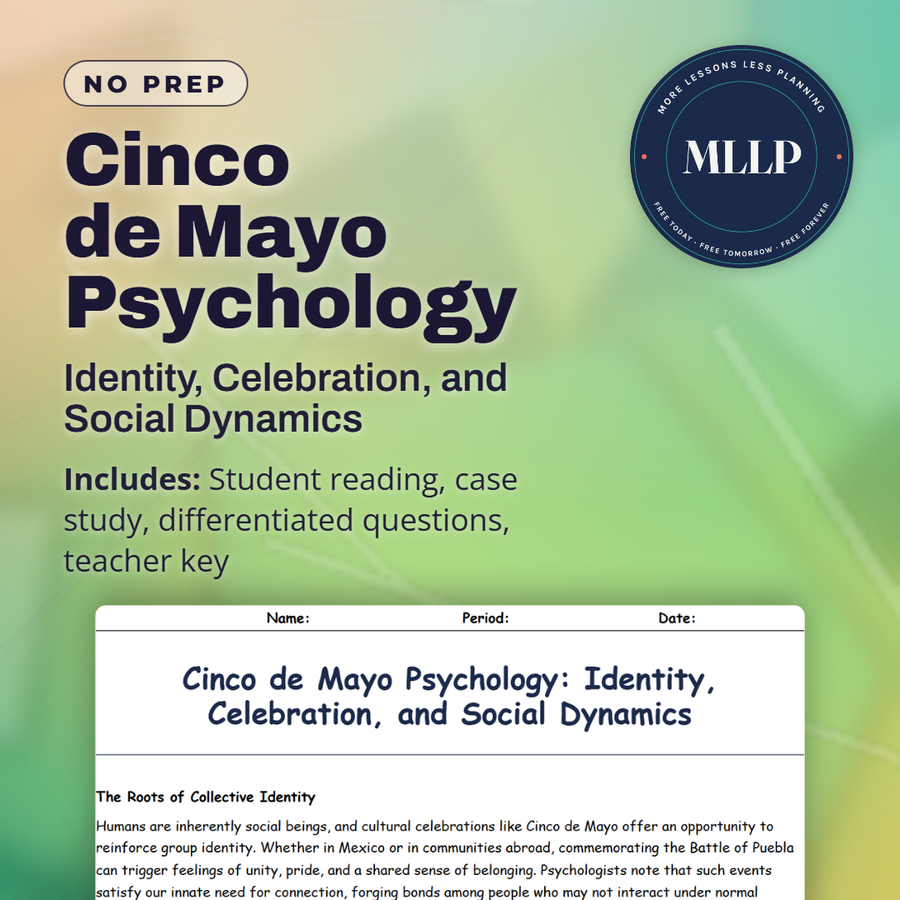
Cinco de Mayo Psychology: Identity, Celebration, and Social Dynamics
Quality reviewed September 2026
Facts verified September 9, 2026
- Subject
- Social Studies
- Grades
- Grades 9-12
- Length
- 6-page student worksheet
- Time
- About one 50-minute class period
- Great for
- Sub plans and independent work
- Includes
- Reading passage, comprehension questions + full answer key
- Format
- Print-and-go PDF
What students do
- Analyze how shared rituals and collective participation strengthen group identity and belonging
- Evaluate the psychological impact of cultural misappropriation on communities
- Examine how social media amplifies cultural events and influences participation
- Assess the relationship between cultural pride and emotional resilience in minority students
What it covers
- Social psychology and group identity
- Effects of cultural celebration on mental health
- Social influence and peer dynamics
Start reading this worksheet
The Roots of Collective Identity
Humans are inherently social beings, and cultural celebrations like Cinco de Mayo offer an opportunity to reinforce group identity. Whether in Mexico or in communities abroad, commemorating the Battle of Puebla can trigger feelings of unity, pride, and a shared sense of belonging. Psychologists note that such events satisfy our innate need for connection, forging bonds among people who may not interact under normal circumstances. Through parades, music, and communal gatherings, individuals align themselves with a collective narrative, reinforcing their sense of who they are in relation to others. Cinco de Mayo particularly resonates with those who have Mexican heritage or cultural ties. The day serves as a touchstone for identity, reminding participants of their historical roots and the resilience of their ancestors. This form of communal reinforcement is crucial, especially in multicultural societies where individuals navigate multiple identities—such as balancing traditional Mexican values with modern or global influences. For some, wearing traditional attire or participating in folkloric dances is more than performative; it is a reaffirmation of cultural pride. Moreover, the psychological impact of symbolic victories like the one at Puebla extends far beyond the battlefield. It underscores the notion that underdogs can prevail, infusing communities with hope and determination. This deep-seated message resonates whenever Cinco de Mayo is celebrated, stirring collective optimism and unity. When individuals experience these uplifting emotions, they often become more motivated to engage in social, civic, or community-oriented activities, thus strengthening communal ties.
Group Dynamics and Inclusivity
Another layer of Cinco de Mayo’s psychological influence involves group dynamics—how individuals behave in crowds or collective settings. Shared rituals, whether chanting, dancing, or singing anthems, foster social cohesion. These activities create a sense of belonging that can be especially powerful for adolescents and young adults seeking identity affirmation. In many schools, for instance, Cinco de Mayo celebrations might include cultural workshops or performances that unite diverse student populations. Yet, not all group dynamics are universally positive. Stereotyping and cultural misappropriation can arise when individuals celebrate aspects of Mexican culture without understanding their significance. This mismatch can cause tensions, especially when the holiday is treated as a superficial costume party rather than a respectful nod to history and heritage. From a psychological standpoint, such misrepresentations can breed frustration and resentment among those for whom Cinco de Mayo holds deep cultural meaning. Nonetheless, positive interactions often overshadow these pitfalls. When communities approach Cinco de Mayo with curiosity, respect, and openness, the result is a bridge-building experience. People of various backgrounds learn about Mexican history, sample traditional foods, and even try their hand at dances like Jarabe Tapatío. These inclusive experiences promote empathy, as individuals gain insight into the cultural narratives that shape others’ identities. In this way, Cinco de Mayo can serve as a unifying force rather than a dividing line.
Social Influences and Behavioral Psychology
Psychologists studying social influence have observed how group norms and peer pressure affect participation in cultural events. If a peer group values Cinco de Mayo as a day of historical reflection or vibrant celebration, its members are more likely to engage with it. Even those who begin as casual observers might be drawn in by the enthusiasm of friends or colleagues. Over time, repeated participation can shift an individual’s perceptions, turning an optional activity into a cherished tradition. Another angle is the role of social media. Platforms like Instagram, TikTok, or Facebook amplify cultural events, enabling them to reach wider audiences. Users post event highlights, share recipes, and discuss historical facts, influencing their networks to participate or learn more. This digital contagion effect can rapidly transform local festivities into global phenomena, although the accuracy of the shared information varies. Nevertheless, the power of social media to shape attitudes and encourage group behaviors is evident when trending hashtags around May 5 generate heightened visibility for Cinco de Mayo. At the same time, social psychologists warn that public celebrations can sometimes lead to groupthink—a phenomenon where the desire for harmony or conformity results in unchallenged consensus. In the context of Cinco de Mayo, groupthink might manifest as a simplified version of Mexican culture, ignoring its complexities. Awareness of this tendency is vital for educators and community leaders who aim to present a balanced narrative. By promoting critical thinking and historical context, they can ensure that collective enthusiasm for the day doesn’t morph into oversimplification or stereotype.
Like what you read? The full reading, the case study, and every question set are in the free download below, along with the answer key.
Why this matters
Ask a teenager why a celebration matters to them and most just shrug and say it's tradition. This reading asks them to look closer. A youth center festival built around performances, dances, and interviews with grandparents gave teens something specific afterward: they reported feeling more culturally aware and more accepted by people around them.
Groupthink and genuine cultural pride can look identical from outside, and telling them apart is the actual skill this reading builds. A group chasing harmony can flatten a tradition into a stereotype, while a group building belonging deepens it. Once students separate those two things, they stop treating misappropriation as a minor complaint.
From one teacher to another
This worksheet lives in my psychology unit because Cinco de Mayo is a case study in how humans meet deep needs for belonging and pride through collective action. A case study about a youth center festival shows teens planning performances, interviewing grandparents, practicing dances. After the event, they reported stronger cultural awareness and feelings of acceptance. Students examine groupthink, how the desire for harmony can oversimplify complex traditions into stereotypes, and contrast it with genuine, respectful cultural exchange. They explore social media's role in turning local celebrations into trending movements. The worksheet doesn't shy away from harm: misappropriation can breed resentment, but inclusive events foster empathy.
What you get
Download
Where should I send the next one?
Everything here is free and it stays that way. Leave your email and I'll send you the new lessons as they go up. You can unsubscribe from any one of them.
Related resources
American History and Cinco de Mayo: Cultural Exchange and Historical Narratives
Cinco de Mayo Biology: The Genetics and Agriculture of Mexican Cuisine
Cinco de Mayo and the Battle of Puebla: Turning Points in Mexican History
Environmental Impacts of Cinco de Mayo Celebrations: Sustainability and Festivals
The Economics of Cinco de Mayo: Celebrations, Commerce, and Cultural Commodification
The Health Science of Cinco de Mayo: Nutrition, Food Safety, and Cultural Dishes
Every lesson on this site is free to download and use. If one of them saved you a prep period, you can chip in a few bucks toward my three kids' daycare fund. That's genuinely where tips go.