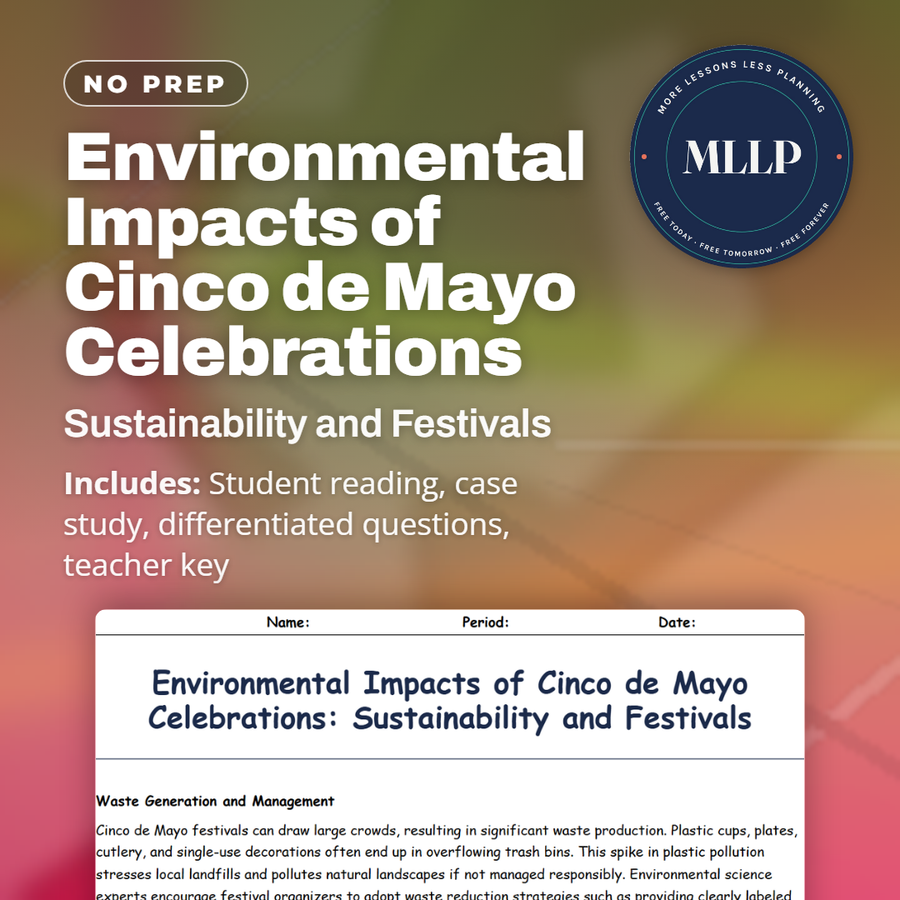
Environmental Impacts of Cinco de Mayo Celebrations: Sustainability and Festivals
Quality reviewed September 2026
Facts verified September 9, 2026
- Subject
- Science
- Grades
- Grades 9-12
- Length
- 6-page student worksheet
- Time
- About one 50-minute class period
- Great for
- Sub plans and independent work
- Includes
- Reading passage, comprehension questions + full answer key
- Format
- Print-and-go PDF
What students do
- Analyze how single-use plastics and waste streams affect local landfills and ecosystems
- Evaluate energy consumption and transportation's contribution to a festival's carbon footprint
- Examine vendor practices in sourcing ingredients and using biodegradable packaging
- Assess how public policy and community volunteers enable sustainable celebrations
What it covers
- Waste management and circular economy
- Carbon emissions and climate impact
- Sustainable commerce and local sourcing
Start reading this worksheet
Waste Generation and Management
Cinco de Mayo festivals can draw large crowds, resulting in significant waste production. Plastic cups, plates, cutlery, and single-use decorations often end up in overflowing trash bins. This spike in plastic pollution stresses local landfills and pollutes natural landscapes if not managed responsibly. Environmental science experts encourage festival organizers to adopt waste reduction strategies such as providing clearly labeled recycling bins and incentivizing the use of reusable dishware. Single-use plastics remain a prime target for sustainability initiatives. Some communities have successfully implemented bans or fees on plastic bags and foam containers, pushing vendors to switch to biodegradable alternatives. While these measures can lower the environmental footprint, they also require public awareness campaigns to ensure cooperation. Education plays a crucial role in helping attendees understand why sustainable materials matter. Another emerging trend is the collection of food waste for composting. Many Cinco de Mayo dishes involve fresh produce, and leftover scraps can be diverted from landfills to create nutrient-rich soil amendments. Municipal composting programs or partnerships with local farms can turn festival refuse into a resource, completing a cycle of reuse rather than disposal. Such initiatives underscore how celebrating a cultural holiday can also serve as a model for ecological responsibility.
Energy Consumption and Carbon Footprint
Large-scale events require electricity for lighting, sound systems, and cooking equipment. Generators that run on diesel fuel contribute to a carbon footprint, emitting greenhouse gases that affect air quality and climate change. Planners can reduce these emissions by using solar-powered or energy-efficient technologies. Simple adjustments, like scheduling daytime activities to minimize artificial lighting, can also make a difference. Transportation adds another layer to the environmental impact. Attendees often drive personal vehicles, leading to congestion and increased carbon dioxide emissions. Local governments and event organizers can promote public transportation, ridesharing, and even cycling to alleviate traffic and reduce pollution. Some festivals offer shuttle services from central locations, making it more convenient for large groups to travel together. Tracking carbon offsets has become a modern approach for events aiming to be environmentally responsible. By purchasing credits that fund renewable energy or reforestation projects, Cinco de Mayo organizers can balance out the festival’s emissions. Although offsets are a compensatory measure rather than a direct reduction, they raise awareness and prompt conversations about how cultural celebrations can align with sustainability goals.
Sustainable Vendor Practices
Vendors selling food, crafts, and souvenirs play a pivotal role in shaping a festival’s environmental footprint. Locally sourced ingredients and materials reduce transportation costs and support regional farmers and artisans. By featuring local produce, Cinco de Mayo events can highlight freshness while curtailing the carbon emissions tied to shipping goods over long distances. This approach also fosters a sense of community, reinforcing ties between farmers and festival-goers. Packaging stands as another critical issue. Traditional plastic or styrofoam containers contribute to marine debris when not properly disposed of. Eco-conscious vendors opt for compostable or biodegradable packaging made from sugarcane fiber or cornstarch. Although these alternatives can be pricier, they reflect a commitment to safeguarding the environment. Some municipalities even provide incentives or grants to help small businesses adopt greener solutions. In addition, local craftspeople often create artwork or souvenirs from recycled or reclaimed materials, turning waste into unique products. Showcasing these items at Cinco de Mayo festivals encourages attendees to rethink consumption, highlighting that sustainability can spark innovation rather than limit creativity. For environmental science students, these examples illustrate how commerce and conservation can intersect productively.
Like what you read? The full reading, the case study, and every question set are in the free download below, along with the answer key.
Why this matters
A festival can cut its landfill waste by 60 percent without cutting a single tradition. A midwestern city proved it by redesigning its Cinco de Mayo celebration around composting stations, incentives for biodegradable packaging, and a volunteer Green Team helping attendees sort waste, without shrinking the celebration itself.
Subsidies are the detail students usually miss: they made compostable packaging cheap enough for vendors to switch, and attendees said the event felt better, not worse, once they saw the waste handled well. Weighing solar generators against diesel, and local farms against long-distance shipping, students stop treating sustainability and celebration as a trade-off.
From one teacher to another
I use this when teaching systems thinking and environmental responsibility. A case study about a midwestern city redesigning their Cinco de Mayo celebration is concrete: they set up composting stations, incentivized biodegradable packaging, and deployed a "Green Team" to help attendees sort waste. The result was a 60% reduction in landfill trash. Students examine the economics, how subsidies made it cheaper for vendors to switch to compostable materials, and the psychology: people actually felt the event was better, not worse, because they were reducing pollution. They work through real decisions: solar generators versus diesel, shuttle services versus personal vehicles, local farms versus long-distance shipping. By the end, they see that sustainability and celebration aren't in conflict.
What you get
Download
Where should I send the next one?
Everything here is free and it stays that way. Leave your email and I'll send you the new lessons as they go up. You can unsubscribe from any one of them.
Related resources
American History and Cinco de Mayo: Cultural Exchange and Historical Narratives
Cinco de Mayo Biology: The Genetics and Agriculture of Mexican Cuisine
Cinco de Mayo Psychology: Identity, Celebration, and Social Dynamics
Cinco de Mayo and the Battle of Puebla: Turning Points in Mexican History
The Economics of Cinco de Mayo: Celebrations, Commerce, and Cultural Commodification
The Health Science of Cinco de Mayo: Nutrition, Food Safety, and Cultural Dishes
Every lesson on this site is free to download and use. If one of them saved you a prep period, you can chip in a few bucks toward my three kids' daycare fund. That's genuinely where tips go.