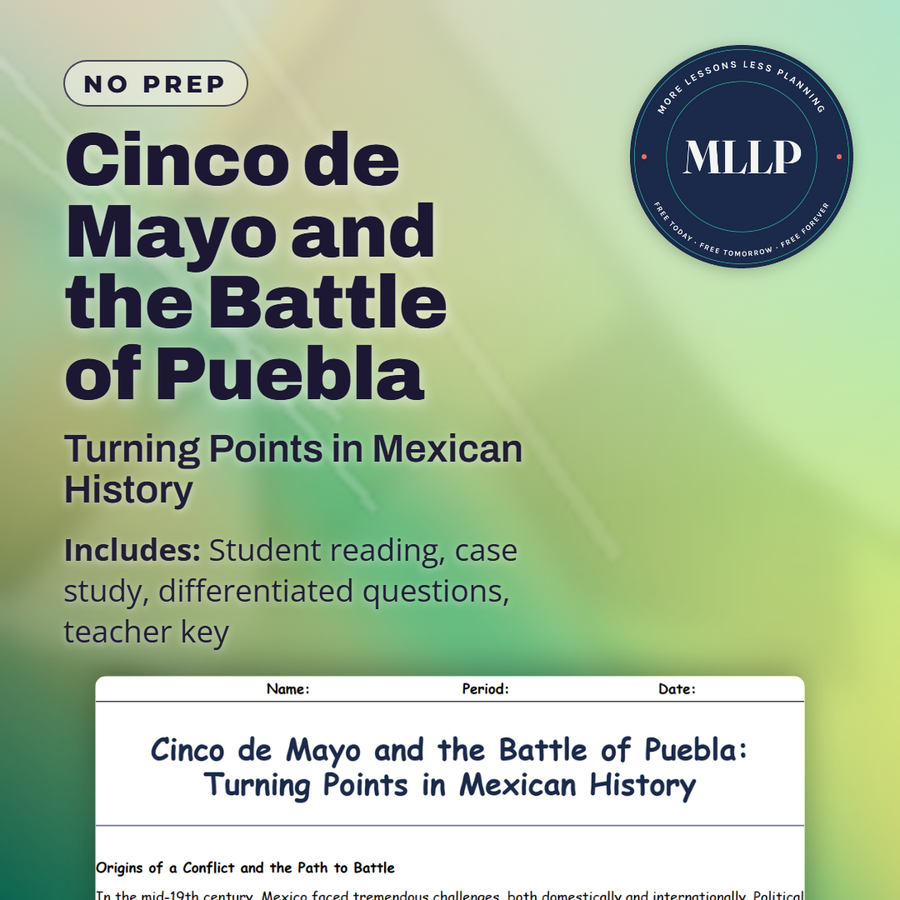
Cinco de Mayo and the Battle of Puebla: Turning Points in Mexican History
Quality reviewed September 2026
Facts verified September 9, 2026
- Subject
- Social Studies
- Grades
- Grades 9-12
- Length
- 9-page student worksheet
- Time
- About one 50-minute class period
- Great for
- Sub plans and independent work
- Includes
- Reading passage, comprehension questions + full answer key
- Format
- Print-and-go PDF
What students do
- Evaluate how morale and strategic positioning led to an underdog military victory
- Analyze the role of key figures like Benito Juárez and General Zaragoza in defending Mexico
- Compare misconceptions about Cinco de Mayo with its actual historical significance
- Examine how a single battle became a symbol of national resilience and collective identity
What it covers
- The Battle of Puebla and Mexican independence
- 19th-century imperialism in the Americas
- Symbolism and memory in historical commemoration
Start reading this worksheet
Origins of a Conflict and the Path to Battle
In the mid-19th century, Mexico faced tremendous challenges, both domestically and internationally. Political struggles and economic instability left the nation vulnerable to foreign intervention. After Mexico suspended foreign debt payments, France, under Emperor Napoleon III, saw an opportunity to expand its influence in the Americas. French forces landed in Veracruz, intending to march inland and eventually establish a regime friendly to European interests. This period became a clash of imperial ambition and national sovereignty, a test of whether a young republic could stand firm against one of the most powerful nations in the world. Around this time, Benito Juárez was serving as Mexico’s president. He was committed to defending his nation’s independence despite internal upheavals and limited resources. The situation worsened when French troops advanced, pressuring the Mexican government to submit. Although the odds seemed bleak—France had an elite military force—the Mexican soldiers relied on the high morale and strategic leadership of General Ignacio Zaragoza. Their mission was to protect their homeland by making a stand in the city of Puebla. Despite being outmatched in weaponry and training, the Mexican army believed that the preservation of national dignity outweighed any numerical disadvantage. The stage was set for a confrontation that would surprise both sides. The unity and resolve of the Mexican defenders showcased a sense of nationalism rarely seen during that tumultuous era. The upcoming events in Puebla would shift the course of history and spark a celebration that endures to this day: Cinco de Mayo.
Significance of the Battle of Puebla
While the battle itself occurred on May 5, 1862, its resonance extended well beyond a single day of fighting. The Battle of Puebla became a potent symbol of Mexican resilience. Facing a formidable European power that many believed unbeatable, Mexico’s outnumbered forces achieved what seemed impossible—a tactical victory that reinvigorated hopes for sovereign self-determination. News of the triumph spread rapidly, elevating Mexico’s reputation on the global stage. Military historians often analyze how morale and strategic positioning contributed to this outcome. Positioned behind fortifications and emboldened by a righteous cause, General Zaragoza’s troops managed to repel repeated French assaults. This moment shattered the myth of European invincibility in the Americas. Although France would eventually regroup and occupy Mexico City in the short term, the victory at Puebla became a defining moment of resistance. It boosted public confidence and showed that unity could overcome adversity, influencing broader discussions about independence and identity throughout Latin America. Even beyond immediate military implications, the Battle of Puebla paved the way for a sense of pride and cultural rebirth within Mexico. Every May 5 thereafter became an opportunity to remember a day when determination and strategy triumphed over might. Schools and public institutions began commemorating the battle with parades, speeches, and reenactments. Over time, the date took on new layers of cultural significance, expanding from a local celebration of a military win into a day that epitomizes the broader struggles of the nation’s past.
Cinco de Mayo’s Transformation into a Cultural Phenomenon
Initially, Cinco de Mayo commemorations were intimate affairs, focusing on the heroic deeds of Zaragoza’s forces. As the Mexican diaspora expanded, particularly into the United States, the holiday underwent a transformation. Mexican communities abroad turned May 5 into a celebration of heritage, blending historical remembrance with contemporary expressions of cultural identity. Parades in cities like Los Angeles, Chicago, and Houston showcased traditional music, dance, and cuisine, serving as a way to maintain a connection to ancestral roots. Over time, Cinco de Mayo evolved beyond a historical tribute. Restaurants and media outlets in the U.S. played a significant role, popularizing the date among broader audiences. Advertisers recognized that themes of celebration, pride, and festivity resonated well with both Mexican Americans and other groups looking for a springtime event to embrace. This expansion often overshadowed the original historical context, but it undeniably brought attention to Mexico’s rich cultural traditions. Meanwhile, some historians worry about misconceptions surrounding Cinco de Mayo. Many people mistakenly believe it marks Mexico’s Independence Day (which actually falls on September 16). Efforts by educators and cultural organizations aim to correct these misunderstandings, emphasizing the holiday’s connection to the Battle of Puebla and the significance of standing up against foreign aggression. In modern classrooms, Cinco de Mayo provides a forum to explore broader questions of cultural exchange and historical remembrance, ensuring that the day maintains a respectful link to its roots.
Like what you read? The full reading, the case study, and every question set are in the free download below, along with the answer key.
Why this matters
Most people call Cinco de Mayo Mexican Independence Day, and that is not what it is. It marks a single 1862 battle, where outnumbered Mexican troops held Puebla against a French army expected to win easily. Word of that victory spread across Latin America within weeks, long before anyone treated the date as a holiday.
Students are usually the ones who notice the gap between one battle and a national symbol, and closing that gap is the lesson here. A soldier's handwritten note passed down through a family, alongside medals and stories from elders, shows how ordinary people keep a moment like Puebla alive, and why commercialization can blur what it meant.
From one teacher to another
This one lands in my history course because students need to see how a real 1862 defeat of French forces matters beyond the textbook. The narrative is tight: outnumbered Mexican troops held Puebla's fortifications, news of the win rippled across Latin America, and decades later it became something bigger than the battle itself. A case study about students curating artifacts, finding a soldier's handwritten note, collecting family medals, listening to elders, drives home how ordinary people become the keepers of history. They work through misconceptions head-on and trace how commercialization sometimes clouds the original meaning. It's a story of determination over odds.
What you get
Download
Where should I send the next one?
Everything here is free and it stays that way. Leave your email and I'll send you the new lessons as they go up. You can unsubscribe from any one of them.
Related resources
American History and Cinco de Mayo: Cultural Exchange and Historical Narratives
Cinco de Mayo Biology: The Genetics and Agriculture of Mexican Cuisine
Cinco de Mayo Psychology: Identity, Celebration, and Social Dynamics
Environmental Impacts of Cinco de Mayo Celebrations: Sustainability and Festivals
The Economics of Cinco de Mayo: Celebrations, Commerce, and Cultural Commodification
The Health Science of Cinco de Mayo: Nutrition, Food Safety, and Cultural Dishes
Every lesson on this site is free to download and use. If one of them saved you a prep period, you can chip in a few bucks toward my three kids' daycare fund. That's genuinely where tips go.