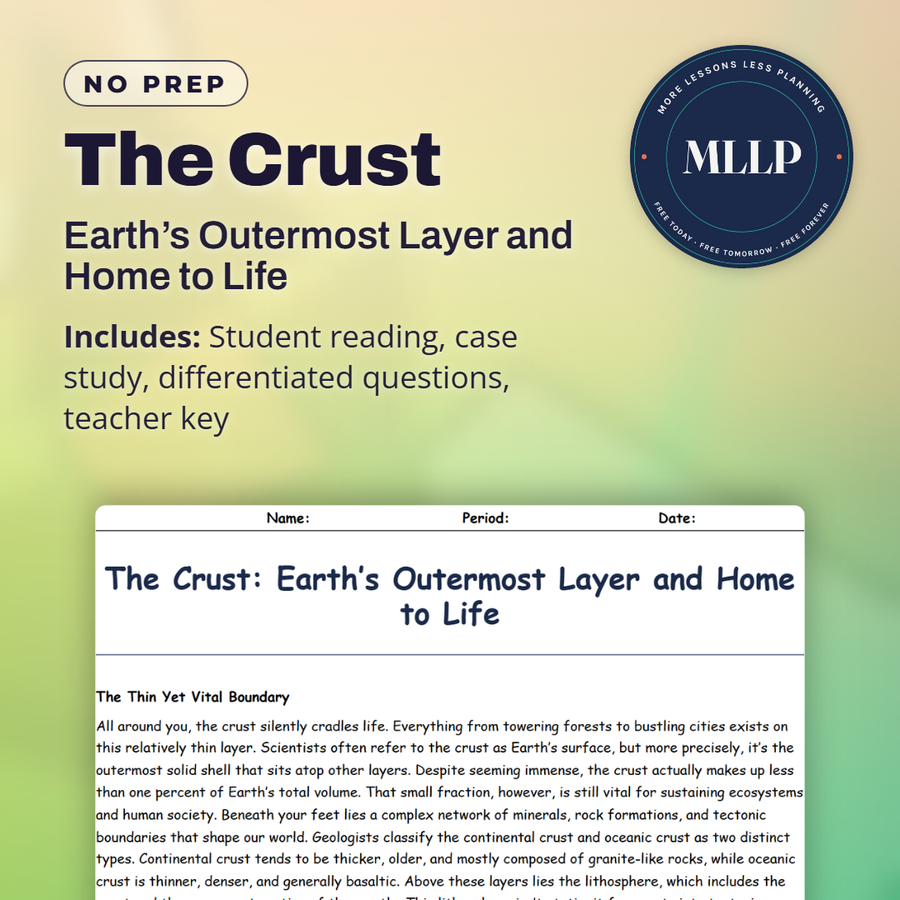
The Crust: Earth’s Outermost Layer and Home to Life
Quality reviewed September 2026
Facts verified September 14, 2026
- Subject
- Social Studies
- Grades
- Grades 9-12
- Length
- 7-page student worksheet
- Time
- About one 50-minute class period
- Great for
- Sub plans and independent work
- Includes
- Reading passage, comprehension questions + full answer key
- Format
- Print-and-go PDF
What students do
- Match terms like granite, basalt, and magma to their correct definitions
- Fill in the blank sentences on the crust, the lithosphere, and the collision that formed the Himalayas
- Answer multiple choice questions on the difference between continental and oceanic crust, what the lithosphere includes, and what causes earthquakes along fault lines
- Write short answers on how the crust interacts with the atmosphere and hydrosphere, why continental versus oceanic crust matters, and how human activity modifies the crust
What it covers
- Continental crust versus oceanic crust, including thickness, density, and rock type, plus how the lithosphere includes the crust and upper mantle
- How tectonic plate movement builds mountains like the Himalayas and triggers earthquakes and volcanic eruptions
- A case study on terrace farming and earthquake risk on an ancient crustal plateau, plus a reference table comparing continental and oceanic crust
Start reading this worksheet
The Thin Yet Vital Boundary
All around you, the crust silently cradles life. Everything from towering forests to bustling cities exists on this relatively thin layer. Scientists often refer to the crust as Earth’s surface, but more precisely, it’s the outermost solid shell that sits atop other layers. Despite seeming immense, the crust actually makes up less than one percent of Earth’s total volume. That small fraction, however, is still vital for sustaining ecosystems and human society. Beneath your feet lies a complex network of minerals, rock formations, and tectonic boundaries that shape our world. Geologists classify the continental crust and oceanic crust as two distinct types. Continental crust tends to be thicker, older, and mostly composed of granite-like rocks, while oceanic crust is thinner, denser, and generally basaltic. Above these layers lies the lithosphere, which includes the crust and the uppermost portion of the mantle. This lithosphere isn’t static; it fragments into tectonic plates that move across the planet at about the speed your fingernails grow. These plates can collide, pull apart, or slide against each other, causing volcanic eruptions, earthquakes, and mountain building. Although most of this action takes place deep underground, the crust’s interactions with the atmosphere and oceans significantly affect life on Earth. The crust’s composition is fascinating. Elementally, it is rich in oxygen, silicon, aluminum, and iron, though exact proportions vary by location. In places like the Andes in South America, tectonic activity has brought precious metals such as copper, silver, and gold to the surface, influencing local cultures for centuries. Across the globe, crustal makeup determines soil fertility, availability of groundwater, and even the natural hazards a region might face. The soils we farm, the mountains we climb, and the canyons we explore can all trace their origins to geological processes involving the crust. Humans have adapted to these crustal variations in remarkable ways. Societies in rugged terrains learned to terrace hillsides for agriculture, while populations living near volcanoes discovered mineral-rich soils beneficial for crop production. In coastal areas, people harness fisheries supported by nutrient flows from eroded crustal sediments. Our reliance on this thin outer shell extends to everything from construction materials to precious gems, underscoring how profoundly the crust shapes civilizations.
Shaping Earth’s Landforms and Hazards
When tectonic plates move, they shape entire continents. Earthquakes occur when stress along faults builds up to a breaking point, releasing energy that can crack and shift sections of the crust. These events are powerful reminders that our planet is dynamic, not static. Mountain ranges like the Himalayas formed when the Indian Plate collided with the Eurasian Plate, forcing the crust to buckle upward. In contrast, volcanic eruptions happen when magma from below the crust rises to the surface, creating new rock and sometimes entire islands, as seen in the Pacific Ring of Fire. Understanding how the crust behaves is crucial for predicting geologic hazards. Advancements in seismic monitoring help scientists gauge when tensions might be reaching critical levels along fault lines. This information aids urban planners and governments, guiding decisions about building codes, evacuation routes, and disaster readiness. In the face of earthquakes and volcanic activity, a community’s resilience often depends on how well it has studied and prepared for these crustal movements. Humans also modify Earth’s crust in various ways, intentionally or otherwise. Mining operations remove minerals from deep deposits, while large-scale constructions like dams and tunnels can alter local geology. Over time, these interventions can lead to erosion or changes in drainage patterns. Balancing the benefits of resource extraction with potential environmental costs remains a global challenge. The crust, though solid, is not indestructible; it demands respect and careful stewardship.
Like what you read? The full reading, the case study, and every question set are in the free download below, along with the answer key.
Why this matters
Two tectonic plates collided and pushed rock high enough to become the Himalayas. This reading uses that fact to make the difference between continental and oceanic crust concrete, comparing the two by thickness, density, and rock type, from granite to basalt.
The case study on terrace farming and earthquake risk is where I linger, because it puts people on top of the geology instead of leaving it underground. Students start to see the crust as something that shapes decisions, where to farm, where a fault line makes a spot too risky to build on, not just a layer to label.
From one teacher to another
This reading covers more ground than a typical crust lesson, tying together plate tectonics, soil formation, and even climate effects from volcanic carbon release. I like that the continental versus oceanic crust comparison gets reinforced in both the reference table and the case study, so students see it applied instead of just memorized. It sets up well for a unit on plate tectonics or Earth's layers.
What you get
Download
Where should I send the next one?
Everything here is free and it stays that way. Leave your email and I'll send you the new lessons as they go up. You can unsubscribe from any one of them.
Related resources
Biomes & Ecosystems: Life Across Earth’s Habitats
Climate vs. Weather: Understanding the Difference
Convergent Boundaries: Where Plates Collide
Deserts: Survival in the Harshest Climates
Divergent Boundaries: Where Plates Pull Apart
Earth’s Layers: From Crust to Core
Every lesson on this site is free to download and use. If one of them saved you a prep period, you can chip in a few bucks toward my three kids' daycare fund. That's genuinely where tips go.