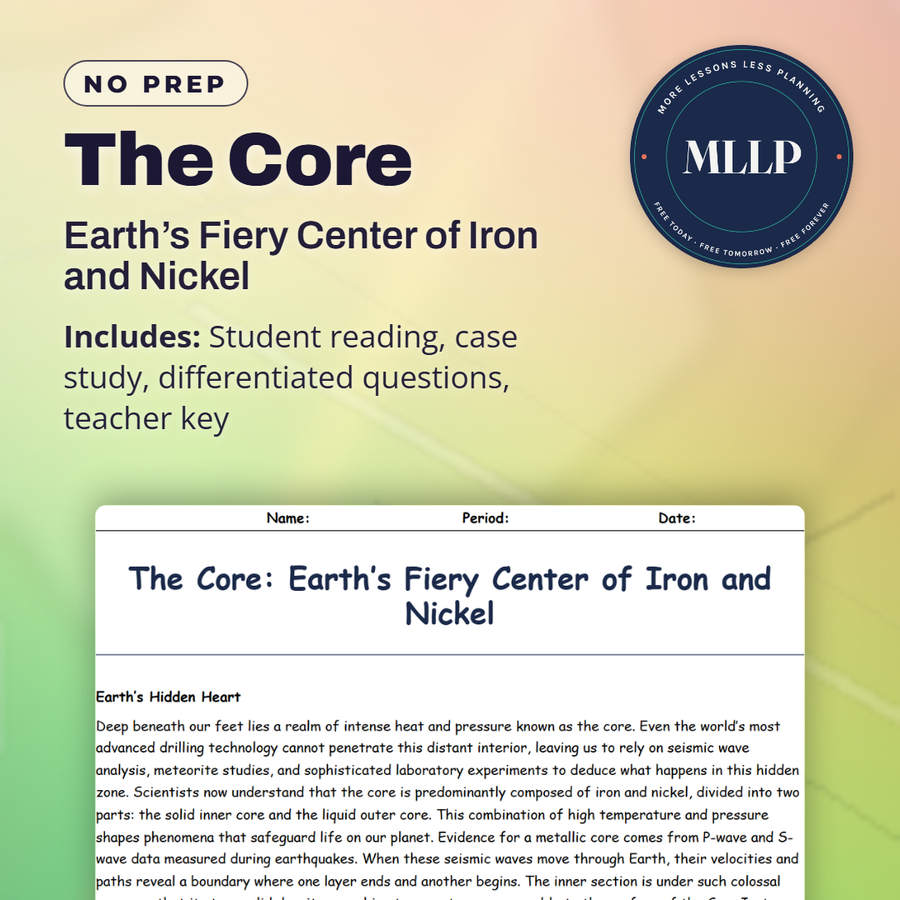
The Core: Earth’s Fiery Center of Iron and Nickel
Quality reviewed September 2026
Facts verified September 14, 2026
- Subject
- Social Studies
- Grades
- Grades 9-12
- Length
- 8-page student worksheet
- Time
- About one 50-minute class period
- Great for
- Sub plans and independent work
- Includes
- Reading passage, comprehension questions + full answer key
- Format
- Print-and-go PDF
What students do
- Match terms like inner core, outer core, and pole reversals to their correct definitions
- Fill in the blank sentences on the outer core, magnetic currents, and why the inner core stays solid
- Answer multiple choice questions on why the inner core stays solid, what generates Earth's magnetic field, and what magnetic reversals show
- Write short answers on why the inner core cannot melt despite extreme heat, how scientists find evidence of past magnetic reversals, and what could happen if the magnetic field weakened
What it covers
- The solid inner core and liquid outer core, both made of iron and nickel, and how their movement generates Earth's magnetic field through the geodynamo
- How the magnetic field protects Earth by forming the magnetosphere and producing auroras, and how magnetic reversals show up in ocean rock evidence
- A case study on shifting magnetic poles affecting polar flight navigation, plus a reference table comparing the inner and outer core
Start reading this worksheet
Earth’s Hidden Heart
Deep beneath our feet lies a realm of intense heat and pressure known as the core. Even the world’s most advanced drilling technology cannot penetrate this distant interior, leaving us to rely on seismic wave analysis, meteorite studies, and sophisticated laboratory experiments to deduce what happens in this hidden zone. Scientists now understand that the core is predominantly composed of iron and nickel, divided into two parts: the solid inner core and the liquid outer core. This combination of high temperature and pressure shapes phenomena that safeguard life on our planet. Evidence for a metallic core comes from P-wave and S-wave data measured during earthquakes. When these seismic waves move through Earth, their velocities and paths reveal a boundary where one layer ends and another begins. The inner section is under such colossal pressure that it stays solid despite scorching temperatures comparable to the surface of the Sun. Just above it, the liquid outer core remains molten, swirling continuously. These swirling currents of molten metal generate Earth’s magnetic field. Understanding the core is far from theoretical. Its magnetic shield deflects harmful solar radiation and stabilizes conditions on our planet. With advanced satellites and measurements from polar regions, scientists observe subtle shifts in magnetic poles and field intensity. Researchers continue to explore how small changes in the outer core might explain fluctuations in the field. If Earth’s magnetic field were to weaken dramatically, we could experience disruptions in navigation, satellite communication, and possibly greater exposure to solar particles.
Solid Inner Core vs. Liquid Outer Core
Scientists define the inner core as a solid sphere composed mainly of iron alloyed with small amounts of nickel and lighter elements. It sits at Earth’s center, enduring pressures measured in millions of atmospheres. Even though temperatures there may exceed 5,000°C, the pressure keeps the core’s metal in a rigid state. This zone is also continually growing. As Earth cools slowly, iron crystallizes at the boundary between the inner and outer cores, making the inner core expand by about a millimeter each year. In contrast, the outer core remains liquid. Here, iron and nickel stay molten due to slightly lower pressure, though still under extreme heat. The flowing metal in the outer core is crucial to our planet’s geodynamo—the process generating the magnetic field. The movement of these electrically conductive fluids creates currents, and these currents induce magnetism. In turn, magnetism can influence how the fluid circulates, forming a feedback loop that has persisted for billions of years. This ongoing geodynamo process highlights the remarkable synergy of heat, motion, and electricity inside Earth.
Protective Magnetic Field
The magnetic field extends far beyond the planet’s surface. It envelops Earth in a cloak called the magnetosphere, which shields us from high-energy cosmic rays and solar wind particles. Without it, charged particles could strip away our atmosphere over geologic time, much like what may have happened on Mars. We experience direct evidence of this protective field when we see auroras at high latitudes—spectacular sky displays created by solar particles colliding with atmospheric gases under the guidance of magnetic field lines. By examining magnetic anomalies in oceanic rocks, which hold fossilized directions of past magnetic fields, geophysicists learn that magnetic reversals have occurred multiple times in Earth’s history. During these reversals, the north and south poles swap places, though the process is slow on a human timescale. Tracking current pole migrations is equally important. Modern compasses can drift off by degrees every few years, prompting updates to aeronautical and nautical charts.
Like what you read? The full reading, the case study, and every question set are in the free download below, along with the answer key.
Why this matters
Shifting magnetic poles are a real problem for polar flight navigation, since the pole a plane's compass points to does not sit still. That detail gives Earth's core a present-tense consequence, the hook this reading uses before explaining how the solid inner core and liquid outer core, both iron and nickel, generate that field through the geodynamo.
Why the inner core stays solid despite extreme heat trips up every student, and I let them sit with the contradiction before the reading resolves it. Seeing why heat alone does not melt it is what makes the ocean rock evidence for past magnetic reversals read as proof of the same mechanism.
From one teacher to another
This one takes something students cannot see or touch, the core, and grounds it in things they can picture, like compasses drifting off course on polar flights. I like that it explains why the inner core stays solid despite extreme heat, since that is one of the less intuitive ideas in the reading. The magnetic pole case study makes a good bridge into a broader unit on Earth's layers.
What you get
Download
Where should I send the next one?
Everything here is free and it stays that way. Leave your email and I'll send you the new lessons as they go up. You can unsubscribe from any one of them.
Related resources

Biomes & Ecosystems: Life Across Earth’s Habitats

Climate vs. Weather: Understanding the Difference
Convergent Boundaries: Where Plates Collide

Deserts: Survival in the Harshest Climates

Divergent Boundaries: Where Plates Pull Apart
Earth’s Layers: From Crust to Core
Every lesson on this site is free to download and use. If one of them saved you a prep period, you can chip in a few bucks toward my three kids' daycare fund. That's genuinely where tips go.