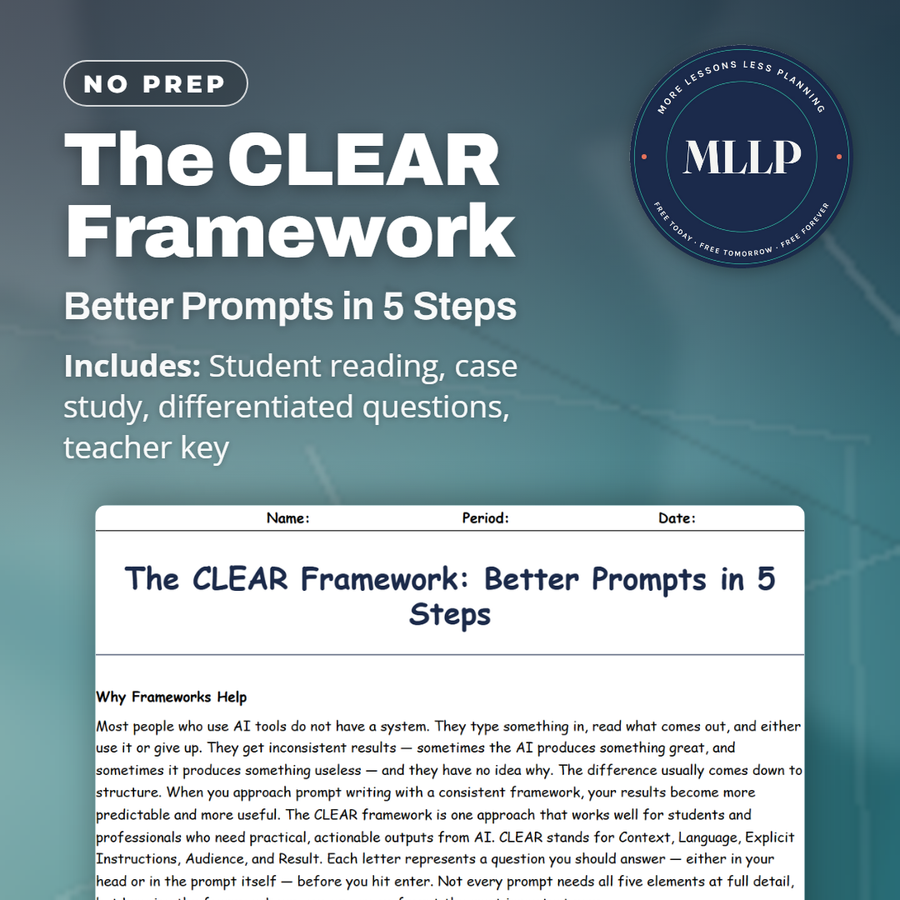
The CLEAR Framework: Better Prompts in 5 Steps
Quality reviewed September 2026
Facts verified September 20, 2026
- Subject
- Career & Life Skills
- Grades
- Grades 9-12
- Length
- 9-page student worksheet
- Time
- About one 50-minute class period
- Great for
- Sub plans and independent work
- Includes
- Reading passage, comprehension questions + full answer key
- Format
- Print-and-go PDF
What students do
- Five terms, from context to calibration, get matched against their definitions
- Three fill-in-the-blank sentences use the reading's own language about explicit instructions and a neutral tone
- Answer three multiple choice questions about language, audience, and the purpose of defining a result
- Write a short answer response identifying which CLEAR elements fixed Priya's first prompt
What it covers
- All seven passages walking through the five CLEAR elements one at a time
- The key info table pairing each CLEAR letter with the question it answers
- Priya's presentation case study and its two model-answer short response questions
Start reading this worksheet
Why Frameworks Help
Most people who use AI tools do not have a system. They type something in, read what comes out, and either use it or give up. They get inconsistent results (sometimes the AI produces something great, and sometimes it produces something useless) and they have no idea why. The difference usually comes down to structure. When you approach prompt writing with a consistent framework, your results become more predictable and more useful. The CLEAR framework is one approach that works well for students and professionals who need practical, actionable outputs from AI. CLEAR stands for Context, Language, Explicit Instructions, Audience, and Result. Each letter represents a question you should answer, either in your head or in the prompt itself, before you hit enter. Not every prompt needs all five elements at full detail, but knowing the framework ensures you never forget the most important ones.
C (Context): Establish the Situation
Context is the background information that frames your request. It answers the question: what is the situation? Without context, the AI has to make assumptions, and its assumptions will usually be wrong for your specific needs. Context can include who you are, what task you are working on, what you have already done, and what constraints exist. For example, if you are writing a research paper, the context might be: "I am a high school student writing a five-paragraph essay on the causes of World War I for a history class. I have already written the introduction and need help with the first body paragraph." Notice that this context tells the AI your level, your task, your format, and exactly where you are in the process. All of that information shapes the kind of help the AI can give you. Without it, you might get a college-level analysis when you needed a simple paragraph.
L (Language): Specify the Tone and Style
Language refers to how the output should sound. Should it be formal or casual? Academic or conversational? Direct or gentle? Does it need to avoid jargon, or is technical language appropriate? The default voice of most AI tools is somewhere between formal and neutral, which is useful for some tasks but wrong for many others. If you are writing an email to a friend about a class project, a formal tone will sound stiff and weird. If you are drafting a message to a college admissions officer, a casual tone could hurt your chances. You need to specify language and tone because the AI cannot infer it correctly from context alone. Try phrases like "use a casual, friendly tone," "write in formal academic English," "keep the language simple enough for a 7th grader," or "match the tone of a professional email without being stiff."
Like what you read? The full reading, the case study, and every question set are in the free download below, along with the answer key.
Why this matters
Students already know that some requests to a teacher, a coach, or a parent land better than others, and the CLEAR framework just gives language to a skill they are half using already. Naming context, language, audience, and a clear result before asking for something is not really about AI at all, it is about getting what you actually need instead of a generic non-answer, whether that request goes to a chatbot or a human being. Priya's twenty-minute outline versus her first four paragraphs of jargon is a small example of a much bigger pattern: specific requests get specific, useful results, and vague requests get vague, forgettable ones.
From one teacher to another
Priya had two days to explain how credit card interest works to her personal finance class, and her first AI prompt produced four paragraphs of jargon she could never say out loud. This reading introduces the CLEAR framework, Context, Language, Explicit Instructions, Audience, and Result, five questions students learn to answer before they send any prompt that actually matters. Each of the five letters gets its own passage, walking through what it means, why AI defaults get it wrong without direction, and a short example showing the difference it makes. A full before-and-after example turns a one-line prompt about a climate change presentation into a prompt with all five CLEAR elements built in, and the reading closes by noting the framework does not need to be applied to every low-stakes prompt.
What you get
Download
Where should I send the next one?
Everything here is free and it stays that way. Leave your email and I'll send you the new lessons as they go up. You can unsubscribe from any one of them.
Related resources
AI Image Generators: Crafting Effective Prompts
AI Translation Tools and When NOT to Trust Them
AI as a Study Partner: Smart Ways to Learn With It
AI for Research: Fact-Checking and Source-Finding
AI in Microsoft Word, Google Docs, and Canva
Free vs. Paid AI: What's Worth It for a Student?
Every lesson on this site is free to download and use. If one of them saved you a prep period, you can chip in a few bucks toward my three kids' daycare fund. That's genuinely where tips go.