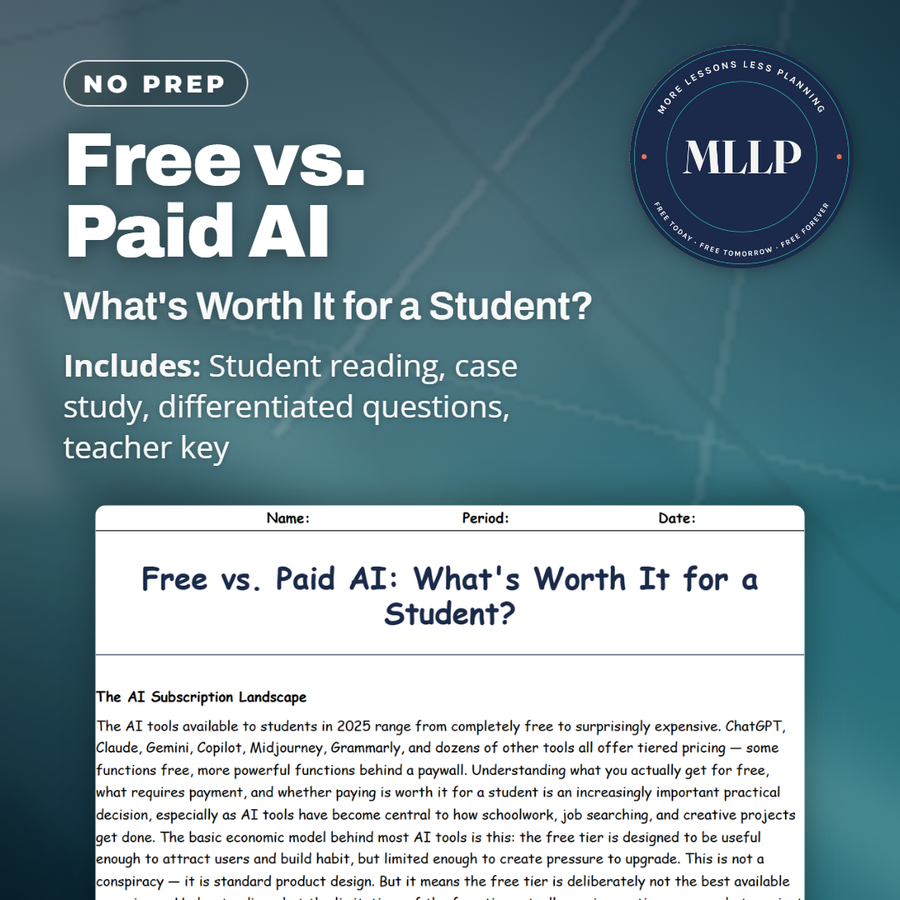
Free vs. Paid AI: What's Worth It for a Student?
Quality reviewed September 2026
Facts verified September 20, 2026
- Subject
- Career & Life Skills
- Grades
- Grades 9-12
- Length
- 9-page student worksheet
- Time
- About one 50-minute class period
- Great for
- Sub plans and independent work
- Includes
- Reading passage, comprehension questions + full answer key
- Format
- Print-and-go PDF
What students do
- Five terms, from free tier to education discount, get matched against their definitions
- Three fill-in-the-blank sentences use the reading's own wording about school access, limitations, and trial periods
- Answer three multiple choice questions about free-tier economics, education discounts, and return on investment
- Write a short answer response walking through Leo's subscription mistake and the five-step decision framework
What it covers
- All six passages on subscription pricing, free tiers, and school-provided access
- The key info table comparing ChatGPT, Claude, Gemini, and Copilot pricing tiers
- Leo's subscription case study and its two model-answer short response questions
Start reading this worksheet
The AI Subscription Landscape
The AI tools available to students in 2025 range from completely free to surprisingly expensive. ChatGPT, Claude, Gemini, Copilot, Midjourney, Grammarly, and dozens of other tools all offer tiered pricing: some functions free, more powerful functions behind a paywall. Understanding what you actually get for free, what requires payment, and whether paying is worth it for a student is an increasingly important practical decision, especially as AI tools have become central to how schoolwork, job searching, and creative projects get done. The basic economic model behind most AI tools is this: the free tier is designed to be useful enough to attract users and build habit, but limited enough to create pressure to upgrade. This is not a conspiracy; it is standard product design. But it means the free tier is deliberately not the best available experience. Understanding what the limitations of the free tier actually are in practice, versus what are just marketing pressure, helps you make smarter decisions about when to pay and when the free version is genuinely adequate.
What You Get for Free: The Major Tools
ChatGPT's free tier (GPT-4o access, as of 2025) is genuinely useful for most student tasks: writing assistance, explaining concepts, brainstorming, and answering questions. The limitations are mainly around usage caps during high-traffic periods, occasional slower response times, and access to specialized features like advanced data analysis, custom GPTs, and the highest-tier models (GPT-4o with extended context). For most everyday studying and writing tasks, the free tier handles them well. Claude's free tier is similarly capable for general student use: strong writing assistance, analysis, and conversation. The paid tier (Claude Pro or Team) adds longer context windows, priority access during peak periods, and access to the most capable models. Google Gemini offers a free tier integrated with Google services, with Gemini Advanced available through a subscription. Microsoft Copilot is available free in many contexts for students through school accounts and the web browser, with more advanced features requiring Microsoft 365 subscriptions.
What Paid Tiers Actually Add
The practical differences between free and paid tiers in AI tools fall into a few categories. First, context window size: paid tiers typically allow you to input significantly longer documents for analysis, summarization, or editing. If you frequently work with long research papers, full books, or lengthy transcripts, the ability to process the entire document at once (rather than in chunks) is genuinely useful. Second, higher model capability: paid tiers usually give you access to more powerful versions of the underlying AI model, which tends to produce better reasoning, fewer errors, and more nuanced outputs on complex tasks. Third, usage limits: free tiers often impose message limits per day or per hour, which can be frustrating when you are in the middle of a long work session. Paid tiers typically remove or significantly raise these limits. Fourth, specialized features. Premium tiers often include tools not available in free versions: advanced image generation, data analysis on uploaded files, web browsing in real time, custom AI personas, or integration with other services. For a student doing occasional work, these specialized features are rarely worth paying for. For a heavy user doing regular research or creative work, they can be genuinely valuable.
Like what you read? The full reading, the case study, and every question set are in the free download below, along with the answer key.
Why this matters
Every student in this reading is going to be pitched a paid AI subscription eventually, whether it is a YouTuber promising a productivity edge or a banner inside the free version they already use. The habit this reading is really teaching is not about ChatGPT or Claude specifically, it is about pausing before a recurring charge and asking what the free version cannot already do. Leo's $165 mistake is an ordinary one, and the same reasoning applies to streaming services, app subscriptions, and every other product built to make a free tier feel like it is missing something. Students who leave high school knowing how to ask that question before they subscribe get to keep more of their own money for the rest of their lives.
From one teacher to another
Leo subscribed to ChatGPT Plus, Claude Pro, and Grammarly Premium in the same month, certain he would use all three constantly. Three months and $165 later, he could not name a single feature the paid tiers gave him that the free versions did not. This reading walks students through what the free and paid tiers of ChatGPT, Claude, Gemini, and Copilot actually offer, what schools already provide at no cost through Google Workspace or Microsoft 365 Education, and a five-step framework for deciding whether a subscription is worth the cost. It closes with the real yearly math: $50 to $80 a month in stacked subscriptions adds up to $600 to $960 a year, a serious number on a high school student's budget.
What you get
Download
Where should I send the next one?
Everything here is free and it stays that way. Leave your email and I'll send you the new lessons as they go up. You can unsubscribe from any one of them.
Related resources
AI Image Generators: Crafting Effective Prompts
AI Translation Tools and When NOT to Trust Them
AI as a Study Partner: Smart Ways to Learn With It
AI for Research: Fact-Checking and Source-Finding
AI in Microsoft Word, Google Docs, and Canva
Prompt Writing 101: How to Talk to AI
Every lesson on this site is free to download and use. If one of them saved you a prep period, you can chip in a few bucks toward my three kids' daycare fund. That's genuinely where tips go.