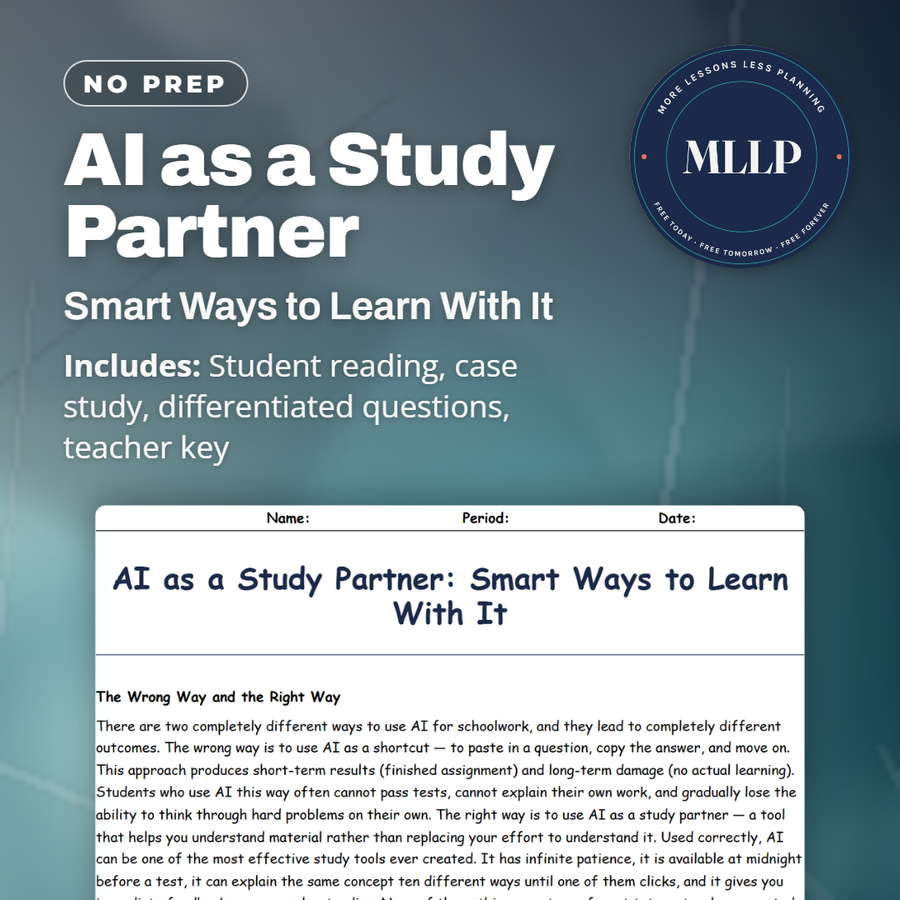
AI as a Study Partner: Smart Ways to Learn With It
Quality reviewed September 2026
Facts verified September 20, 2026
- Subject
- Career & Life Skills
- Grades
- Grades 9-12
- Length
- 9-page student worksheet
- Time
- About one 50-minute class period
- Great for
- Sub plans and independent work
- Includes
- Reading passage, comprehension questions + full answer key
- Format
- Print-and-go PDF
What students do
- The Feynman Technique and Socratic dialogue headline a five-term matching set on smart study habits
- Jordan's chemistry panic and his 88 on the test anchor two case study questions
- Retrieval, Socratic, and experience complete three blanks pulled from the passage on study habits
- Explain why Jordan's second attempt at the concept revealed gaps his first attempt hid
What it covers
- Six passages on using AI as a study partner instead of a shortcut, from Feynman to Socratic dialogue
- A case study on Jordan's chemistry panic and how explaining a concept out loud rebuilt his understanding
- A key info table naming eight AI study techniques, from concept mapping to error analysis
Start reading this worksheet
The Wrong Way and the Right Way
There are two completely different ways to use AI for schoolwork, and they lead to completely different outcomes. The wrong way is to use AI as a shortcut: to paste in a question, copy the answer, and move on. This approach produces short-term results (finished assignment) and long-term damage (no actual learning). Students who use AI this way often cannot pass tests, cannot explain their own work, and gradually lose the ability to think through hard problems on their own. The right way is to use AI as a study partner, a tool that helps you understand material rather than replacing your effort to understand it. Used correctly, AI can be one of the most effective study tools ever created. It has infinite patience, it is available at midnight before a test, it can explain the same concept ten different ways until one of them clicks, and it gives you immediate feedback on your understanding. None of those things are true of most tutors, teachers, or study guides. The question is not whether to use AI for studying; it is whether to use it well.
The Feynman Technique and AI
One of the most effective study strategies ever described is the Feynman Technique, named after physicist Richard Feynman. The method is simple: if you can explain something in plain language to someone with no background in the topic, you actually understand it. If you cannot, you have identified exactly where your understanding breaks down. Most students discover during this process that they understand a lot less than they thought. AI turns this technique into an interactive practice. Instead of just writing an explanation on paper, you can explain a concept to an AI and ask it to tell you where your explanation is incomplete or wrong. Try it: explain how supply and demand affects prices, or how the water cycle works, or what caused World War I, and do it in your own words, without looking anything up. Then ask the AI to critique your explanation: "I just explained supply and demand as [your explanation]. What did I get right, what did I get wrong, and what important idea did I leave out?" The AI's response will tell you exactly what you do not yet understand.
Using AI to Generate Practice Questions
One of the highest-value uses of AI for studying is generating practice questions. Most students study by rereading notes, which is one of the least effective study strategies known to research. Testing yourself on material (called retrieval practice) is far more effective for long-term retention. The problem is that finding or creating good practice questions takes time. AI solves this problem instantly. You can paste in a section of your notes or a chapter summary and ask the AI to generate ten multiple choice questions, five short answer questions, or a mix of both. You can ask for questions at different difficulty levels ("give me three easy questions, three medium questions, and three hard questions") or targeted at specific concepts. You can then answer the questions and ask the AI to check your answers and explain any mistakes. This turns AI into a fully functional quiz generator and tutor, available on demand for any subject.
Like what you read? The full reading, the case study, and every question set are in the free download below, along with the answer key.
Why this matters
Every student in this room already has access to a tool that can quiz them at midnight before a test, explain the same idea ten different ways, and push back with guiding questions instead of easy answers, and most are using it wrong. This worksheet is here because Jordan's story is common: reading an AI's definition feels like learning, but it rarely is, while forcing yourself to explain a concept and getting corrected actually builds the kind of understanding that survives a closed-notes test. Students who walk away from this reading with one new habit, using AI to generate practice questions or to question their own explanations, will study more effectively for the rest of the year.
From one teacher to another
Pasting a question into AI and copying the answer is the wrong way to study, and this worksheet spends six passages explaining the right way instead. Students read about the Feynman Technique, explaining a concept in plain language to an AI and asking it to find the gaps, then move to retrieval practice, where AI generates practice questions instead of students simply rereading notes. A passage on Socratic dialogue shows how prompting AI to ask guiding questions, rather than handing over answers, builds deeper understanding even though it takes more effort. The reading also covers concept mapping and the limits of AI as a study tool, including the reminder to verify anything it tells you. The case study follows Jordan, who could not explain endothermic reactions until he tried explaining them to AI himself and let it flag his gaps.
What you get
Download
Where should I send the next one?
Everything here is free and it stays that way. Leave your email and I'll send you the new lessons as they go up. You can unsubscribe from any one of them.
Related resources
AI Image Generators: Crafting Effective Prompts
AI Translation Tools and When NOT to Trust Them
AI for Research: Fact-Checking and Source-Finding
AI in Microsoft Word, Google Docs, and Canva
Free vs. Paid AI: What's Worth It for a Student?
Prompt Writing 101: How to Talk to AI
Every lesson on this site is free to download and use. If one of them saved you a prep period, you can chip in a few bucks toward my three kids' daycare fund. That's genuinely where tips go.