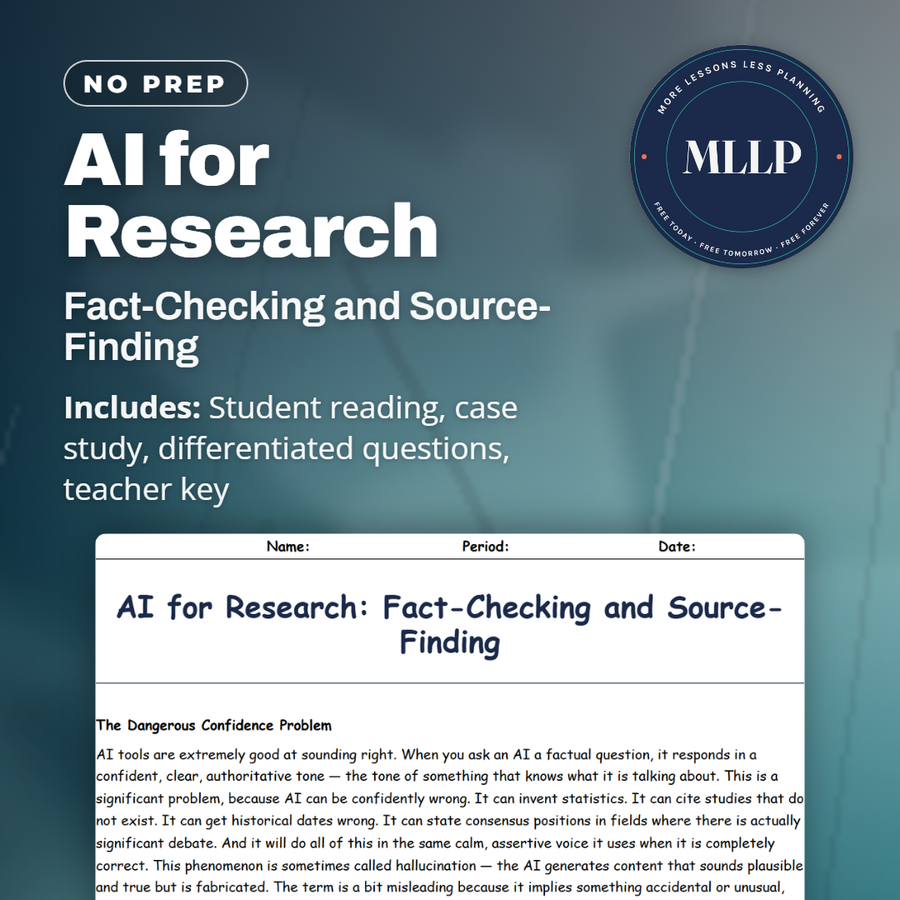
AI for Research: Fact-Checking and Source-Finding
Quality reviewed September 2026
Facts verified September 20, 2026
- Subject
- Career & Life Skills
- Grades
- Grades 9-12
- Length
- 9-page student worksheet
- Time
- About one 50-minute class period
- Great for
- Sub plans and independent work
- Includes
- Reading passage, comprehension questions + full answer key
- Format
- Print-and-go PDF
What students do
- Lateral reading and fabricated citation headline a five-term matching set on verifying AI research
- Tomás's invented journal citation anchors two case study questions on verifying AI research
- Hallucination, claim, and terminology complete three blanks pulled from the passage on AI research
- Answer three multiple choice questions on lateral reading and safe source-finding
What it covers
- Six passages on using AI for early research while verifying every fact through lateral reading
- A case study on Tomás and a fabricated Journal of Adolescent Psychology citation
- A key info table naming a seven-step research workflow and why AI cannot be cited directly
Start reading this worksheet
The Dangerous Confidence Problem
AI tools are extremely good at sounding right. When you ask an AI a factual question, it responds in a confident, clear, authoritative tone (the tone of something that knows what it is talking about). This is a significant problem, because AI can be confidently wrong. It can invent statistics. It can cite studies that do not exist. It can get historical dates wrong. It can state consensus positions in fields where there is actually significant debate. And it will do all of this in the same calm, assertive voice it uses when it is completely correct. This phenomenon is sometimes called hallucination: the AI generates content that sounds plausible and true but is fabricated. The term is a bit misleading because it implies something accidental or unusual, when in reality it is a structural feature of how large language models work. They predict what words should come next based on patterns in training data. Sometimes those patterns produce accurate facts. Sometimes they produce plausible-sounding falsehoods. The model cannot distinguish between the two because it has no ground truth to check itself against.
What AI Research Is Actually Good For
Despite the hallucination problem, AI is genuinely useful in the early stages of research. What it does well is provide a broad orientation to a topic, helping you understand the landscape of a subject before you dig into primary sources. If you are starting a research paper on criminal justice reform and have no idea where to begin, asking AI to outline the five or six major areas of debate is a legitimate and useful starting point. You will get a sense of the terrain: mandatory minimums, recidivism, prison conditions, police reform, bail reform, disproportionate sentencing. You can then go research each of those areas properly using verifiable sources. AI is also useful for explaining concepts and terminology that appear in your research. If you are reading a scholarly article and encounter a term you do not understand, asking AI to explain it in plain language is faster and often more effective than searching a dictionary. If you are confused about how a specific policy works, AI can give you an accessible explanation. These uses are low-stakes; you are using AI to understand the language of your sources, not to generate the substance of your argument.
Why You Should Never Cite AI Directly
There are several reasons why citing AI as a source in academic or professional work is problematic. First, AI outputs are not verifiable: there is no URL you can check, no page number, no publication record. Second, the same question asked to the same AI on different days may produce different answers, which means the source is not stable or consistent. Third, AI can be wrong in ways that are not obvious to a reader, and citing it as a source implies a level of reliability it cannot provide. Most educational institutions have policies against citing AI directly, and for good reason. The purpose of a citation is to let your reader check your source, evaluate its credibility, and see whether it says what you claim it says. AI cannot support any of those functions. If AI tells you a fact, that fact needs to be verified through a citable source before you can use it. Think of AI as a tipster who gives you leads. A good journalist does not print a story based on a tipster's claim alone, they verify it independently before publishing.
Like what you read? The full reading, the case study, and every question set are in the free download below, along with the answer key.
Why this matters
Tomás's mistake is the one every student researcher is one AI query away from making: a specific year, journal name, and statistic feel real, so it is tempting to trust them without checking. This worksheet teaches lateral reading as a sixty-second habit, not a research overhaul, because the fix is fast once a student knows to do it. Students who leave this reading treating AI as a tipster whose leads still need verifying, rather than as a source they can quote directly, will write stronger papers and avoid the kind of citation error that can sink a grade or a professional reputation.
From one teacher to another
Sounding right and being right are not the same thing, and that gap is the whole subject of this worksheet. Students read that AI is genuinely useful for orienting to a new topic and explaining unfamiliar terms, but that its outputs cannot be cited directly because they are not verifiable, stable, or checkable the way a real source is. A passage introduces lateral reading, the professional fact-checker's habit of leaving a source immediately to see what independent sources say about a claim, and walks through a seven-step research workflow that keeps AI in an orientation role while humans handle verification. The case study follows Tomás, who included a specific but entirely invented statistic and journal citation in a paper on social media and teen anxiety, then used lateral reading to find real studies instead.
What you get
Download
Where should I send the next one?
Everything here is free and it stays that way. Leave your email and I'll send you the new lessons as they go up. You can unsubscribe from any one of them.
Related resources
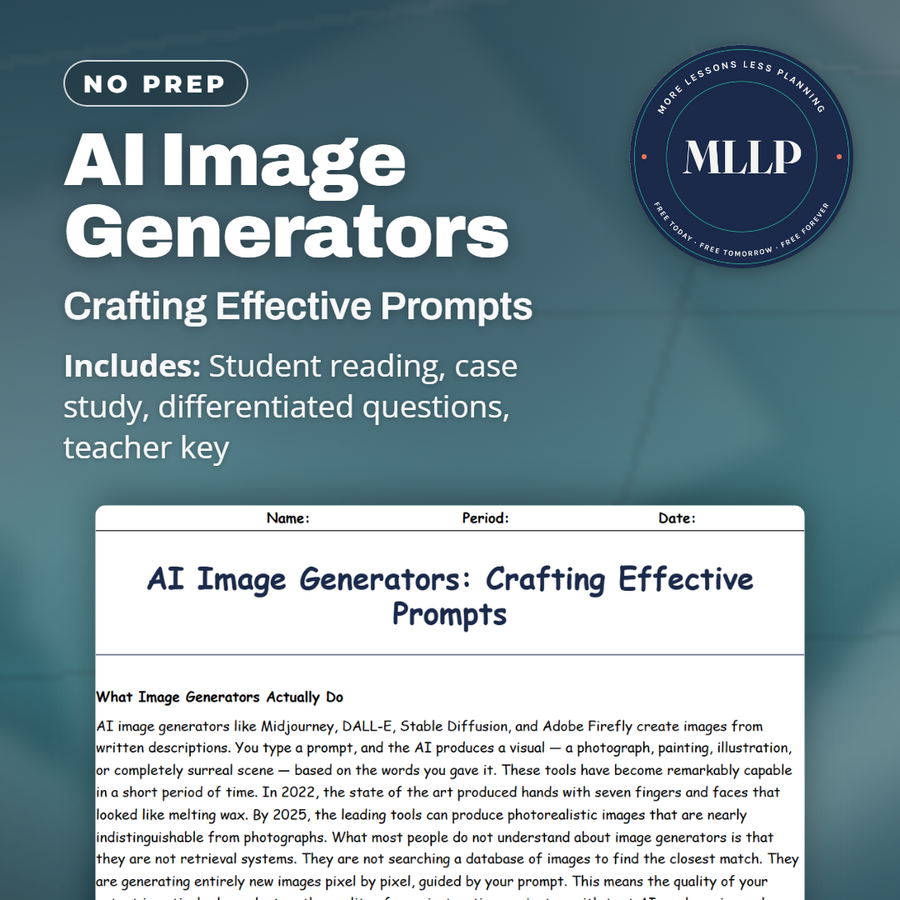
AI Image Generators: Crafting Effective Prompts
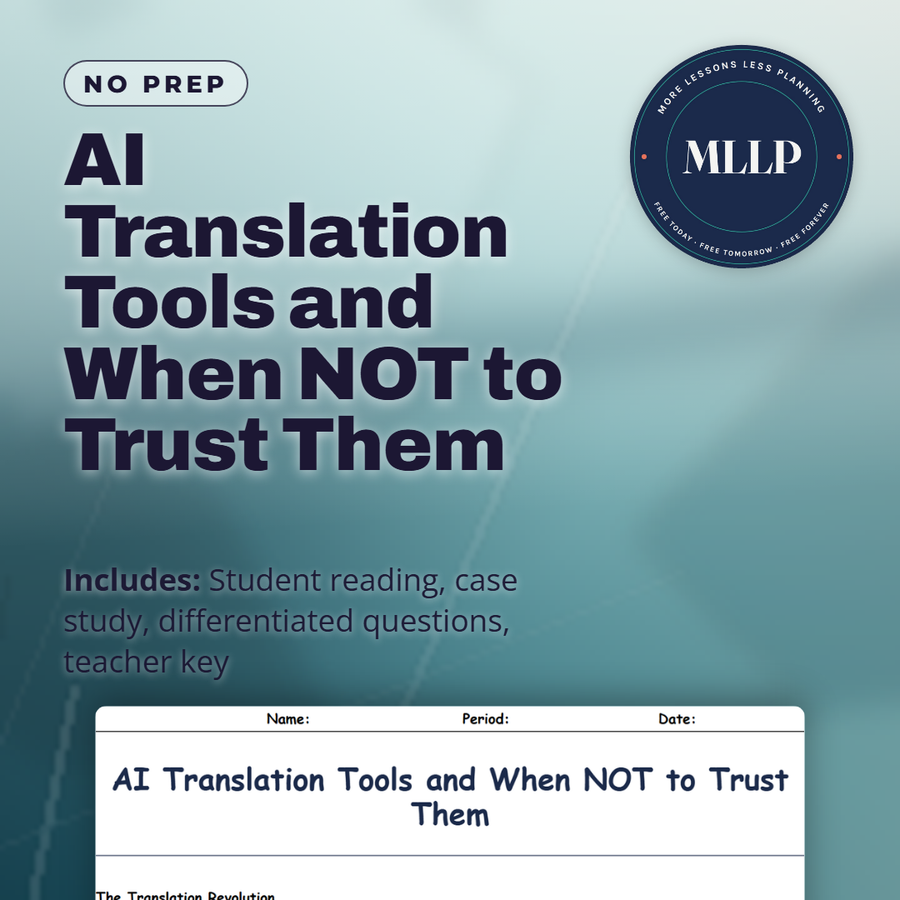
AI Translation Tools and When NOT to Trust Them
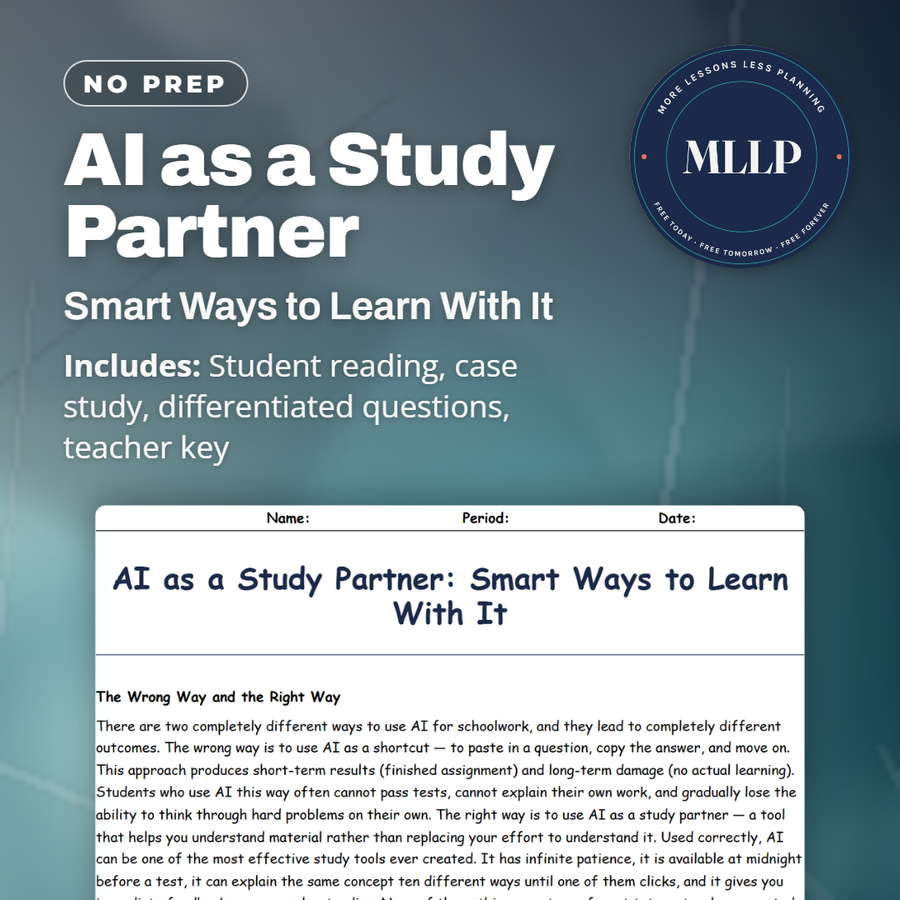
AI as a Study Partner: Smart Ways to Learn With It
AI in Microsoft Word, Google Docs, and Canva
Free vs. Paid AI: What's Worth It for a Student?
Prompt Writing 101: How to Talk to AI
Every lesson on this site is free to download and use. If one of them saved you a prep period, you can chip in a few bucks toward my three kids' daycare fund. That's genuinely where tips go.