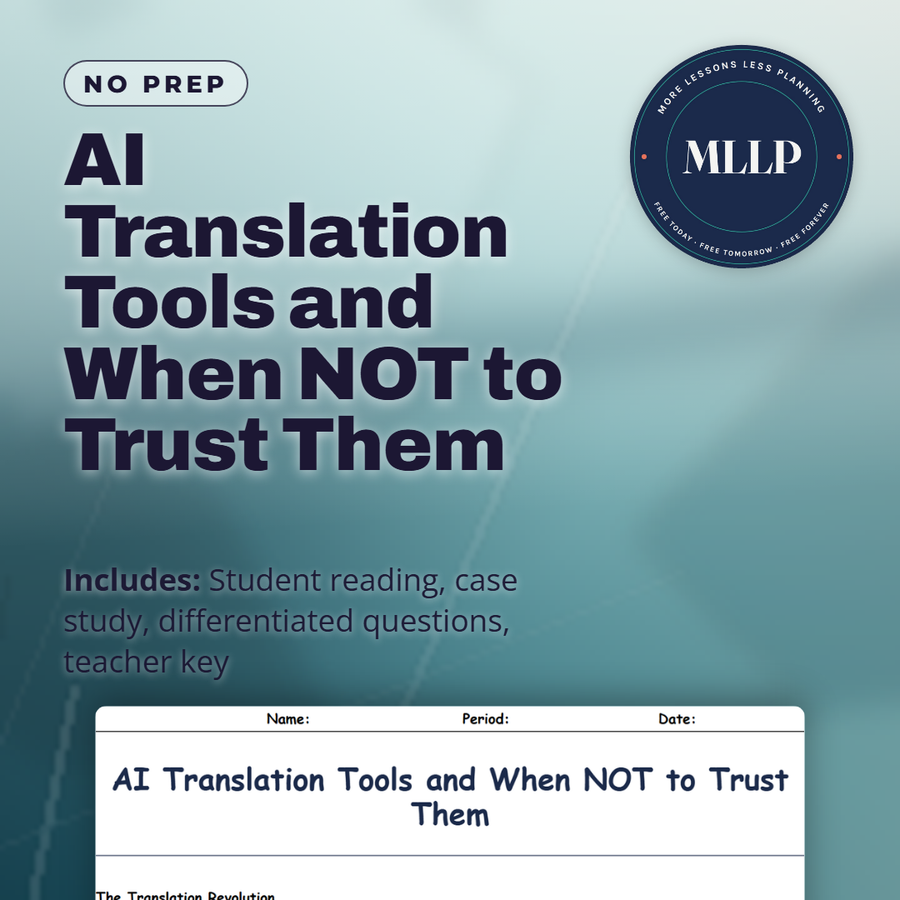
AI Translation Tools and When NOT to Trust Them
Quality reviewed September 2026
Facts verified September 20, 2026
- Subject
- Career & Life Skills
- Grades
- Grades 9-12
- Length
- 9-page student worksheet
- Time
- About one 50-minute class period
- Great for
- Sub plans and independent work
- Includes
- Reading passage, comprehension questions + full answer key
- Format
- Print-and-go PDF
What students do
- Five terms, from neural machine translation to high-stakes translation, get matched against their definitions
- Three fill-in-the-blank sentences use the reading's own language about factual content, fluency, and first drafts
- Answer three multiple choice questions about training data, figurative language, and the critical literacy skill
- Trace why a fluent-sounding translation error is more dangerous than an obvious one, in short answer form
What it covers
- All six passages on how AI translation works, where it excels, and where it fails
- The key info table ranking reliability across eight different translation contexts
- The medical appointment case study and its two model-answer short response questions
Start reading this worksheet
The Translation Revolution
AI translation has improved so dramatically in the past decade that it is difficult to overstate the change. In 2010, Google Translate was famously bad: it produced literal word-for-word translations that missed idioms, inverted grammar, and produced sentences that were comprehensible but often stilted or wrong in subtle ways. By 2025, the leading AI translation tools can produce fluent, natural-sounding translations of most major languages that a native speaker would recognize as high quality. DeepL, Google Translate with neural machine translation, and AI chatbots with multilingual capabilities have transformed how people communicate across language barriers. This matters enormously for everyday life. It means a first-generation immigrant family can help their child with homework in English even if they do not speak it. It means a student can read a source document in Spanish or French for a research paper. It means a small business can communicate with international customers without hiring a professional interpreter for every interaction. The practical democratization of language access is real and significant, and it happened primarily because of AI.
How AI Translation Works
Modern AI translation is powered by neural machine translation (NMT), which works fundamentally differently from older rule-based approaches. Rather than applying grammatical rules and dictionary lookups, neural translation systems learn patterns from enormous amounts of bilingual text: documents, websites, books, and other materials that exist in multiple languages. The model learns not just word-for-word equivalents but how phrases, sentences, and entire paragraphs tend to map from one language to another. This approach has a critical implication: AI translation systems are only as good as the bilingual data they were trained on. Languages with large amounts of available bilingual training data (Spanish, French, German, Chinese, Japanese, Arabic) perform much better than languages with limited digital text (endangered languages, regional dialects, and less-documented languages). A translation of an English document into Spanish is likely to be excellent. A translation into Wolof, Quechua, or a minority regional dialect may be significantly less reliable.
Where AI Translation Excels
AI translation is most reliable for straightforward, factual content in major world languages. News articles. Legal boilerplate. Technical documentation. Medical information with standardized terminology. Social media posts. Business correspondence. In these contexts, the language is relatively formal, the meaning is relatively literal, and the bilingual training data is relatively abundant. The outputs in these contexts are often good enough to use directly with minimal or no human editing. AI translation is also surprisingly strong at informal conversational language (text messages, chat, casual speech) in well-resourced languages. If you are trying to understand a text message in Portuguese or a casual social media post in Korean, AI translation will give you a solid understanding of what is being said even if it does not perfectly capture every nuance of tone. For comprehension purposes (understanding what someone is saying), AI translation tools are excellent across a wide range of everyday situations.
Like what you read? The full reading, the case study, and every question set are in the free download below, along with the answer key.
Why this matters
Most students have never thought about why an AI translator sounds so much better in Spanish than in a language like Tagalog or Wolof, or why a fluent translation can still be a wrong one. That gap matters most for the people who cannot check it themselves: a grandmother handing over a medical form, a family reading a lease, a student trusting a translated source for a research paper. Knowing when the stakes are high enough to ask for a human translator, and when a quick AI translation is genuinely fine, is a decision teenagers will keep making long after this worksheet, in a world where fewer and fewer everyday interactions happen in just one language.
From one teacher to another
Rosa's grandmother went in for a routine appointment and got handed a Spanish translation of her medical history form that quietly turned "unusual bleeding" into "strange accidents." That mistake sits at the center of this reading, which walks through how neural machine translation actually works, why it handles Spanish or Mandarin far better than Wolof or Haitian Creole, and where a fluent-sounding translation can still be dangerously wrong. Students read six passages covering everyday wins for AI translation, the training-data gap behind low-resource languages, and the specific contexts, medical, legal, safety, where a human translator is still worth the cost. The case study anchors the abstract idea in a concrete near-miss, and the questions push students to explain why a fluent error is more dangerous than an obvious one.
What you get
Download
Where should I send the next one?
Everything here is free and it stays that way. Leave your email and I'll send you the new lessons as they go up. You can unsubscribe from any one of them.
Related resources
AI Image Generators: Crafting Effective Prompts
AI as a Study Partner: Smart Ways to Learn With It
AI for Research: Fact-Checking and Source-Finding
AI in Microsoft Word, Google Docs, and Canva
Free vs. Paid AI: What's Worth It for a Student?
Prompt Writing 101: How to Talk to AI
Every lesson on this site is free to download and use. If one of them saved you a prep period, you can chip in a few bucks toward my three kids' daycare fund. That's genuinely where tips go.